Fall 2020
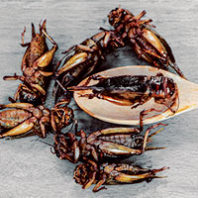
In a crunch for lunch?
Not only are insects packed with protein, vitamins, minerals, omega-3 fatty acids, and flavor, they offer a sustainable way to eat. » More ...

Remember when picking a potato was easy? You had your choice: bake or boil?
Today there are dozens of decisions. Waxy? dry? fingerling? yellow? red? blue? banana?
That world of choice started the early 1980s, when the Yukon Gold emerged from a breeding program in Canada. The yellow potato’s creamy texture and buttery taste made it an instant hit. Chefs roasted it with garlic, mashed it with Gorgonzola, and paired it with the likes of duck and filet mignon.
But while our potato palate was expanding in one direction, it was narrowing in another. Shortly after Yukon Gold’s debut, the Russet Norkotah sprouted on the … » More …
In a wooded spot a half-mile from Washington State University’s Pullman campus, an older woman with long braids and an apron emblazoned with the words “got buns?” tended an alderwood fire. Geraldine Jim, a salmon expert from the Warm Springs Reservation in Oregon, used the back of a pickup truck as her staging area. She threaded the salmon halves lengthwise onto long, stripped sticks of dogwood and ironwood. While the fish roasted, she circled the fire, running her hand up the skin side to feel for doneness. She pointed out how a half-section of the fish is threaded down the stick, the thin tail end … » More …
Barry Swanson, professor of food science, and I see eye to eye on at least one significant issue. We like our rhubarb pie to be made exclusively with rhubarb. NOT strawberries. Just rhubarb.
However, Swanson actually prefers his rhubarb as sauce, over ice cream. Although Swanson does no research on the tart vegetable, he is an avid enthusiast and considers it an acidic parallel to his work with cranberries. And obviously, given his rhubarb enthusiasm, Swanson is from the Midwest, where every old farmstead has a rhubarb patch. “Mom always made rhubarb pie in the spring,” he says.
Rhubarb is also known by Midwesterners as … » More …
Blackberry is a flavor of fall in the Pacific Northwest. Whether you sample blackberries straight from the bush, still warm from the sun, or bake it into a pie and top it with a cool scoop of ice cream, it’s a deep, sweet taste that conjures up those last days of sunshine.
Blackberries live in the rose family and are close relatives of red raspberries. Their commonly cultivated versions include the black and shiny marionberry and red-black hybrid Boysenberry. Both varieties are available mid-July through early August here in Washington. They are grown mostly on farms in the Puyallup and Mt. Vernon areas and sold … » More …
If sublimity is a perfectly ripe watermelon, then where do 101 varieties take you?
I used to think watermelon was pretty much watermelon. Aside from some variability in ripeness and sweetness, you taste one, you taste them all. I am pleased to report that, as with a select few other things, I was wrong.
Last August [2005] I was fortunate to be in Vancouver on the day that Carol Miles hosted her watermelon tasting. That summer, as well as the previous, Miles had conducted variety trials of small “icebox” watermelons, in order to determine their suitability for organic production by small farmers in western Washington.
… » More …
In March, Don Olmstead Jr. (’70 Hort.) watches over his cherry trees night and day, ready to activate a heating system or switch on the wind machines to protect the tender buds from a killing frost. It’s a task he shares with his son and business partner, Don Olmstead III (’98 Hort.).
In April, the Olmsteads worry about pollination, which only works if pollen is on the blossoms and the weather is right for insect activity. Since most cherries can’t self-pollinate, there must be another variety close by and in bloom. To facilitate cross-pollination, the Olmsteads hire one beehive per acre, inviting a few million … » More …
If there’s just one thing you plant in your garden, make it garlic.
For one thing, it’s extraordinarily easy to grow. Plant it around Columbus Day. Cover it with mulch. Or don’t. Water it now and then when it starts growing again in the spring. And that’s about it.
You can start eating it at any stage, though obviously you don’t want to eat it all up before it develops heads. Thus, you need to plant a lot. You can chop the young shoots and add to a stir-fry. Pull the developing young heads and slice, using it for a mild flavoring. In early summer, … » More …
Entomologist Steve Sheppard has never gotten over his wonder at how people came to raise swarms of stinging insects for the honey they produce.
“To see this guy dumping out thousands of bees to collect honey from their hive. . .” He shakes his head. “It’s amazing that humans ever figured it out to do that.”
But the Washington State University associate professor, who not only keeps bees himself, but unflinchingly opens beehives with his bare hands, understands the passion for honey.
People prize it as a delicacy and demand it as a staple. They cherish some honeys for their color and admire others for … » More …