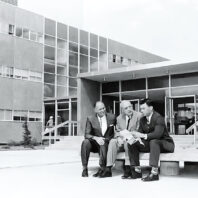
Kruegel and McAllister Halls, with a connecting lounge space (informally called KMac, or K-Mac) were built in 1956 and used initially as residence halls. They were on the south side of the Washington State University Pullman campus, off of Stadium Way.
The buildings were named for Dean Charles E. McAllister (former President of the Board of Regents) and William C. Kruegel (Bursar of the College, instrumental in financing the Pullman Community Building Company, a nonprofit corporation set up to build WSC residence halls). The halls were jointly dedicated with Neill Hall on April 28, 1957.
The dormitories housed 207 students each. Designed by architects … » More …
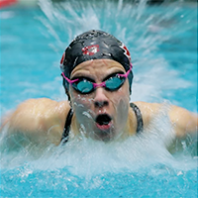
Since the earliest days of the college, when students would jump into Reaney Park pool, to the record-breaking 2024-25 season for the women’s intercollegiate swim team, Cougs of Washington State have been swimming for fun and competition.
Read on for a sampling of some swimming and other water milestones of Washington State. (All photos below courtesy WSU Manuscripts, Archives, and Special Collections)
Swimming for fun in the early days
It took a couple of decades to get a pool on campus at Washington State College, but there was a … » More …
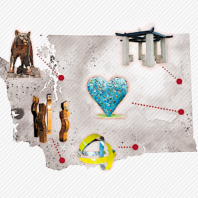
Besides Washington State University’s many permanent collections in its museums, the university also has an extensive collection of outdoor artwork.
On the Pullman campus, pieces range from a life-size bronze book-figure Bookin’ by Terry Allen to Palouse Columns by Robert Maki to The Technicolor Heart, a fourteen-foot painted bronze work by Jim Dine.
A large part of WSU’s public art collection is made possible by the percent-for-art Art in Public Places program of the Washington State Arts Commission.
Take a virtual tour of the outdoor* sculptures and other installations by using this ArcGIS map which shows the locations, … » More …