
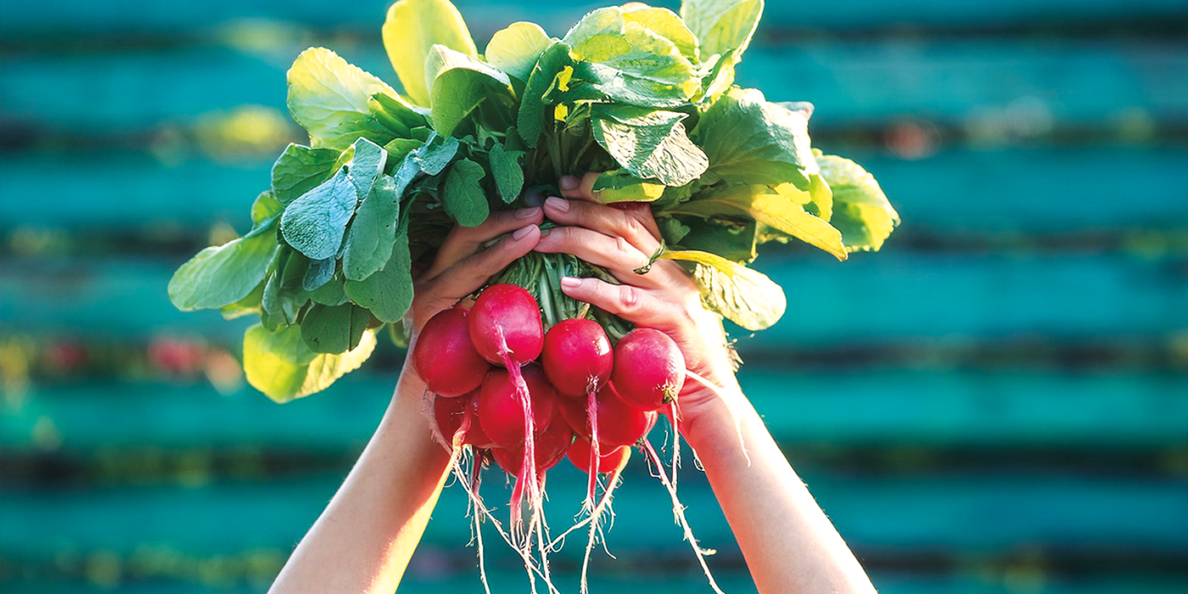
With their bold peppery bite and satisfying crunch, it’s easy to relish radishes.
These often jewel-toned root vegetables pack quite a punch, spicing things up and adding a crisp, snappy texture to tacos, salsas, and salads but—and here’s the great news—almost no calories. A half cup of radish slices has only 9.
What’s more: radishes are easy to grow. And some varieties rank among spring’s earliest crops. Planted early in the season during still-cool temperatures, spring radishes are usually ready for harvest in just three or four weeks.
“The thing I love about them is going to hunt for them, looking between the leaves, and finding their little red shoulders coming out of the ground,” says Pat Munts, a retired longtime small farms and urban agriculture coordinator at Washington State University Extension in Spokane County. She’s been growing radishes (Raphanus sativus) on and off for nearly 50 years in her Spokane-area garden.
“I have a cold garden,” she explains. “Cold air drains off the Palouse and into my garden, which is usually two to three weeks behind the center of the Spokane Valley.”
Lucky for her, spring radishes—“your little round red radishes, your French breakfast radishes, your Easter egg radishes”—like cool weather. Still, she says, “Sometimes planting can be a little dicey because radishes have to go in when the ground can be worked. That means when you take a clump of soil in your hand and squeeze it, it doesn’t remain a clump. It comes apart easily and crumbles.”
In western Washington, soil can be worked as early as mid-March. In eastern Washington, it’s often not until mid-April. “Radishes will germinate within 10 days,” says Munts, a Master Gardener who retired in 2022. “They will grow fast, and stay tender and juicy”—until it gets hot and dry. “Then they start to get woody and really spicy and just not edible.”
Radishes require full sun for at least six hours a day and loose, well-drained soil. Plant seeds a half inch deep in rows or blocks. “You have to thin them out,” Munts says. She recommends spacing seeds “2 or 3 inches apart. If you plant successive batches every five to 10 days through late May, you’ll have a continuous supply of radishes for a couple of months.”
Her tip: use seed tape to help ensure evenly spaced rows. Another tip: make your own.
“It’s really fun and so easy,” Munts says. “You simply take toilet paper and mix up a flour-water paste, then run a strip of paste down the center of the paper, space the seeds along the strip, and let it dry. Then roll it up and take it out to the garden and plant it.” (Unroll it first, of course.)
The flour paste should have the consistency of thin pancake batter—“not too thick and not too thin,” says Munts, co-author of the Northwest Gardener’s Handbook, published in 2014 by Cool Springs Press. She’s also a freelance garden writer for the Spokesman-Review newspaper and runs her own garden coaching business.
One of the fun things about radishes, Munts says, is that they come in a wide variety of colors, shapes, and sizes. They look pretty on a plate, presenting pops of color. “I love the color—the bright red and bright white. That’s appealing to me,” she says, noting she particularly enjoys the Cherry Belle and French breakfast varieties. “I like the crunchy texture, and the snappy spice. When you’re putting together a fresh salad and that spice comes through, it broadens the flavors and makes it more interesting.”
Both radish roots and their quick-cooking leaves are edible. Raw radish leaves are admittedly a bit bitter. Mix them with other leafy greens to add depth and dimension to a salad. Low in calories—greens from a typical bunch have about 50—they also more than meet the daily requirements for vitamin A (280 percent) and vitamin C (173 percent). That’s much more than the root, which provides about 10 percent of the daily required dose of vitamin C.
Radish greens make great puréed soups. Or blend them into pesto with pine nuts, Parmesan cheese, garlic, and olive oil. Sauté them for a side, or mix wilted radish leaves with pasta or eggs.
Radish roots can be pickled, braised, roasted, sautéed, or enjoyed fresh. Add raw radishes to plates of colorful crudités. Munts prefers hers just picked.
“Fresh out of the garden is always best,” she says. “That’s what pant legs are for: wiping the dirt off.”
Recipes
Relish the radish with some of these recipes…and some other fun.
Radish Leaf Soup (Spokesman-Review)
Radish Leaf Pesto from David Lebovitz
More uses for radish leaves from Love and Lemons
Roasted radishes (Serious Eats)
Radish recipes from Food Network
Radish recipes from Delish
Radish recipes from Bon Appetit
Radish sandwiches (Splendid Table)
Radish poetry
Ode to the Radish
Ode to Radishes
Mexico’s Night of the Radishes
Mexico’s whimsical Night of the Radishes (BBC, February 28, 2022)
Night of the Radishes in Oaxaca, Mexico (Atlas Obscura)