
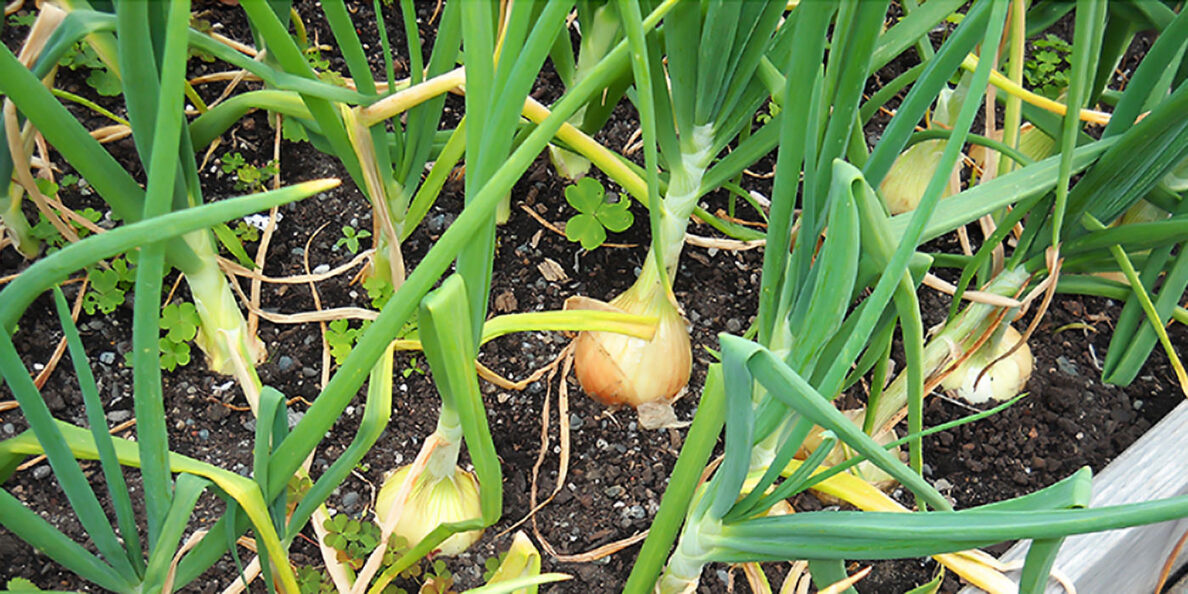
Brad Jaeckel has grown yellow onions for decades—at his home garden as well as Washington State University Eggert Family Organic Farm in Pullman, where he’s been the manager for 20 years.
About half of the crops from WSU’s organic farm are sold to the Moscow Food Co-op. Local food banks buy about 40 percent. The rest is sold to local restaurants such as James Beard Award finalist Black Cypress in Pullman and Nectar, Lodgepole, and Maialina Pizzeria in Moscow.
Yellow onions are “an important garden vegetable,” Jaeckel says. “Their storability is great.”
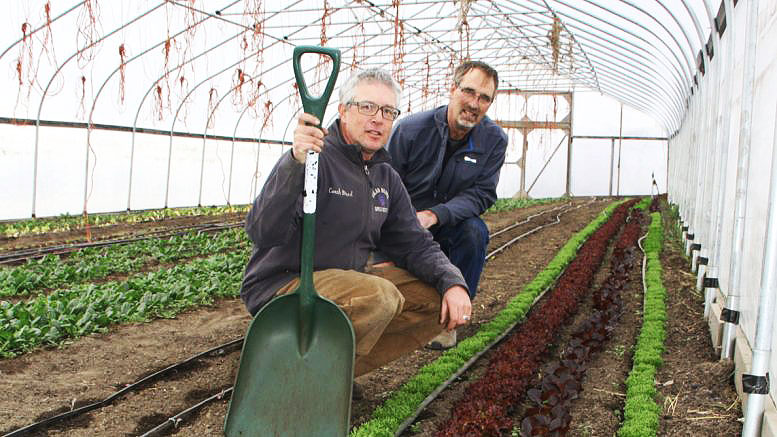
Here, Jaeckel offers tips for gardeners who want to grow their own:
Variety
Cortland was the one I grew forever at the WSU Eggert Family Organic Farm. It’s just a really nice tried-and-true one that worked well on the Palouse. I never had any failures with it. There are other ones, but Cortland is one of the standards for organic growers.
Seed selection
The important thing to know is there are northern and southern varieties. The difference is day-length sensitivity. If you choose a southern variety and try to grow it in the north, it won’t bulb correctly. With northern varieties, the summer solstice triggers bulb production.
Planting
The first thing is seeding. I’ve seeded as early as February. But with our nice greenhouse at the farm, I seed about eight weeks before I intend to plant. Say I’m shooting to transplant at the end of April. I would seed maybe late February or early March. If you don’t have great light or great heat, it will take longer. If you’re doing it at home, it may take longer—like ten weeks. Eight to ten weeks is pretty typical. Start them indoors. In our greenhouse, it takes seven to ten days for them to germinate. Then, they get hardened off in our hoop houses. There, they get a little more acclimated to the outdoor temperatures and the light. They can be in the hoop houses for a minimum of about two weeks before they go fully outdoors.
Transplanting you want to do as early in the spring as you can work in your garden because yellow storage onions take a long time to reach maturity. They are frost-hardy, so you can put them out before the last frost. Transplant them six inches apart when they are no bigger than six inches tall. You don’t want humongous transplants because they won’t do as well.
Growing
They’re very slow growing. That time between April and the solstice, they are just growing their leaves. It’s pretty slow going until mid-June. Then they really shift gears. They begin the bulbing process. They have to be well-weeded or they won’t produce a good bulb. That’s the most time-consuming part. They’re competing for resources of nutrients and water. Walla Walla sweets are the first ones to mature. You can start pulling those in July. But yellow onions won’t finish up until August. They’re very tough but shallow-rooted, and they do need to be watered. We were doing a deep watering twice a week. We would leave the drip irrigation on for an hour. We were trying to get an inch of irrigation per week. Watch the size of the bulb. You want to stop watering about two weeks before you’re going to pull them. You want to give them some time to dry down in the soil. The leaves will start to die back, and they’ll start to get limp.
Curing
When you pull them, you can leave them on the ground and let them dry. But if they get rained on, they’re not going to store quite as well. Cure them in a warm dry place with ventilation. If I have space, I hang them indoors. That ensures the best air flow. Don’t cut anything just yet. Just take the dirt off their roots. Leave the leaves on. You want them to shrivel up to nothing. You want the neck to be sealed from moisture and bacteria. You want to keep those things from entering the bulb.
Storing
Remove only the very outer wrappers around the bulb. You want to leave as many layers on the bulb as you can for storage, though. The more layers on the onion, the better it stores. You want to store them dry and dark, ideally with low humidity and no freezing temperatures—45 to 60 degrees is perfect. You can leave them in a box or a mesh bag for up to six months. That’s essentially it for storing.
Enjoying
You can buy them at the grocery store but they are never as good as your own. There’s nothing better than having your own onions to eat.
Learn more
In Season: Yellow onions (WSM Winter 2024)
Protecting the onions: WSU’s research on onion cultivars
From the archives
Walla Walla sweet onions (WSM Fall 2010)
Video: Grilling Walla Walla Sweets
Onions (WSM Winter 2012)
Onion lore…and choosing the right onion (WSM Winter 2012)