
Linda McLean got the idea during the COVID-19 pandemic when she was looking for socially distanced programing opportunities centered around food security and food sovereignty.
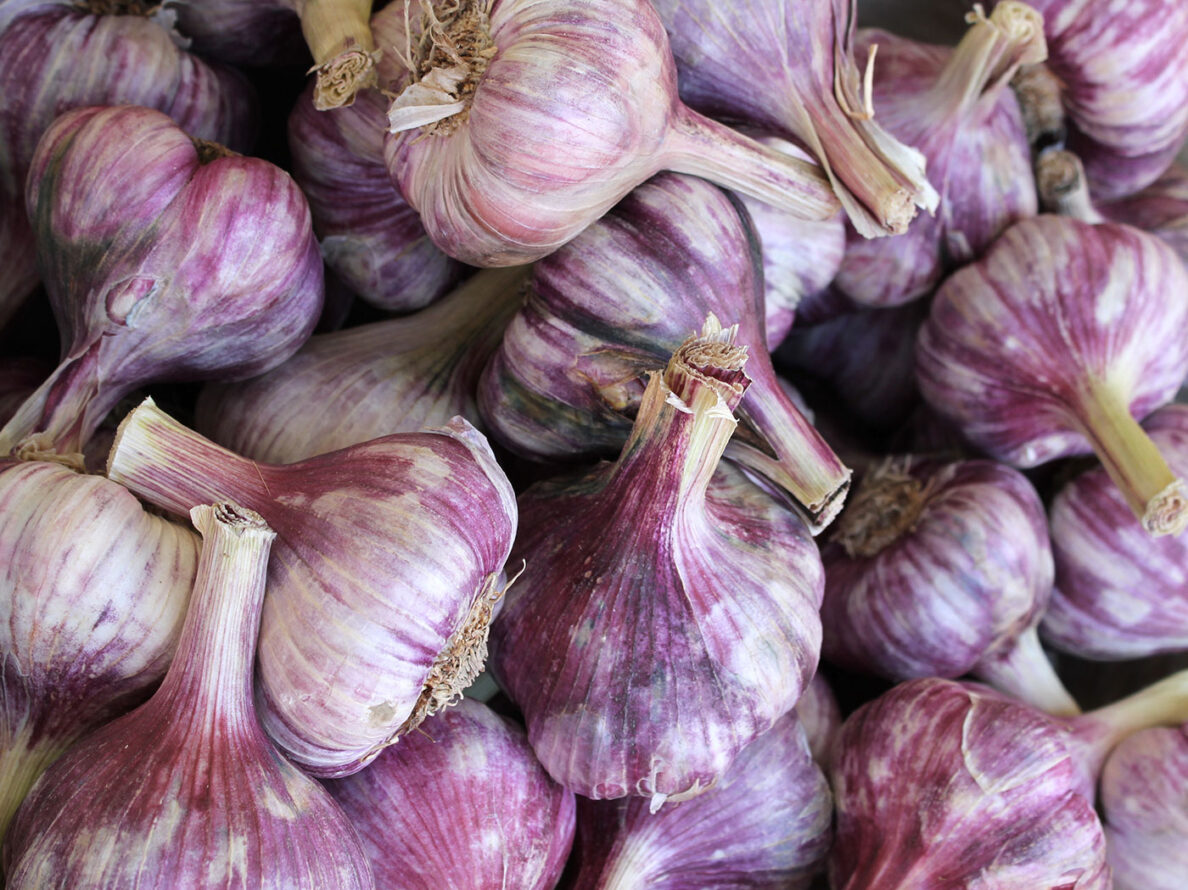
She held her first two Inchelium Red garlic workshops—one drive-thru and one walk-thru—in autumn 2020, giving out bulbs along with tips for planting, growing, and cooking them. There was so much interest in the garlic, known for its mild flavor and reddish color that appears as the bulbs cure, that she made it her mission. Since then, promoting Inchelium Red garlic has become a primary focus.
“The goal is to encourage tribal members to grow Inchelium Red garlic in large quantities and market them at a premium with labels that say, ‘tribal grown.’ Eventually, we would like to expand into value-added products,” says McLean, an enrolled member of the Confederated Tribes of the Colville Reservation.

This marks her seventeenth year at the Colville Reservation WSU Extension in Nespelem, where she is an educator for the Federally Recognized Tribal Extension Program, part of the US Department of Agriculture’s National Institute of Food and Agriculture, as well as the director of 4-H and the Agriculture and Natural Resources Extension Program.
Inchelium Red garlic, McLean says, “was discovered here on the Colville Reservation, and it was named after one of the districts on the reservation.”
Other than that, though, its origins remain a bit mysterious. “It’s believed that it was grown here before settlers,” she continues. “I don’t know how it got here. One theory is that an explorer or a missionary came through and dropped it and it crossed with wild garlic. But there isn’t a lot of tribal history about it.”
What she knows for sure: “It originated here, on the Colville Reservation. It has our name on it. It tastes good, and it grows well.”
Inchelium Red garlic was top-rated in a 1990 Rodale Test Kitchen soft-neck garlic taste test. It is available commercially. But, “it’s kind of been forgotten,” McLean says.
While Inchelium Red garlic was first found on the reservation, it’s not widely grown on the reservation. And McLean is hoping to change that.
She sees Inchelium Red garlic as a potential driver for economic development and has been expanding her outreach, distributing bulbs along with planting instructions and additional info at workshops throughout the reservation.
A new Inchelium Red Garlic Revitalization Coalition plans to plant and maintain a demonstration site for Inchelium Red garlic, providing reservation residents with bulbs and raised beds to grow 100 square feet of Inchelium Red garlic.
“We’re trying to revitalize it,” McLean says. “We’re celebrating it. And we’re bringing it back.”
Learn more
Growing garlic in home gardens (WSU Extension)
Bringing back First Foods (Washington State Magazine, Winter 2024)