
Abundant and essential but risky, yellow storage onions are a challenging, labor-intensive crop for commercial growers in Washington.
Weeding, done in part by hand, is essential to ensure the onions don’t have to compete for nutrients and can fully develop their pungent bulbs.
Thrips, tiny but rapidly reproducing insects that not only feed on onion leaves and other plants but also spread viruses, can reduce photosynthesis and overall production.
There’s not much to be done about the weeding, a necessary chore. But Washington State University researchers are working on behalf of growers to help control viruses, bacteria, fungal pathogens, thrips, and other pests. Ongoing variety trials serve as an opportunity to help explore pesticide effectiveness, prevent neck rot, and more.
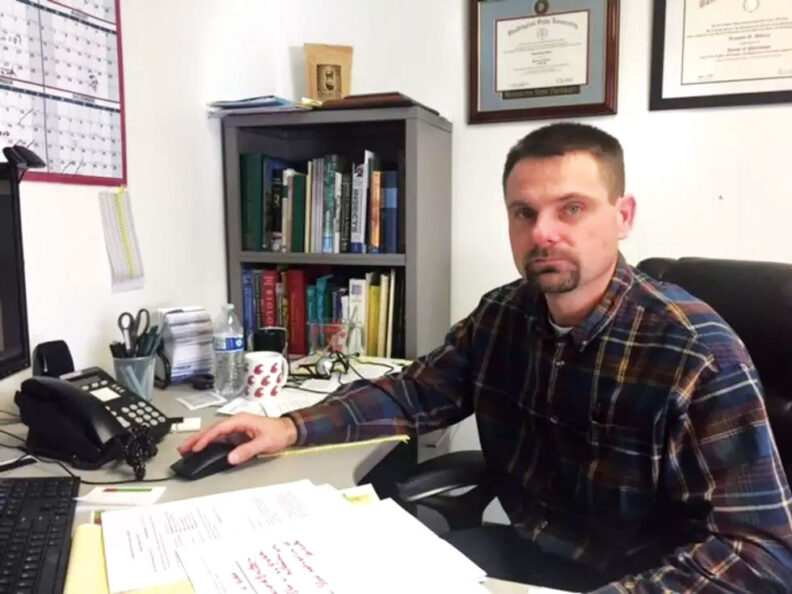
“A lot of money is at stake,” says WSU regional vegetable crops specialist Tim Waters.
The 2022 Washington onion crop was valued at $368 million, up 72 percent from the year earlier, according to the United States Department of Agriculture. Also in 2022, Washington state was the number two onion-producing state in the country, with some 19,000 acres of onions. Only California grew more.
And, Waters notes, “they’re super-challenging to grow.”
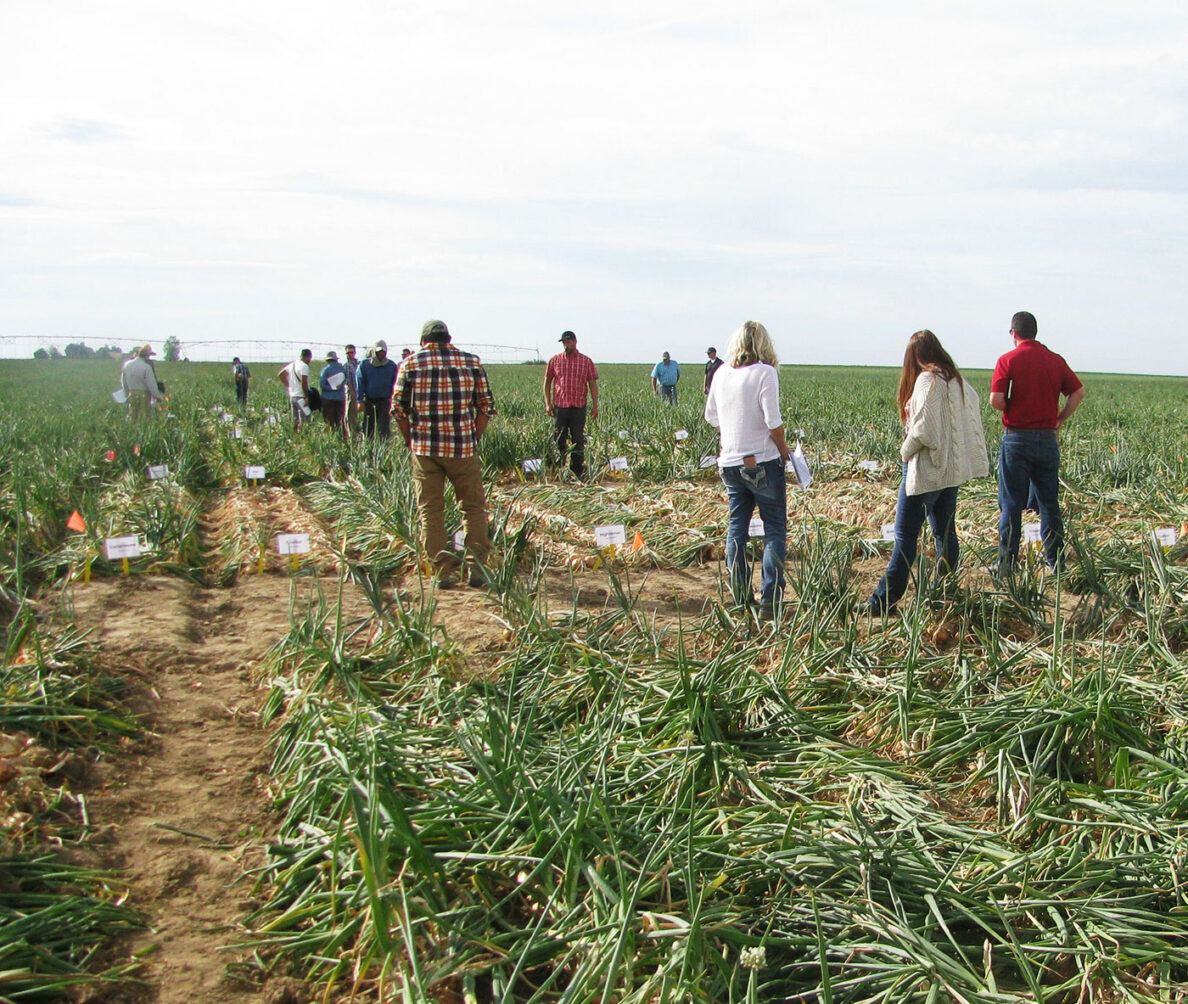
Waters (’02 Biol., ’04 MS, ’09 PhD Entom.), a Pasco-based Extension educator for Benton and Franklin Counties, has worked for WSU since 2006. He and WSU regional vegetable crops specialist Carrie Wohleb (’99 MS, ’00 PhD Hort.), a Moses Lake-based Extension educator for Grant and Adams Counties, coordinate WSU’s annual Onion Field Day, which draws growers and researchers to their revolving test plots to evaluate cultivars. Wohleb has worked for WSU since 2008. Both she and Waters have worked with onions since they started at WSU.
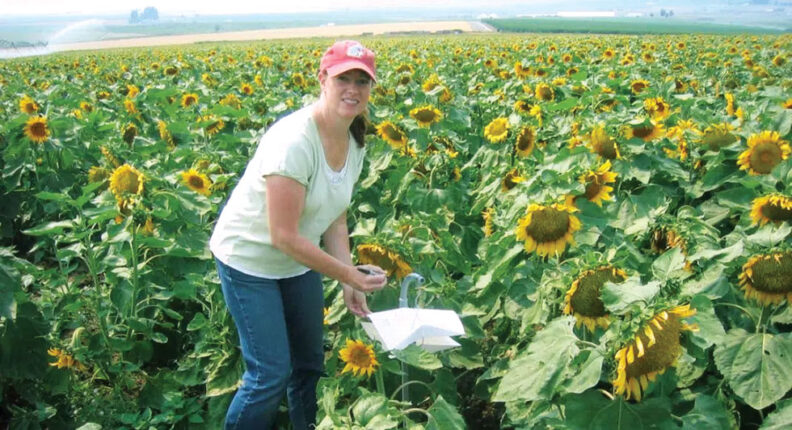
WSU’s current onion variety trials date back much longer than that, to 1984, when they were started by now-retired WSU vegetable Extension specialist Gary Pelter, Wohleb’s predecessor. The field day is part of the same program.
“I think we skipped one year due to COVID,” Wohleb says. “But other than that, it’s been going on that long.”
Seed companies submit cultivars that farmers are growing or are considering to grow, Waters explains. They’re planted in a field volunteered for the study by a Washington state onion farmer. The farmer and the field rotate between six different growers in the Columbia Basin, where most of Washington’s commercial onions are grown. Growers as well as others in the onion industry volunteer to help evaluate the cultivars and see how they fared in the trials.
“We like the cooperation we get from the growers,” Wohleb says. “It makes it their trials as much as ours.”
There are 50 cultivars in the trials. And, typically, Waters says, “we get entries from seven to ten seed companies.” In all, that translates to about 120,000 onions covering six- or seven-tenths of an acre each year. Notes Waters, “We only evaluate a subset of what we plant.”
“The vast majority of what we’re looking at is yellow storage onions,” Waters says. “Maybe 5 or 10 percent are red and white.”
That’s been the same since the start of the trials. But lots of other things have changed in those 40 years. Yields have grown from 25 tons per acre to 49 tons per acre, something Wohleb and Waters chalk up to better management, irrigation, storage, pest and disease control, and cultivars. Irrigation has changed, too—from furrow irrigation to mostly overhead irrigation with center pivots.
Pathogens and pests remain problems. Thrips, in particular, “stunt their growth and are expensive to control,” Waters says. “In the past, growers could lose 30 to 40 percent of their yield due to thrips. Now, we’ve come up with better ways to manage them.”
It’s trickier with weeds, which are sometimes hand-pulled. “Weeds are their number one problem,” Waters says. “Weeds will always be a problem. One of the biggest challenges is onions are really slow to grow. They never make a full canopy; you always see soil. So you’re going to have weeds. Weeds are probably the biggest challenge for growers. It’s labor intensive. It’s really expensive to weed an entire field.”
But, he notes, “We have really good commercial growers. They are meticulous. They pay close attention to detail.”
Some onion operations have been up and running for two or three generations. Says Waters, “Generational knowledge is part of it. You have people with 40 or 50 years of experience. They’ve learned over the years what not to do.”
In all, WSU researchers have studied more than 300 different cultivars. “Every row, I’m looking for something specific,” Wohleb says. For example, “Certain onions are grown for their nice single centers. Some are grown for slicers. Some are grown for onion rings. Some have different resistances.”
At the end of each year—in August—they are counted, sized, weighed, and otherwise evaluated, then put into cold storage. In February, they are removed from storage, cut horizontally and vertically, and re-evaluated.
“Growers really care about what they look like when they come out of storage,” says Waters, who spends about 40 percent of his appointment working on onions and another 40 percent working on potatoes. In addition to the variety trials for the annual field day, Waters oversees about 5 acres of onion test plots outside of Pasco. By contrast, Wohleb works on potatoes 70 percent of the time. Onions take up 15 percent of her appointment.
“Our jobs kind of change day to day,” Waters says. “We do applied research. We do risk calculations for growers. Carrie writes articles for magazines and newsletters,” Waters notes, including WSU’s Onion Alerts.
Onions aren’t the only crop they study. “We grow nearly 300 crops in Washington state,” Waters says. The crops we work with include potatoes, carrots, beans, peas, sweet corn, melons, peppers, tomatoes, seed crops, sweet potatoes, and asparagus.
One area they don’t work in is onion breeding. “We don’t have a breeding program,” Waters says. But, as already noted, “we do a lot of work with disease and pests.”
Onions from the test plots and trials are donated to local and regional food banks whenever possible. Volunteers from the nonprofit Second Harvest, which supplies a network of food banks, meal sites, and other programs in eastern Washington and north Idaho, glean the test plot, too.
Onions from Columbia Basin commercial growers go across the country and overseas. “Most grocery store medium yellow onions are from Washington,” Waters says. “A couple Washington growers grow onions for Subway. If you go into a Subway, chances are the onions on your sandwich are from Washington.”
Learn more
In Season: Yellow onions (WSM Winter 2024)
Tips for planting, growing, and curing yellow onions
From the archives
Walla Walla sweet onions (WSM Fall 2010)
Video: Grilling Walla Walla Sweets
Onions (WSM Winter 2012)
Onion lore…and choosing the right onion (WSM Winter 2012)