
Butterflies outnumber people in tiny Elkton, Oregon, which hosts one of the region’s largest conservation efforts for western monarch populations.
Each year, volunteers in Elkton—population 200—raise, tag, and release hundreds of monarchs. About 5,000 people visit the city southwest of Eugene annually to see the charismatic orange butterflies and learn more about their life cycle, migration, and habitat needs.
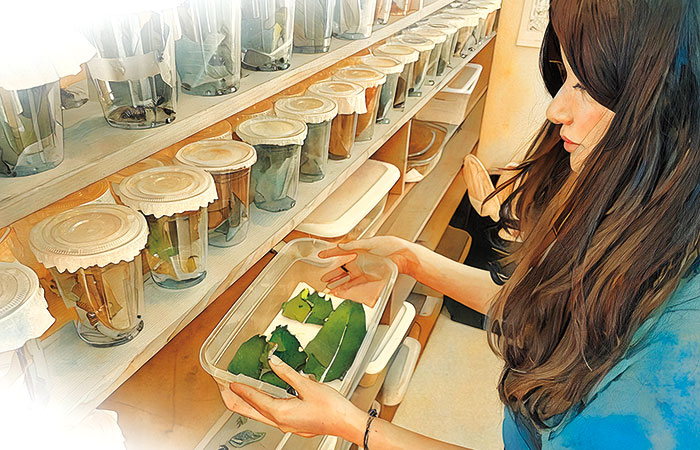 Staff illustration based on photo provided by Elkton Community Education Center
“Elkton is a major contributor to our monarch research through tagging,” says David James, associate professor of entomology at Washington State University. “They do a really good job at rearing healthy butterflies, and they get higher than average rates of return.”
Western monarch populations have plummeted since the 1990s as a result of new pesticides, climate change, and loss of native milkweed, the host plant for monarch caterpillars. But citizen science projects such as Elkton’s are a hopeful sign for the species, says James, who studies monarch migration in the West and provided early advice to volunteers on growing milkweed and butterfly rearing.
Besides the valuable data gained from tagging, Elkton’s work is raising awareness and creating advocates for monarchs, he says.
The city’s monarch project got its start in 1999, when retired teacher Carol Beckley asked local residents about ideas for some pastureland she owned. The result was the Elkton Community Education Center, which supports pollinator and vegetable gardens, a butterfly pavilion, small café, and the local library.
Jobs for teens are part of the project. Each summer, the center employs about 15 to 20 youth. “It doesn’t sound like a lot, but we’re a small town, so that’s a pretty good percentage of the high school,” says Barbara Slott, Elkton’s volunteer butterfly steward.
After monarchs lay eggs on Elkton’s milkweed plants, Slott and her team collect the leaves and rear the caterpillars in a research room so they’re safe from predators. The chrysalises are moved into the pavilion where the butterflies emerge and tourists can see them, along with painted lady butterflies also raised in Elkton.
“We have students give tours all summer, talking to people about the status of monarchs, their life cycle, and why milkweed is important,” Slott says. Tourists can pay $20 for the opportunity to name, tag, and release a monarch. It’s a popular fundraiser, and the idea came from a student worker.
WSU provides the adhesive tags that attach to the butterflies’ wings. People who find the tagged monarchs report the serial numbers, helping researchers map migration patterns.
Elkton’s monarchs overwinter in about 250 sites along the California coast. The eggs they lay in spring become the butterflies that return to the Northwest in May and June.
Several generations of caterpillars hatch on Elkton’s milkweed plants and turn into butterflies during the summer. When daylight hours start to wane, a “super generation” of monarchs emerges from their chrysalises and migrates south to wintering areas.
Beckley, the founder of Elkton’s butterfly conservation efforts, recently turned 90 and still volunteers in the pollinator garden.
“She’s my role model,” Slott says. “When I think I’m too old to do something, I think, ‘What would Carol Beckley do?’”
 Staff illustration based on photo by Deb Gritton provided by Elkton Community Education Center
Web exclusive
Cultivate milkweed for monarchs and other pollinators
More volunteer stories
Comforting arms: Maddie’s Place in Spokane takes care of babies born with prenatal exposure to drugs and alcohol, with the help of volunteers.
Really pumped: Community members on Whidbey Island banded together to put in heat pumps.
What’s cookin’: A commercial kitchen in Port Angeles reduces food waste and food insecurity, thanks to WSU Extension and community volunteers.
More about WSU work with butterflies
As U.S. butterfly populations plummet, scientists map a road to recovery (WSU Insider, June 16, 2025)
A world without insects? (WSM, Fall 2020)
Very well off the beaten path (WSM, Summer 2017, monarch butterflies in Pullman)
Life Histories: The Butterflies of Cascadia (WSM, Fall 2012)
The fate of a blue butterfly (WSM, Summer 2011)