
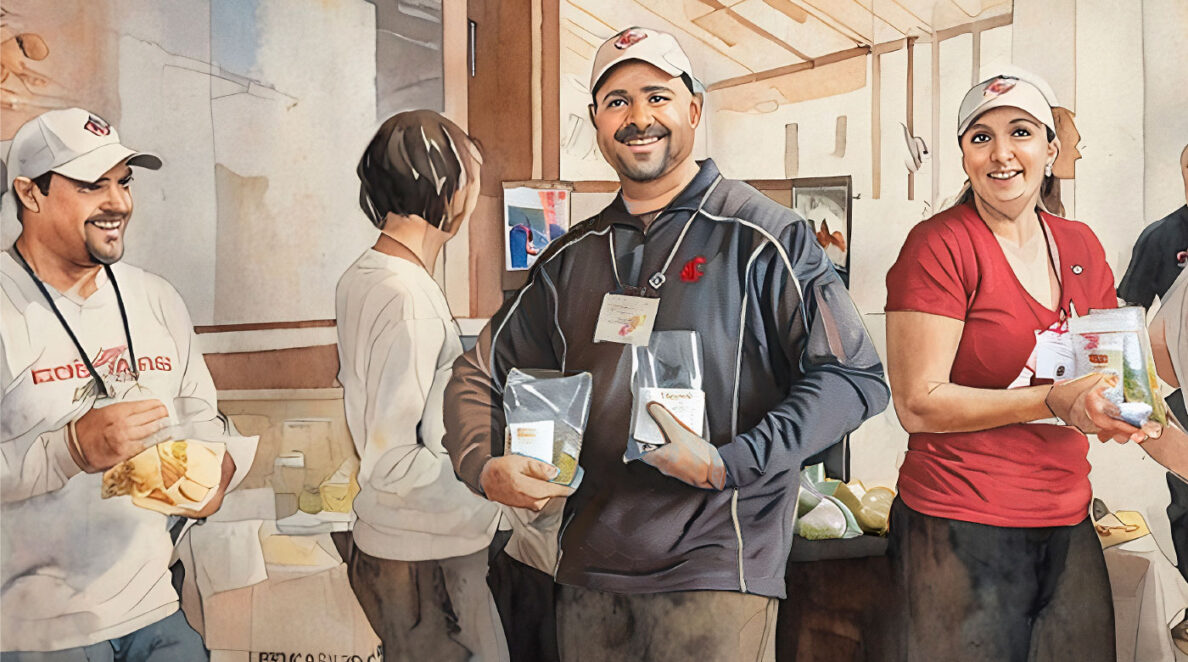
There’s a simple way to improve your overall well-being. It’s as easy as becoming a volunteer.
People who regularly give back to their communities report a greater sense of purpose, stronger social ties, and better mental and physical health. Volunteer work also builds more cohesive communities as people come together, sharing their skills to address local needs and solve problems.
While national or international problems often seem insurmountable, people can make progress locally. Reducing food insecurity in your community is a small step toward addressing hunger. Planting native shrubs along a creek is a step toward a healthy planet. And working with non-native English speakers is a step toward global understanding.
Pullman Mayor Francis Benjamin is an advocate for volunteering at the local level.
“I encourage everyone to think about what legacy they want to leave in their community,” says Benjamin (’06 Psych., ’14 MA Poli. Sci.), who also works at Washington State University as an adjunct faculty and staff member.
Wherever you live, Benjamin suggests reflecting on several questions to help guide your focus as a volunteer: What do you like about your community? What do you miss from places you previously lived? What do you wish you could change?
The important thing is to get started, Benjamin says. He tells working adults not to wait until they’re retired to volunteer and students that they’re not too young to make a difference.
In Washington, nearly one-third of people 16 and older volunteer, the US Census Bureau reports. In the following stories, we highlight some of the ways volunteers make an impact in their communities—including a monarch butterfly conservation project that supports rural youth employment and a nonprofit nursery for babies born with addiction from their mothers’ substance abuse. Each of these projects connects to WSU’s mission of sharing its expertise to benefit communities, the state, and the region.
Besides providing support to community projects, WSU plants the seeds for a lifetime of volunteering in students through the Center for Civic Engagement.
For more than 30 years, the Pullman-based center has connected WSU students, faculty, and staff with nonprofits and other organizations that need volunteers. Opportunities range from walking dogs at a local shelter to class projects that tap students’ expertise in areas like landscape architecture, digital marketing, or mechanical engineering.
“We look for ways to engage students in the community, whether that means Pullman or another community,” says Jessica Perone, assistant director at the Center for Civic Engagement.
More than 4,800 students took part in service learning projects during the fall 2024 semester, putting in more than 28,000 hours of volunteer time. Students volunteer with local organizations as part of service learning requirements for their classes, so they get real-world experience, Perone says.
The nonprofits benefit from WSU students’ time and energy, but students might gain even more. Volunteering helps them grow their professional networks, learn about career opportunities, and have projects they can talk about at job interviews.
The sense of connectedness is valuable too. First-year students who volunteer as part of class assignments are more likely to return for their sophomore year, according to studies by the Center for Civic Engagement and faculty researchers.
“We believe it fosters that sense of connection—to the community, to their peers, and to an off-campus experience that resonates with their interests and passions,” Perone says.
“And when our students graduate and land in communities all over the world, they are prepared and ready—not just professionally and academically, but to be socially responsible community members and leaders,” she says.
In terms of volunteer impact, the place where you live is often where you can see the most results, Benjamin says. Through community involvement, you’re also taking steps toward a more cooperative, less polarized society.
Most issues are nonpartisan at the local level, he notes. By volunteering, you’ll work alongside people who voted differently than you did. But focusing on a common goal encourages respectful interactions despite differing backgrounds and viewpoints, says Benjamin, who coauthored a book on how civility in government contributes to more productive debate and greater likelihood of reaching consensus.
“If you think locally, your hometown is small enough that eventually, you will probably need to work with that person on something else,” Benjamin says. “You can’t just burn a bridge. You might be able to do that on a state or national level, but locally you can’t.”
So next time you’re frustrated or despairing over the state of the world, consider where you could make a difference locally. Think of it as an investment in the issues you care most deeply about, and the chance to create a legacy.
And remember, by volunteering, you just might benefit the most.
Volunteer stories
Comforting arms: Maddie’s Place in Spokane takes care of babies born with prenatal exposure to drugs and alcohol, with the help of volunteers.
Really pumped: Community members on Whidbey Island banded together to put in heat pumps.
What’s cookin’: A commercial kitchen in Port Angeles reduces food waste and food insecurity, thanks to WSU Extension and community volunteers.
Launching butterflies: Monarch butterflies get a helping hand in Elkton, Oregon.
Volunteer!
Volunteer opportunities abound during the holidays
(WSU Insider, November 25, 2025)