
Volunteers with Washington State University Clallam County Extension’s Farm Gleaning Program harvest excess produce from fields or orchards, with crops going directly to the Port Angeles Food Bank.
But, says Clea Rome, director of Clallam County Extension, “There are only so many raw apples that can be distributed. Applesauce,” she notes, “might be easier to consume, especially for elderly clients who might have difficulty digesting raw fruit.” Plus, she says, “Clients don’t always have access to kitchen equipment for chopping and cooking, not to mention the time it takes to cook a meal.”
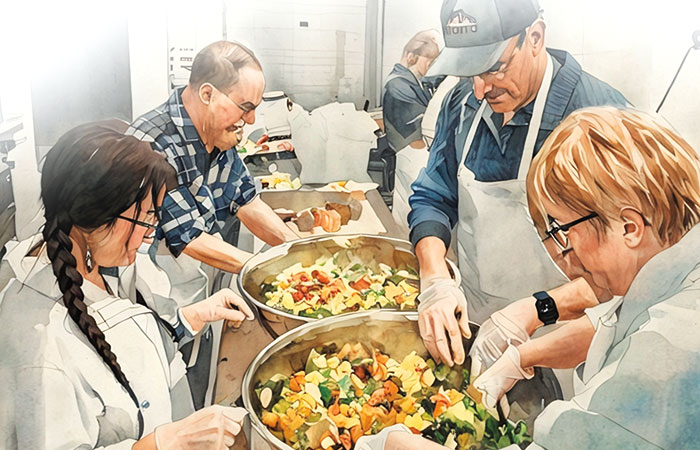 Staff illustration based on photo provided by WSU Clallam County Extension
A new processing kitchen is boosting the food bank’s ability to handle large amounts of fruit and produce, transforming ingredients into soups, salads, and sides, or minimally processed ingredients that are easier for clients to use.
The Port Angeles Food Bank, in partnership with WSU Clallam County Extension, operates the kitchen to improve access to locally grown and raised food, reduce food waste, and provide nutrition education. It opened in spring 2023 after more than eight years in the works.
“There’s a strong coalition of food banks and food-access organizations here on the Olympic Peninsula. The whole group had long recognized that this kind of infrastructure could be a game-changer,” Rome says. “COVID offered both the challenge and the opportunity to get the job done.”
Clallam County spent $1.88 million of Coronavirus State and Local Fiscal Recovery Funds, allocated under the American Rescue Plan Act, on food security programs. This includes relocating the food bank to a larger building, adding the kitchen, and completing other renovations, such as the creation of a marketplace space, built to resemble a grocery store, where clients use points—allocated based on household size—to “buy” items.
Community donations and state funds supported the project. WSU Clallam County Extension lent expertise to help design the kitchen and funded supplies and equipment. Extension staff members provide ongoing technical assistance, training, and project management.
“Food insecurity continues to rise in our state,” Rome says. “Post-COVID, food banks have seen their numbers of clients rise upwards of three times as much as pre-pandemic levels.”
In 2024, the Port Angeles Food Bank experienced an increase in demand of approximately 40 percent over the previous year, with nearly 10,000 households receiving assistance. Some 20 percent of those were first-time clients.
In Washington state overall, some 10 percent of the population faces food insecurity, according to Feeding Washington, a statewide association of Washington food banks. That includes one in seven children. In Clallam County, where Port Angeles is the county seat, the rate is higher, with 15 percent of the population experiencing hunger, including one in four children.
“The availability of the food processing kitchen really enhances access for clients,” says Rome, noting the food bank often receives ingredients “near the end of their life cycle that need to get out to clients in a timely way. The kitchen allows food to be processed in ways that make it easier to eat and not as perishable, and increases convenience and possibilities for clients.”
The food bank now has the capacity to turn apples into applesauce. It’s also able to prepare minimally processed fajita kits with washed and sliced peppers and onions, as well as pints of mirepoix, the classic French base of diced onions, carrots, and celery used as a foundation for soups and many other dishes.
Food preparers are able to wash and peel an abundance of beets so they are ready for immediate use, and wash and shred a surplus of zucchini, portioning it into pints. The kitchen provides packages of the ready-to-use minimally processed ingredient, along with a recipe for how to use them, such as zucchini bread.
Recently, “We had an incredible amount of gleaned cauliflower, and we were able to blanch and freeze it for later use in prepared meals. We did the same thing with broccoli and kale and collards that were later used in stews,” says Danielle Carson, the community health and Supplemental Nutrition Assistance Program Education coordinator at WSU Clallam County Extension. She also serves as the regional food safety adviser and food protection manager for the processing kitchen.
“The kitchen has been a really wonderful jumping off point for a lot of community health and food-waste prevention programs,” Carson says.
Thirty to 40 percent of the US food supply goes to waste, according to the US Department of Agriculture. In Washington state, more than a million tons of food waste is generated every year, according to the state Department of Ecology. About 35 percent is edible food going into landfills.
Last year, the Farm Gleaning Program rescued 13,146 pounds of food from three local farms, according to WSU Clallam County Extension. About a third of that food was processed in the kitchen; the rest went straight to the marketplace as raw produce for food bank clients. In all, the kitchen helped divert approximately 350 tons of food from the waste stream in 2024.
Its chef-created, single-serving, frozen Comfort Café Home Style Meals, low in fat and salt, can be purchased by community members online for $12 each and picked up in person the following week. For each meal sold, one is donated to the food bank.
The kitchen has also allowed WSU Clallam County Extension’s Farm to School program to pilot a project aimed at getting locally grown food into school meals. “The eventual goal is to add a product line to the Comfort Café, so schools could purchase minimally processed ingredients to serve to students,” Carson says.
Meantime, some 350 meal kits, or fresh meals, are prepped at the kitchen for clients each week, Carson says.
“We’ve been doing food access work for years and are really starting to see some impacts,” Rome says. “I’m very proud of the work our team is doing here. This kitchen is an example of how WSU Extension can do community-level work with trusted partners to bring a community development project to fruition, and that’s been really gratifying.”
More volunteer stories
Comforting arms: Maddie’s Place in Spokane takes care of babies born with prenatal exposure to drugs and alcohol, with the help of volunteers.
Really pumped: Community members on Whidbey Island banded together to put in heat pumps.
Launching butterflies: Monarch butterflies get a helping hand in Elkton, Oregon.