
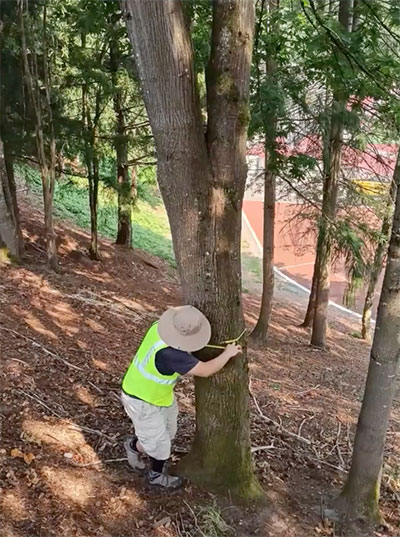
Nelson Pham spent six hours at Tacoma’s Boze Elementary School one day last summer. Armed with the iNaturalist app and GPS tagging, he identified and mapped every tree on the school’s property.
Some trees were healthy, others were struggling. Only two were providing shade for the crowd of spectators watching youth soccer games at the school’s playfields.

“All these parents were just baking in the sun,” says Pham, a Tacoma Community College student. “I wondered where the trees were.”
By the end of the summer, Pham created an interactive database of trees at 12 Tacoma schools. The work was part of an internship with the Ravenholt Urban Forest Health Lab at Washington State University’s Puyallup Research and Extension Center.
Seven community college students took part in the internship, which was supported by a US Forest Service grant. For Pham, it was an opportunity to put theory into practice.
“In the classroom, we learn about the benefits of sustainability and caring for our environment,” he says. “I grew up in Tacoma, so this is my city. I wanted to get out into the field, get my hands dirty, and do something.”
Pham’s project describes nearly 1,800 trees on school grounds, including their species, size, condition, and GPS coordinates. The results are available through the Tacoma Public Schools Tree Inventory project. Besides helping identify areas where trees are needed, Pham says the interactive database is a resource for teachers and students interested in hands-on science projects.
After graduating from community college, Pham is transferring to the University of Washington to study environmental science. He aspires to work in environmental policy.
Meanwhile, Pham says he hopes his tree mapping project will help reduce “plant blindness” for both students and educators.
“People often aren’t aware of the plants around them or recognize their value,” he says. “If we can give the next generation the tools and learning to help them understand why this is important, they can contribute to making the world a better place.”
Watch Pham’s presentation and learn about other interns’ urban forest projects.
Read more about urban trees.