
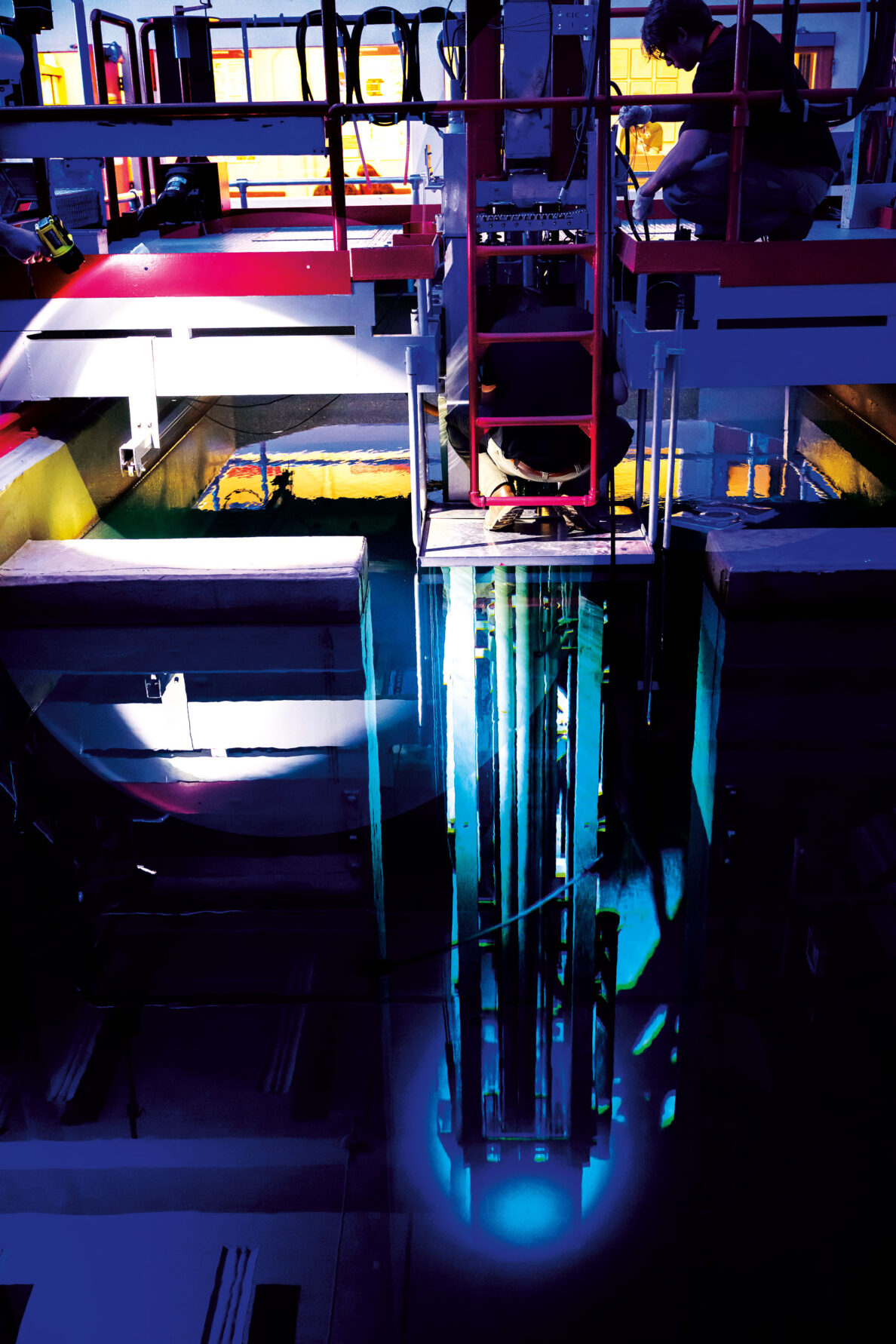
It’s a new era for nuclear energy, and Washington State University will help shape that future by building on its past.
WSU has more than a half-century of experience educating nuclear scientists and reactor operators. The university is home to the state’s only research reactor.
A major expansion at WSU’s Nuclear Science Center in Pullman will enable new lines of research and potentially new certificate and degree options, says Corey Hines, director of the center.
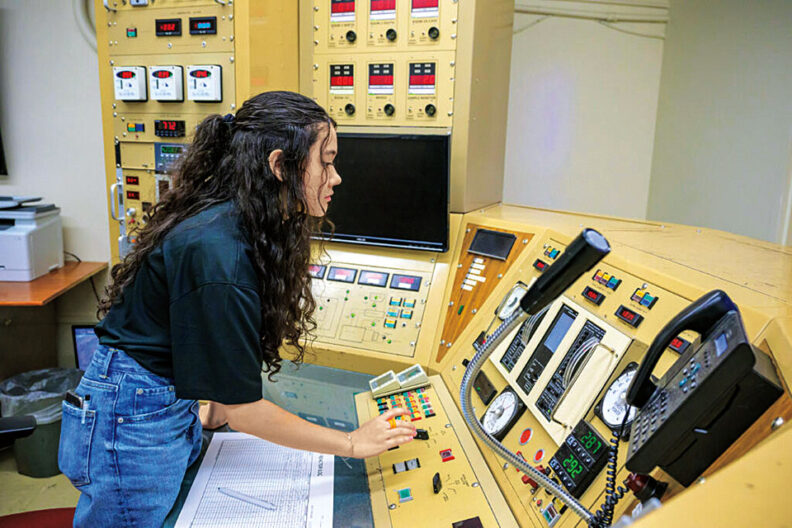
Interest and investment in nuclear power is increasing globally, driven by soaring demand for energy, advances in technology, and climate goals. New reactors are being built worldwide, while companies are also developing next-generation small modular reactors that could lower costs and speed construction.
All of these facilities will need people to run and monitor them.
WSU helps fill that pipeline through its longtime reactor operator training program, where undergraduate students can get the education and training needed to become a licensed reactor operator or senior reactor operator.
Since the center’s establishment in 1961, 113 nuclear reactor operators trained there have been licensed by the US Nuclear Regulatory Commission, as of fall 2025. Students with nuclear training also work in many other capacities where that experience is valuable. Those students come from a wide variety of majors.
“We’ve had music majors take the course; they’ve passed and become senior reactor operators. We’ve had history majors. We take all backgrounds,” says Layla Lumzer (’25 Mech. Eng.), who has worked at the Nuclear Science Center for two years and is a licensed reactor operator. She graduated in December and will sit for the US Nuclear Regulatory Commission’s senior reactor operator license exam this summer.
Students need one chemistry prerequisite to start the program. Then they must pass three additional courses and work at WSU’s research reactor to be eligible to sit for the exam. Average pay for a reactor operator in the United States is $121,000 per year, according to the US Bureau of Labor Statistics.
The reactor core represents an incredibly versatile resource. It is one of just four research nuclear reactors in the Pacific Northwest; it is a TRIGA facility—Training, Research, Isotopes, General Atomics—that uses fuel especially suited for research.
The core is operated from a control room, where student operators in training adjust the power of the reactor by raising and lowering materials that act as sponges to control the nuclear chain reaction.
WSU offers five nuclear science courses and now has a nuclear science certificate within the chemistry department. The university may launch a nuclear science minor later, which would be a rarity in the United States.
“Our recent motivation has been in development of undergraduate course work to introduce students to sought-after nuclear science skill sets earlier in their academic lives,” says Hines.
 Corey Hines (Photo Shelly Hanks)
In addition to more training, the expansion includes a new 5,000-square-foot facility being built at the Nuclear Science Center. It will house three “hot cells” for nuclear research, a chemistry wet lab, and other facilities. The building is expected to take a year, and then about five years to bring the hot cells into operation.
“With the expansion, we’re now going to be able to use the full nuclear capacity of the core,” says Hines.
Kim Christen, WSU vice president for research, says, “These hot cells will supercharge the ability of WSU scientists and our regional and national partners to discover new kinds of fuels, produce specialized isotopes, and develop materials suited to extreme environments, like next-generation nuclear reactors.”
The research taking place in WSU’s Nuclear Science Center is conducted by university faculty and government and private partners. The center also produces radioactive isotopes for use at US national laboratories, for advanced nuclear and energy industry partners, and medical research.
A particular priority is national security work contributing to nuclear science, nuclear non-proliferation, and emergency readiness exercises and training programs, Hines says. “This is an exciting moment for nuclear energy,” Christen says. “WSU is uniquely positioned to drive next-generation nuclear innovations while preparing the highly qualified operators and scientists needed to power the industry’s future.”
Lumzer says she encourages all students to look into the nuclear field.
“Don’t be afraid to try it out if you’re not a STEM major. We’ll teach you the basics,” she says. “You get hands-on training. And, while you’ll be supervised, you get to operate a nuclear reactor yourself.”
Through it all, Hines says, the center will retain its focus on safety. The facility operates with several layers of safety checks and precautions, and encourages a culture with several channels for anyone to report safety concerns, for any reason at any time.
“We strive every day to be the safest building on campus,” he says.
Institute for Northwest Energy Futures
WSU’s Institute for Northwest Energy Futures, started in 2021 at WSU Tri-Cities, works to meet the global need for sustainable clean energy production. INEF is partnering with Energy Northwest and Columbia Basin College on a small modular reactor operations simulation center inside the INEF building, which will be a critical training resource for the next generation of nuclear operators. Energy Northwest recently signed an agreement with Amazon to build and deploy small modular reactors in the Tri-Cities.