
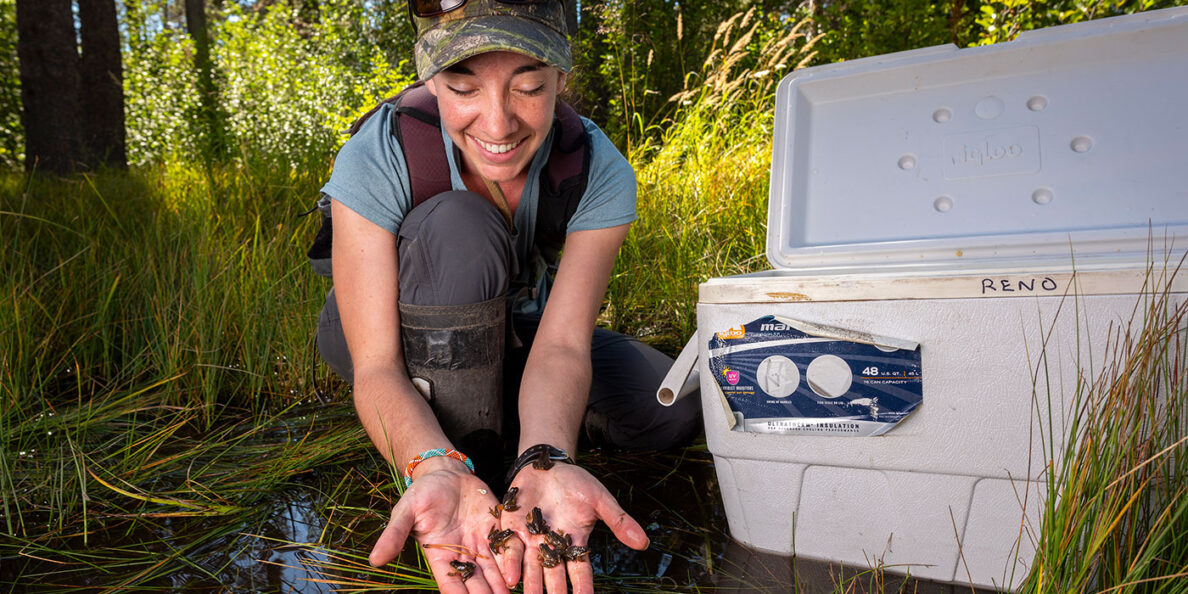
A wildlife biologist crouches in a forest wetland. In her hands are tiny frogs, ready to leap back into their watery home.
Ryan Wagner, a doctoral student at Washington State University, photographed young Cascades froglets being released into the wild at a Northern California research site. His picture was recently featured in Nature’s “Scientist at Work” contest.
“For me, the photo represents a lot of hope for amphibians,” says Wagner, who studies wildlife disease ecology at WSU Vancouver. “The frogs’ release is the culmination of hard work and a lot of science.”
Cascades frog populations are plunging in Northern California, and the chytrid fungus is a primary culprit. To increase their chances of survival, the young frogs are captured and held for a week, receiving daily antifungal baths.
It’s a labor-intensive effort. Researchers scout for remnant Cascades frog populations in high-elevation meadows and lakes. They catch the froglets in fall, shortly after they change out of their tadpole stage. Antifungal treatments increase the frogs’ survival rates from less than 5 percent to more than 50 percent during their first winter.
“We’re starting to have tools that make a difference against chytrid,” Wagner says of the highly infectious fungus responsible for worldwide declines in amphibian numbers.
Wagner frequently pairs photography with his research. This is the second year his work has been featured in the Nature contest. Last year’s winning photo showed a researcher feeding an endangered Hawaiian songbird.
“I try to capture images that connect with a broader audience, and show just how cool scientists can be,” Wagner says. “We’re very down-to-earth people, and our work can be a lot of fun.”
Web exclusive
Gallery: Fighting a deadly fungus in frogs