
Growing up, she “never thought of higher education as a career in and of itself.”
The daughter of a Navy submariner and a nurse for the Department of Veterans Affairs—immigrants from the Philippines who met in America—Rosie Rimando-Chareunsap (’99 English, ’11 EdD) was born in South Carolina and raised on Bainbridge Island.
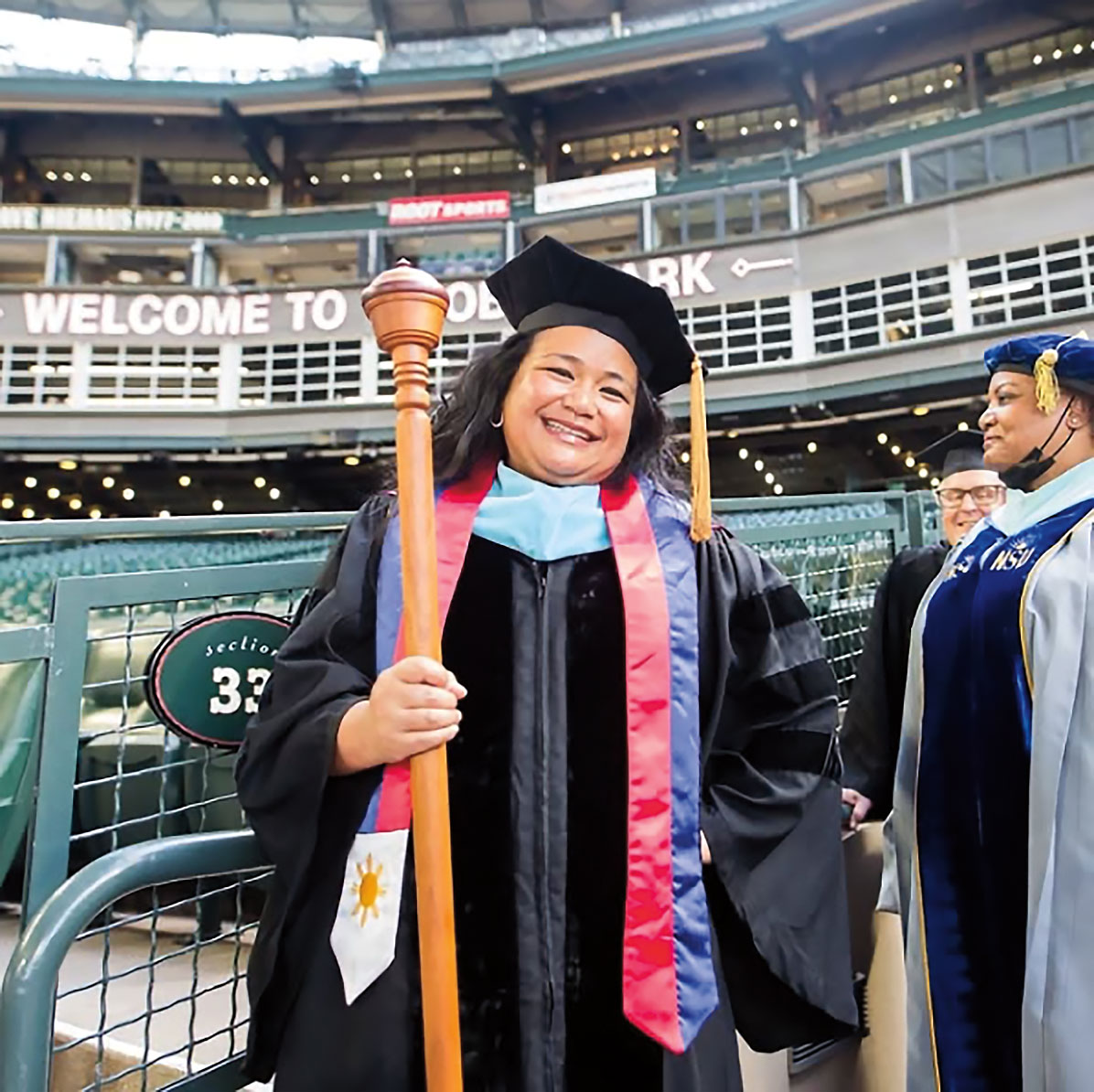
(Courtesy South Seattle College)
“I was this Filipina girl with a Southern accent in the Pacific Northwest,” she says.
Washington State University, particularly its professors and student support services, helped shape her studies, career, and approach to leadership. As chancellor for Seattle Colleges, Rimando-Chareunsap uses the lessons she learned at WSU and through federal TRIO programs to create equitable success and make college accessible for all.
“I wanted to change the experience for kids like me,” she says.
Rimando-Chareunsap arrived in Washington state in fifth grade, when her dad was stationed at Naval Submarine Base Bangor. Her mom landed a job with the VA in Seattle. Bainbridge was halfway. A couple of campus visits helped her and her parents become comfortable with the idea of coming to Pullman for college.
At WSU, she had mentors—and became a mentor herself—through the Office of Multicultural Student Services. She was a member of the Asian Pacific American Student Coalition and the Association of Pacific and Asian Women, and an officer in the Filipino American Student Association. She also participated in a newly established recruitment program aimed at diversifying the ranks of Washington’s teachers. Milton Lang (’98 MA Elem. & Sec. Ed., ’08 EdD Higher Ed. Admin.), former director of student recruitment and retention at the College of Education, founded and coordinated the Future Teachers of Color Program.
“When I look back, it was really effective retention programming,” she says. But that first year, “I struggled. When I faced hardships, it was the people that kept me there. I had a mentor in the College of Education. I had a mentor in Multicultural Student Services. (Professor) Michael Delahoyde in the English department encouraged me as a writer and introduced me to an identity I never otherwise would have embraced.”
Her most impactful undergrad professor, Rory Ong, an emeritus professor of comparative ethnic studies and American studies and culture, sat on her doctoral committee. “He introduced me to histories and literature that actually reflected me,” Rimando-Chareunsap says. “He was able to see me come full circle, from this young and naive underclassman figuring out life and developing critical thinking skills to a doctoral candidate trying to apply the things I learned from him in a professional career.”
A 2025 recipient of the WSU Alumni Achievement Award, the highest honor awarded by the WSU Alumni Association, Rimando-Chareunsap started her career at South Seattle College as a student success specialist in the TRIO Educational Talent Search and Upward Bound programs, working with first-generation college-bound youths. Federal TRIO programs support students from low-income and other disadvantaged backgrounds.
“I was in pre-college TRIO programs, and I really identify as a TRIO alum today,” says Rimando-Chareunsap, who described her core values—service, and racial equality and justice—and TRIO’s importance in her keynote address for WSU’s 2025 National TRIO Day.
“My TRIO experience defined what I’ve sought to create across higher ed wherever I can,” she says. “TRIO works. Focusing on creating more equitable systems and outcomes works. Those concepts are evergreen, regardless of how they may be threatened or politicized. What this environment is telling me is that not enough people understand this on a fundamental level.”
She became director of student outreach, admissions, and recruitment, then vice president of student services before serving as president of South Seattle College from 2018 to 2022. In 2023, Rimando-Chareunsap took the helm of Seattle Colleges, where she oversees three colleges, five specialty sites, 2,000 employees, 30,000 students, and an operating budget of nearly $200 million.
Rimando-Chareunsap believes strongly in the W. Edwards Deming quote: “Every system is perfectly designed to achieve the results that it gets.” This sentiment was on her mind when she helped plan Seattle Promise, an initiative from Seattle Colleges, Seattle Public Schools, and the City of Seattle that guarantees two years of free community college tuition. “It’s really something that I’m proud of,” says Rimando-Chareunsap, noting she helped design the program based on TRIO.
Funding is always a concern. Community colleges, like public universities, depend on state revenue. “All of higher ed is facing a revenue shortfall on the order of billions,” says Rimando-Chareunsap, who holds a master’s degree in public administration from the University of Washington and has two children, ages 10 and 13. “The more ground we lose in state funding, the less accessible college becomes for students to access our own public higher education.”
On top of that, colleges and universities are facing a devaluation of higher education, Rimando-Chareunsap says. “There’s this faulty rhetoric taking hold that college is not for everyone,” she says. “The cliché of underwater basketweaving—that’s not what we’re doing here. I think we need to remind people of all the ways they interact with higher education degrees on any given day. College includes everything from pre-med and business school to veterinary science and welding and nursing. Even traditional blue-collar jobs require training, usually through community colleges.
“The open-access mission of community colleges has democratized higher education. Our work is in our communities and ensuring every individual can transform their own life through education. That’s why I am in this work, to ensure we uphold the promise of that mission.”