
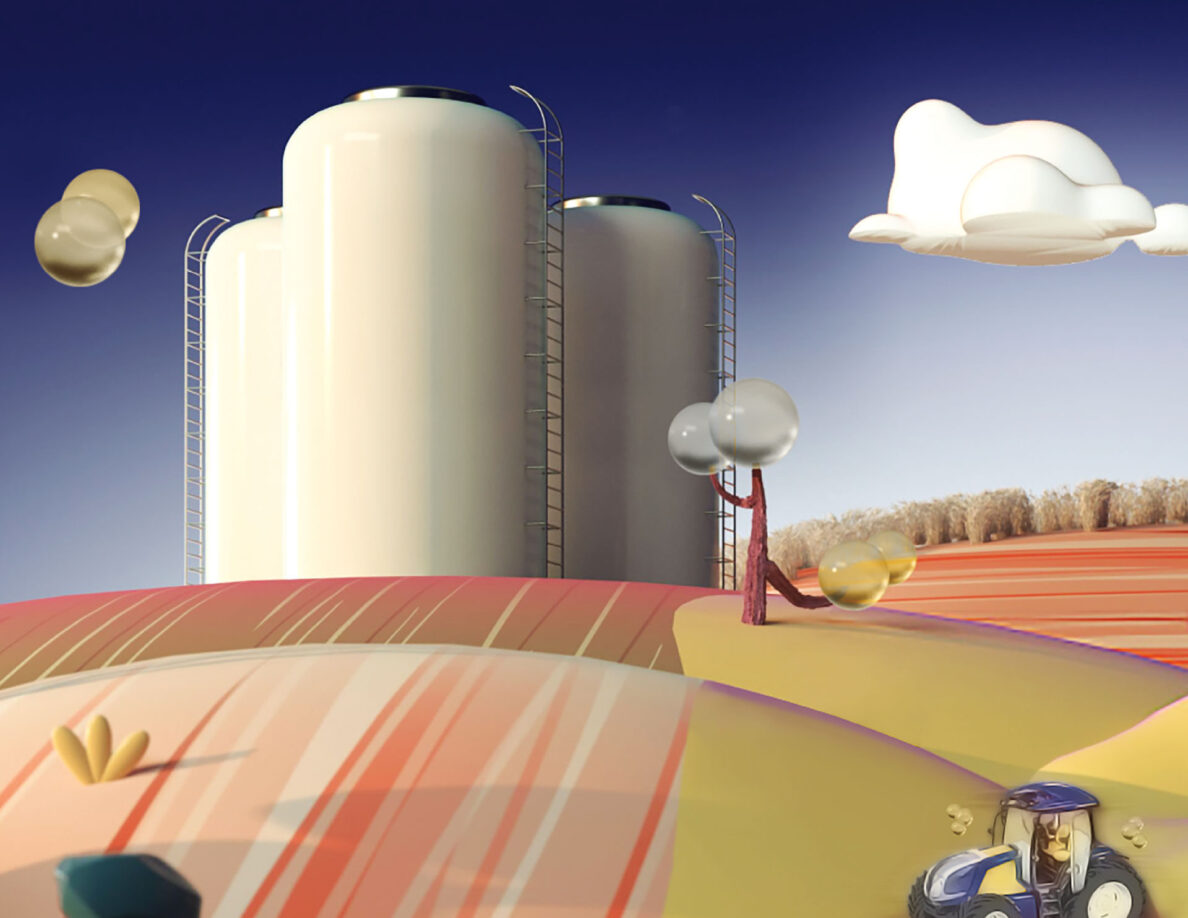
CryoCowboys’ ultimate goal is building an entire hydrogen system that could be used on farms. … Farmers could generate their own hydrogen, liquify and store it, and run their equipment on the fuel.
At his family’s wheat farm near Dusty, Washington, Kyle Appel grew up helping his dad repair diesel tractors and combines. But he can picture a day when the farm’s equipment is powered by clean hydrogen fuel.
The idea took hold in Appel’s combustion engine class at Washington State University, when the professor brought in a paper about converting diesel engines to run on mostly hydrogen. With his hands-on mechanical experience, “I could see the possibilities for heavy equipment,” says Appel (’22, ’24 MS Mech. Eng.).
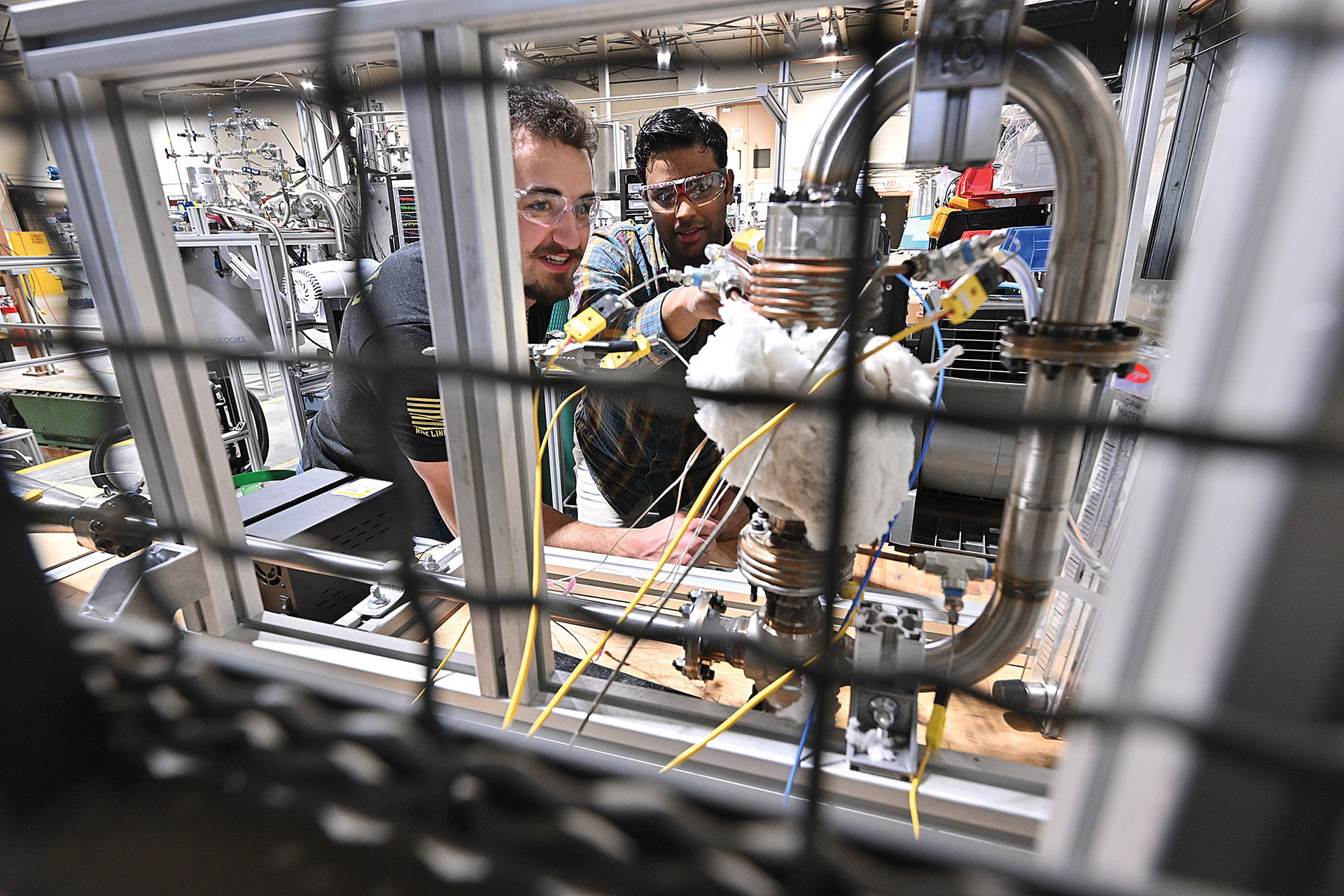
Last year, he cofounded CryoCowboys LLC with colleague Matthew Shenton.
“Kyle and I have a vision,” Shenton (’25 PhD Mech. Eng.) says. “We want to drive hydrogen-powered tractors. We want to push sustainability forward by making liquid hydrogen a viable fuel for the agricultural industry.”
Hydrogen fuel has plenty of upsides. It’s energy intensive, but unlike fossil fuels, it doesn’t produce greenhouse gasses when it burns. It can be made from water by using electrolysis to break the hydrogen-oxygen bond. And if the electrolysis is fueled by renewable energy—like solar panels on a farm—the resulting hydrogen is considered climate neutral.
Hydrogen-powered forklifts are already used in US warehouses, moving about 30 percent of the nation’s groceries. But as a fuel for widespread use, hydrogen still has challenges to overcome.
For industrial uses, hydrogen is most practical as a liquid fuel. However, keeping hydrogen in a liquid state requires extremely low temperatures of −420 degrees Fahrenheit, which falls in the cryogenic temperature range. And that’s where Appel and Shenton’s work comes in.
The business partners met at WSU’s HYdrogen Properties for Energy Research (HYPER) Laboratory run by Jacob Leachman, a professor in the School of Mechanical and Materials Engineering. The lab is working on a variety of liquid hydrogen fuel applications, including aviation and other types of transportation. Appel and Shenton zeroed in on agriculture.
“He’s from an ag background and so am I,” says Shenton, who grew up on an Idaho cattle ranch. “One day, one of our friends said, ‘Here come the CryoCowboys. They work in cryogenics, but their hearts are in agriculture.’” The name stuck.
They formed CryoCowboys LLC to apply for small business innovation grants through the US Department of Energy. During his master’s degree, Appel worked on mathematical modeling to improve liquid hydrogen storage tank operations and prevent fuel loss.
But the company’s immediate focus is Shenton’s thermoacoustic research at the HYPER lab, which uses sound waves to liquify the hydrogen and keep it cold. The research was the focus of his doctoral thesis. To explain how the science works, Shenton draws parallels to talking.
“When I’m talking, the air is vibrating through pressure fluctuations, producing sound waves,” Shenton says. In a pure hydrogen environment, the hydrogen molecules would be vibrating instead.
“We can generate and amplify the pressure waves in hydrogen by using the vast difference between room temperature (70 degrees) and cryogenic conditions of −420 degrees,” he adds. By harnessing those pressure fluctuations, energy is transferred from the cold space to the warm space, creating refrigeration.
Shenton is working to refine the thermoacoustic wave technology with hydrogen for eventual commercialization. He says it has advantages over refrigeration compression systems for keeping liquid hydrogen cold.
“It’s less likely to break down, and it requires less maintenance,” Shenton says. “We’ve eliminated the compression system’s mechanical parts, and we’re using the hydrogen molecule to cool itself.”
CryoCowboys’ ultimate goal is building an entire hydrogen system that could be used on farms. The partners envision a future when farmers could generate their own hydrogen, liquify and store it, and run their equipment on the fuel.
Appel and Shenton’s work epitomizes WSU’s mission of producing research that benefits society, Leachman says. “Kyle and Matthew are quietly realizing the technologies needed for clean, energy-independent agriculture right here on the Palouse.”
Appel turned down a lucrative job offer after earning his bachelor’s degree to work in the HYPER lab while getting his master’s.
“I looked at what I wanted to do with my life,” he says. “What I saw was a great opportunity to make hydrogen a viable fuel for industries that currently rely on heavy equipment with big block diesel engines.”
“Hydrogen has great potential for agriculture,” Shenton adds, “and the industry is interested in seeing it reach the point where it’s economically feasible.”