
It’s an unconventional narrative, flipping back and forth between Tibet and Idaho’s St. Joe National Forest and the perspectives of two main characters: a homing pigeon and a typewriter. Not just any typewriter, but a Smith Corona Silent, the same kind he brought with him when he worked for the US Forest Service.
“There’s a lot of play in the work. Alex loved play—and a challenge,” says Joan Burbick, wife of writer and longtime Washington State University professor Alex Kuo.
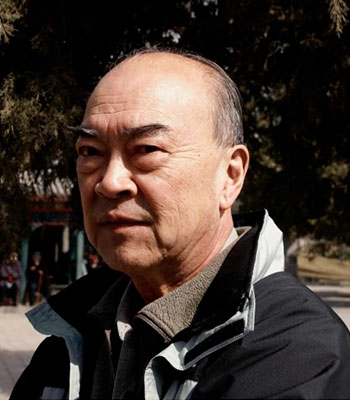
The distinguished Chinese-American poet and novelist, whose heritage figured prominently in many of his works, died in Anacortes on June 11, 2025, three days into what was supposed to be a three-week getaway on Lopez Island, one of his all-time favorite vacation spots. He was 86.
His sixteenth book, Clearcut: A Tale of Forests—with the pigeon and typewriter—is slated for posthumous publication by Redbat Books in spring 2026.
“He was absolutely determined to finish his last book. No matter how badly he felt, he kept writing,” says Burbick, also a longtime WSU professor and distinguished nonfiction writer. “Alex loved to write. He enjoyed the process. Some people just need to write. He was like that. It’s a cliché but for him it was a way to figure out what he was thinking.”
Kuo, who resided in Spokane the last three years of his life and loved the great outdoors, spent summers in his younger years living in lookouts, studying fire management, and fighting fires for the US Forest Service. “The woods and mountains of Washington, Colorado, and New Mexico were not only an inspiration for his writing, but also a sanctuary, away from the troubled past of war and political violence that he had experienced,” Burbick writes in Kuo’s obituary.
Burbick arrived at WSU in 1978, a year before Kuo. They married in 2000 after twenty years together. Her latest work, Erased (2024, Redbat Books), a fictional memoir, is based on his life.
“Writing gives you options,” Burbick says. “It gives you possibilities. It’s a way out of feeling trauma. It’s a way out of feeling hopeless.”
Kuo was born in Boston where his parents were working on research fellowships. At nine months old, he traveled to his parents’ native China, surviving World War II in Chongqing and Shanghai. He left for Hong Kong in 1947. At 17, he returned to the United States, where he finished high school and college, and earned a master of fine arts at the University of Iowa Writers’ Workshop.
He held positions in Colorado, Illinois, Wisconsin, Rhode Island, South Dakota, and at Central Washington University before coming to WSU, where he taught for 33 years. He chaired the new Department of Comparative American Cultures, now American studies, and, in 2001, served as the university’s first writer-in-residence. In 2002, he won the American Book Award for Lipstick and Other Stories (2002, Soho Press).
He also received three National Endowment for the Arts grants, a Senior Fulbright Fellowship, United Nations research award, Lingnan Foundation American Studies professorship, and Rockefeller Foundation Bellagio Center residency.
“These global encounters gave him an opportunity to learn from young people and writers of all ages who were often marginalized and silenced,” Burbick writes in Kuo’s obituary, also noting, “Alex was a dedicated teacher who worked tirelessly to inspire his students, giving them the means to become artists, writers, and independent thinkers.”
Among them: the award-winning writer Sherman Alexie (‘94 Amer. Stu.). Kuo was Alexie’s first writing professor. In early 1988, during Alexie’s first class with Kuo, the professor pulled the transfer student aside, encouraging him to write.
“He clashed with university officials, department chairs, and other professors,” Alexie writes in an August 2025 post titled “My Writing Professor” on Substack. “He was vain and generous. Formal and inappropriate. Hilarious and secretive. Welcoming and judgmental. Ambitious and jealous. So complex. So contradictory.”
The last time they dined together it had been years since they last talked. “We weren’t estranged. My life had just become smaller,” Alexie writes. He didn’t say then what he now wishes he had been able to express. “I wish I would have said, ‘Everything that I am as a writer is because of you, Alex. I’m a poet because you said I was going to become a poet.’ I wish I would have said, ‘And for everything that my writing life has been, I say, “thank you” … for believing in me from the first word that I wrote.’”
Kuo created the long-running “Who Speaks for America?” lecture series, bringing award-winning writers, poets, and activists to the Pullman campus. He also served as a writer-in-residence at Fudan University, Beijing Forestry University, and Knox College, as well as for Mercy Corps. His poetry has been translated into Chinese and a selection of his stories are being translated into Italian.
“There are a lot of funny jokes in his books. But there’s also this sadness,” Burbick says.
Kuo’s publications include more than 350 poems, stories, essays, and photographs in magazines, newspapers, and anthologies. His books include: The Window Tree (1971, Windy Row Press), New Letters from Hiroshima (1974, Greenfield Review), Changing the River (1986, Reed and Cannon Co.), Chinese Opera (1998, Asia 2000), This Fierce Geography (1999, Limberlost Press), Panda Diaries (2006, University of Indianapolis Press), White Jade and Other Stories (2008, Wordcraft of Oregon), A Chinaman’s Chance (2011, Wordcraft of Oregon), The Man Who Dammed the Yangtze (2011, Haven Books), My Private China (2013, Blacksmith Books), shanghai.shangai.shanghai (2015, Redbat Books), Meeting Words at the Gate (2016, Intellectual Property Publishing House), Mao’s Kisses: A Novel of June 4, 1878 (2019, Redbat Books), and Cadenzas (2021, Redbat Books).
When Clearcut is published, Burbick is planning to hold a simultaneous book launch and memorial for Kuo.
Friends and former students remember poet, novelist, and WSU professor Alex Kuo