
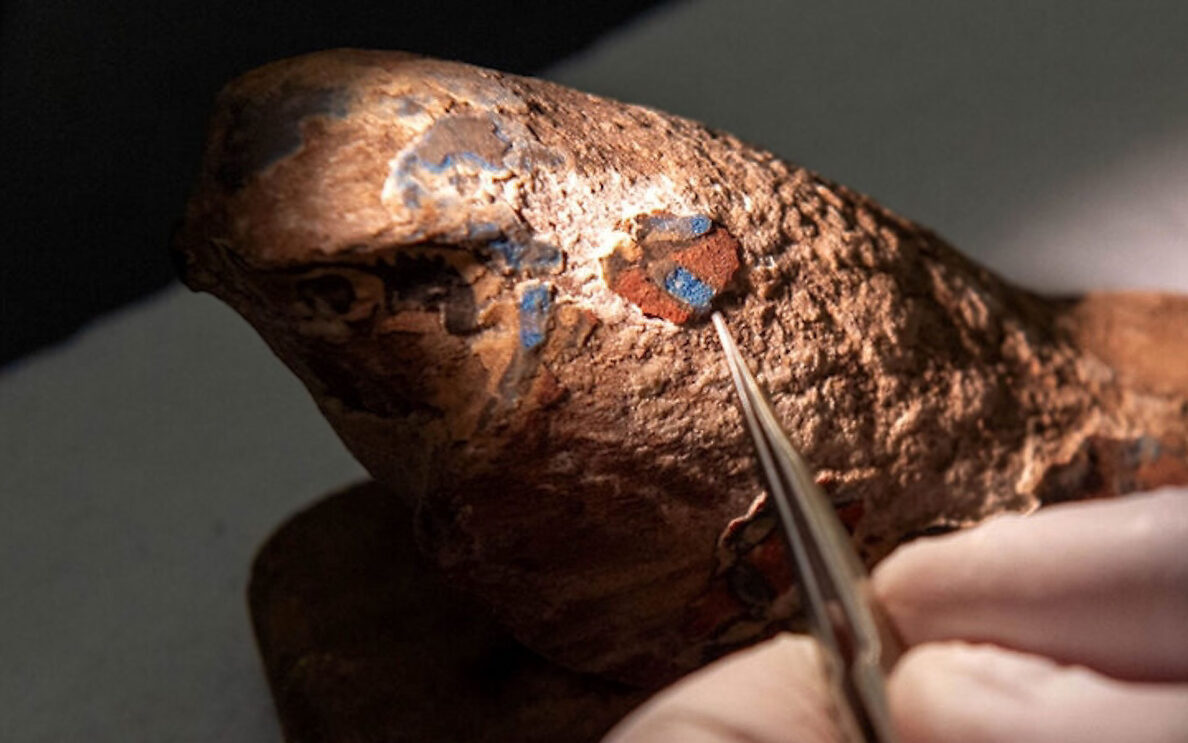
The world’s oldest synthetic pigment, Egyptian blue, had been lost to time.
That was the case until 2025, when researchers led by Washington State University successfully recreated the pigment used in ancient Egypt nearly 5,000 years ago.
The researchers used a variety of raw materials and heating times to develop 12 recipes for the pigments, providing useful information for archaeologists and conservation scientists who study the ancient Egyptian materials. The work was done in collaboration with Carnegie Museum of Natural History and the Smithsonian’s Museum Conservation Institute.
“We hope this will be a good case study in what science can bring to the study of our human past,” says John McCloy, lead researcher and director of WSU’s School of Mechanical and Materials Engineering. “The work is meant to highlight how modern science reveals hidden stories in ancient Egyptian objects.”
While Egyptian blue pigment was valued in ancient times, there is limited archaeological evidence of how it was made. It was used as a substitute for expensive minerals like turquoise or lapis lazuli and was used in painting wood, stone, and a papier-mâché-type material called cartonnage. Depending on its ingredients and processing time, its color ranges from deep blue to dull gray or green.
After the Egyptians, the pigment was used by Romans, but by the Renaissance period, the knowledge of how it was made was largely forgotten.
In recent years, there has been a resurgence of interest in the pigment because it has interesting optical, magnetic, and biological properties with potential new technological applications, McCloy says. The pigment emits light in the near-infrared part of the electro-magnetic spectrum that people can’t see, which means it could be used for things like fingerprinting and counterfeit-proof inks. It also has a similar chemistry to high-temperature superconductors.
Read more about Egyptian blue pigment.