
From his Pullman apartment, John Williams spent his Thursday mornings last spring interacting with people from all over the world.
Brokering a deal in India typically starts with pleasantries exchanged over a cup of tea, the Washington State University junior learned as part of his online International Relations and Global Leadership class.
Saudi Arabia values its strategic partnerships with the United States and the European Union, but also works with Russia and China.
 Courtesy John Williams
And China—with its large, upwardly mobile population—is a valuable market for American beef, soybeans, and other US agricultural exports.
Williams appreciated the chance to hear people from other countries discuss business, trade, and political systems. “I want to work for a multinational corporation or start-up, so I was looking for that broader global perspective,” he says. “This has been my best class for that objective.”
Not everyone gets to do a study abroad or travel internationally, says Dipra Jha, an associate dean and faculty member at the Carson College of Business, who teaches the class.
“So we’re bringing the world to the classroom, allowing students to hear different perspectives and voices,” he says. “It’s more meaningful to students than me lecturing from a PowerPoint.”
Jha, who joined WSU in 2020, draws on his extensive network to recruit speakers. New this year was Saudi Arabia’s permanent representative to the United Nations, who discussed the country’s 80-year relationship with the United States, along with energy and tourism initiatives.
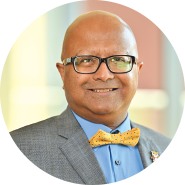 Dipra Jha (Photo Robert Hubner)
Jha had taught the diplomat’s daughter during a semester at César Ritz Colleges in Switzerland. A speaker from the East African island nation of Mauritius is an acquaintance through a mutual friend.
WSU students also interacted with students from universities in Kosovo, Ukraine, and the republic of Georgia, who joined the class with their professors through a collaborative online learning arrangement. The classes started at 7:45 a.m. Pacific Time to accommodate a variety of time zones.
About 40 percent of the jobs in Washington state are tied to international trade. “This class gives our students the opportunity to understand how the world operates,” Jha says. “If they’re going to have an internationally engaged career, they’ll need to be able to work with people from other countries.”
The way people conduct business in the United States, “where communication is direct and time is sacrosanct,” won’t necessarily work in other countries, he says.
Ashish Dahiya, a professor at Maharshi Dayanand University in India, told students that professional relationships in his country are often built on personal rapport. Something as simple as having a cup of tea together plays a meaningful role in establishing trust and respect.
Students also need to know that patience is a virtue in Indian culture. Decisions are made by consensus. Respecting hierarchy within organizations is the norm. And while meetings might start late, they’re usually very productive once they get going, Dahiya says.
“People appreciate knowing that you understand a few of their cultural norms,” Jha says. “Most of the world is forgiving if you make some stumbles, but it’s good to learn from your mistakes.”
Other speakers talked about the value of international trade for US agriculture. Soybeans, corn, beef, dairy, and pork are important export commodities for Midwest growers, while Washington state is a top agricultural exporter for apples, wheat, and other fruits and vegetables.
Williams says the class got him interested in a study abroad in Asia. He’s also considering Spain, where he could refine his Spanish language skills. Being in class with students from other countries, particularly Ukraine, was also eye-opening, he says.
“The students from Ukraine talked about what’s going on in their lives,” Williams says. “It was nerve-wracking when we learned their professor had air-raid sirens go off during a lecture.”
It’s important that students learn to connect the dots between world events and the economy, Jha says.
“How does the war between Ukraine and Russia impact global wheat prices, and ultimately the cost of baked goods at Safeway?” he says. “It’s a big epiphany for many of our students, because they haven’t thought about these things.”