
If one thing can be said of Kirk Schulz’s service as president of Washington State University, it’s this: It was never dull.
Schulz arrived in Pullman in 2016 after the untimely death of the previous president, Elson S. Floyd. Almost immediately he had to grapple with budget deficits and ongoing efforts to open WSU’s new medical school. Next up, a global pandemic disrupted education for more than a year and led to enrollment declines. Then, as that crisis eased, WSU’s historic athletic conference, the Pac-12, imploded.
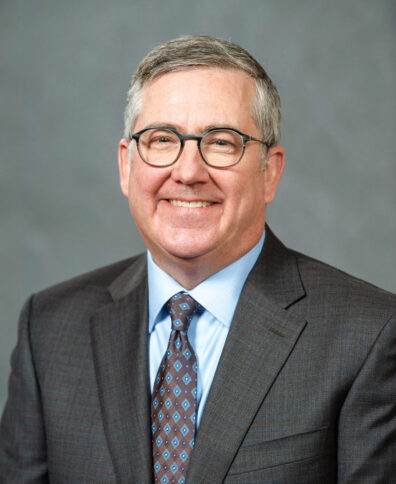
Any one of those challenges would have defined a university presidency. But all of them?
“There might have been a few more big events than most university presidents would encounter over a nine-year period,” Schulz allows. But in rereading a book about his predecessors at WSU, Leading the Crimson and Gray, he says he was struck by the fact that most presidents faced some upheaval, from war to campus riots.
Schulz was prompted to reflect on his presidency as he transitions out of the job. On April 1 he stepped into the role of senior advisor to new WSU President Elizabeth Cantwell. On June 30 he’ll begin a yearlong sabbatical where he plans to write and be available to consult with Cantwell as needed. After that he’ll officially retire from the university.
Despite the headwinds of his tenure, Schulz was able to effect significant change. Among the most permanent are buildings on WSU campuses across the state.
WSU Vancouver has a new life sciences building, completed in 2024. Collaboration Hall at WSU Tri-Cities opened in 2021 adding classrooms, teaching laboratories, and study areas. At WSU Health Sciences in Spokane, an existing building was substantially remodeled to house the Elson S. Floyd College of Medicine.
And at WSU Pullman, a state-of-the-art Washington Animal Disease Diagnostic Laboratory opened in 2021; the Taylor Sports Complex opened in 2024; and construction is underway on two buildings to open in 2026, the USDA Agricultural Research Service’s Plant Biosciences Research Building and Schweitzer Engineering Hall.
Schulz also brought new rigor to budgeting processes at WSU, helped along by a $30 million project to modernize finance and human resource systems across the university. That modernization project “will be a benefit for the next three presidents,” Schulz says.
He helped build WSU’s presence in Africa, where the university has taken a leading role in battling infectious diseases and food insecurity.
He reorganized campus leadership, appointing a chancellor for the Pullman campus. That move freed him to spend more time at WSU’s other campuses promoting greater cohesion among them and forging relationships with stakeholders statewide.
Schulz was visible to the WSU community. He visited every college and campus each year for town halls where he and other administrators laid out successes and challenges, and fielded questions from faculty and staff. During the pandemic he hosted frequent online Q&A sessions. He attended football games, of course, but also made a point to be in the stands for other WSU sporting events, like tennis and track and field.
Schulz has said that the enrollment decline sparked by the pandemic was one of his most difficult hurdles.
But the sudden collapse of the Pac-12 tested his equanimity in ways that other challenges hadn’t. That process saw Schulz, ever the diplomat, going public with disappointments and disagreements. Even so, he buckled in and worked with Oregon State University to rebuild the conference almost from scratch.
There are things he wasn’t able to accomplish. He would have liked to have made more progress on the “One WSU” initiative to more closely align WSU’s statewide campus operations, for example.
But on the whole, he’s satisfied.
“I feel like I’ve left my mark. I’ve been able to hire great people, and we’ve had a lot of positive accomplishments,” Schulz says. “I feel blessed to have served as president of Washington State University.”
Letter from Kirk Schulz
By the time you read this, I’ll have stepped into a new role at Washington State University and turned over the presidency to Elizabeth Cantwell.
Leading Washington State University for the past nine years created great memories and reinforced lessons I’ve learned during my career. I reflected on both as I prepared for this transition.
Among the fun memories is when College GameDay came to Pullman. I remember leaving the house before dawn and could already hear the thousands of people gathered on the other side of campus. Then two years ago, the WSU women’s basketball team beat UCLA to win their first-ever Pac-12 tournament championship.
I got to work with nine amazing student Regents during my time here, and with world-class faculty, five of whom were inducted into national academies.
The COVID-19 pandemic was a hurdle, but I’m proud of the way we pivoted to online education in a matter of weeks. Faculty, staff, and students rolled up their sleeves and got the job done, the way Cougs do.
Some of my warmest memories are of the WSU alumni I’ve had the privilege to meet. In packing up my office I came across the coin given to me by Ronald J. Schurer, a Congressional Medal of Honor winner who we honored at the Apple Cup in 2018. Ron had cancer and died in 2020, but the time I spent with him and his young family sticks with me to this day.
As for the lessons, leading an academic enterprise based on shared governance is unique. You don’t dictate, you collaborate.
So, most importantly, be kind. Being a decent human being to those around you helps build the goodwill you’ll need when things go south, as they inevitably do.
Tell people when they’re doing a good job. Everyone, at every level, appreciates hearing it.
A leader also has to create an atmosphere where bad news can be delivered without fear, or else you won’t see the complete picture.
And everyone has strengths and weaknesses; celebrate the strengths and don’t spend too much energy on the weaknesses.
Finally, intercollegiate athletics is the proverbial third rail for university presidents, the thing that could jeopardize your ability to lead the institution. It’s a balancing act that involves the interests and needs of alumni, faculty, staff, students, athletes, and donors.
I can’t say I’ve always succeeded, and there are things I wish I could have accomplished. But I always felt like the WSU community had my back.
I ask you to give President Cantwell and her family the same warm Coug welcome you gave Noel and me when we arrived in 2016. Give her your support and your trust, and WSU will continue to do great things.
—Kirk Schulz