
In a basement room, Monique Slipher unwraps odd fungal forms: fingerlike organs, tentacle-studded galls, and the dried remains of “zombified” fungal-infected insects.
Slipher curates the Charles Gardner Shaw Mycological Herbarium, a vault of more than 76,000 fungal specimens kept for teaching and research to aid human health, agriculture, and the environment housed at Washington State University Pullman. Fungi of all shapes and sizes are preserved, from the cute to the eerie.
“Fungi are more like animals, in some ways, than plants,” Slipher says. “The colors, the shapes, the lifestyles are weird. To human conceptions, they’re kind of strange.”
Few people know of the herbarium, which Slipher has managed for the past decade. She considers herself a librarian of fungi, keeping specimens organized and records accessible in an online database.
Alphabetized by genus and species, specimens are kept in boxes, vials, and envelopes in a climate-controlled room at Vogel Hall. Scientists consult these specimens to identify and understand past and present organisms and are beginning to sequence DNA from them to assist research into crop disease resistance, ecosystem health, and climate resilience.
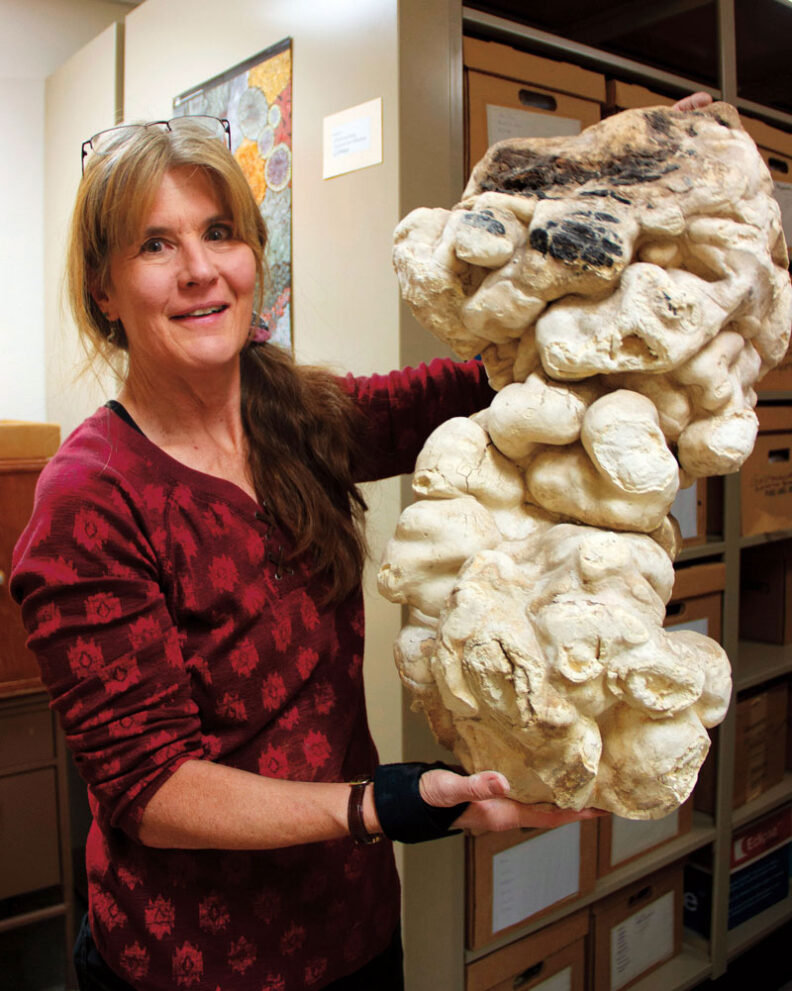
“The Shaw Herbarium is a treasure trove of biological and chemical diversity,” says Jana U’Ren, herbarium director and assistant professor in the Department of Plant Pathology. “It’s a time capsule of organisms we may no longer see as climate and forests change. Many may become extinct or at least very rare.”
Nearly every herbarium specimen is a fruiting body—a reproductive organ, akin to the typical mushroom. The real body of the organism is the mycelia, non-reproductive tissues that form a network of hairlike threads. These hyphae burrow through leaf litter, soil, living and dead plants, and even insects to find or decompose food. Only when fungi are ready to reproduce do they sprout fruiting bodies, which launch spores to seed the next generation.
Many fungi have different life stages, moving back and forth between hosts. Cedar apple rust causes its hawthorn hosts to make galls, swellings from which tiny, tentacle-like fruiting bodies emerge. Black knot, which wraps a black crust around cherry and plum branches, can be frequently found on wild or unkempt trees.
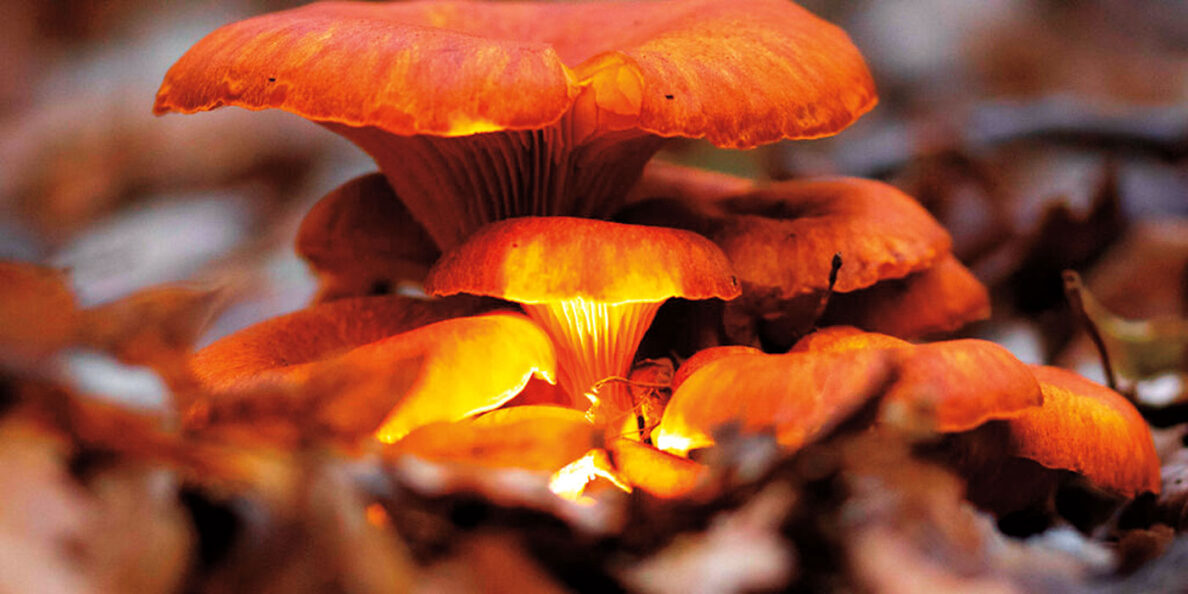
“Working here has made me more aware of the amazing diversity of fungi,” Slipher says. She brings out an earthstar fungus, whose petal-like extrusions resemble an alien egg, and a jack-o’-lantern fungus, with an orange cap the color of a pumpkin when fresh.
“If you see a fresh one out in the woods, you may notice that the gills glow green in the dark,” she says. “But they’re poisonous, so don’t eat them!”
Packets of dead insects contain some of the so-called zombie fungi made famous by the video game and streaming series The Last of Us. Some species infect insects, changing their behavior to favor the fungus, which eventually erupts as a fruiting body.
Among visual materials is an enlarged microscope image of a predatory fungus, Arthrobotrys conoides. It has coiled a loop around a microscopic worm and is devouring it from the inside out.
“Isn’t that creepy?” Slipher says. “And so cool!”
U’Ren’s favorite fungi are the forest dwelling Xylaria, which include Xylaria polymorpha, or “dead man’s fingers.” These fruiting bodies sprout from beneath decomposing logs in clusters that resemble grasping claws.
“Some people think they’re spooky,” U’Ren says. She finds them charismatic and studies their dual, hidden lives.
Xylaria begin their journey as spores that enter openings in tree leaves, where they hide unseen for months. The fungus isn’t causing disease in the plant and seems to be simply a houseguest.
“They don’t go into the cells; they go between them,” U’Ren says. “There’s some debate about what they’re doing inside. We don’t know how they’re communicating with the plant.”
When the leaves fall, the fungus starts its second life in the litter, growing and feeding before sprouting its telltale fingerlike fruiting bodies. Rain splashes spores back up onto the leaves, and the cycle begins again.
Working to understand how fungi like Xylaria interact with their hosts, U’Ren has genotyped hundreds of species and isolated more than 17,000 cultures of plant-associated fungal endophytes that dwell incognito in leaves.
“You can’t see them, but inside there can be dozens of fungal species, many new to science,” she says. “I use DNA sequencing to learn who these fungi are and how they fit into the fungal tree of life.”
Many fungi, including the Xylaria genus, produce bioactive compounds that hold potential for health, including use as antimalarial or cancer-fighting drugs. Others make insecticidal compounds that could be of use to agriculture.
“There’s evidence that some endophytic fungi provide plants with resistance to drought and climate stress,” she says.
Fungi support the microbiome and contribute to a healthy ecosystem, plant productivity, and the food web. For U’Ren and Slipher, there is still much to learn from them in the wild and within the herbarium.
“These collections aren’t just dusty specimens sitting in a box,” U’Ren says. “They’re a huge resource for science.”
More about the Shaw Herbarium
Charles Gardner Shaw Mycological Herbarium — search the collection and read about the history