
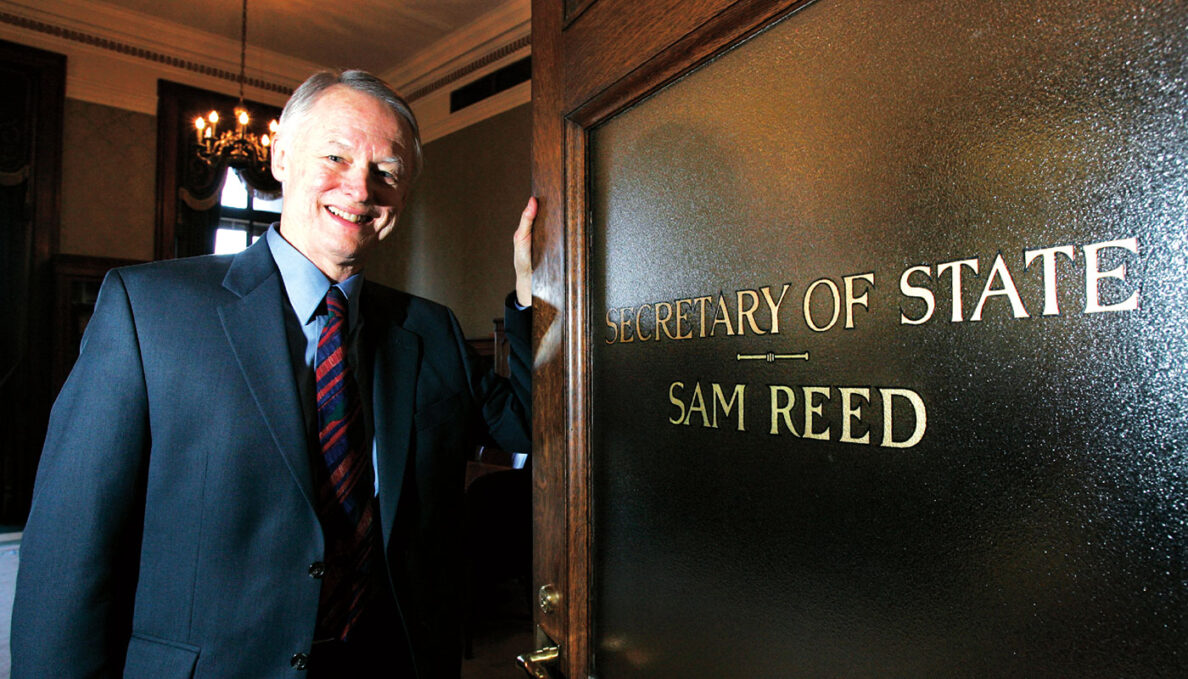
A day or so after Sam Reed was sworn in as secretary of state the first time, a group of enthusiastic Washington State University students showed up at his new office to lobby on behalf of his alma mater. “No one could walk into my office and not know about my WSU connection,” Reed says.
His framed diplomas hung on the wall, along with a distinguished alumnus award from his Kappa Sigma fraternity chapter. Photos and other memorabilia dotted the room. But it wasn’t only his crimson-and-gray decor that earned him the nickname “the Cougar in the Capitol.” In Olympia, notes Reed (’63 Soc. Stud., ’68 MA Poli. Sci.), “there are quite a few Huskies. I made sure to be very assertive about my position, and we enjoyed the banter back and forth.”
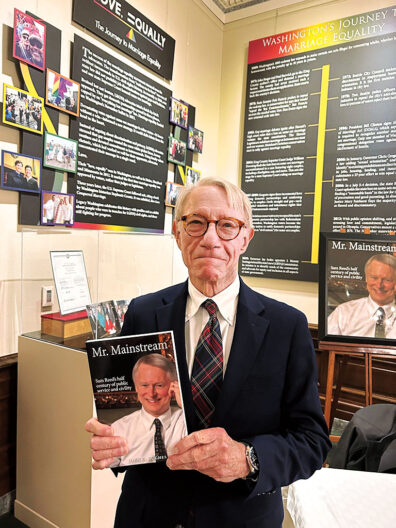
Reed’s half century of public service is detailed in the new book Mr. Mainstream. It describes his early life, studies in Pullman, positions he’s held, and the way he’s served. His guiding principles: civility, moderation, and bipartisanship.
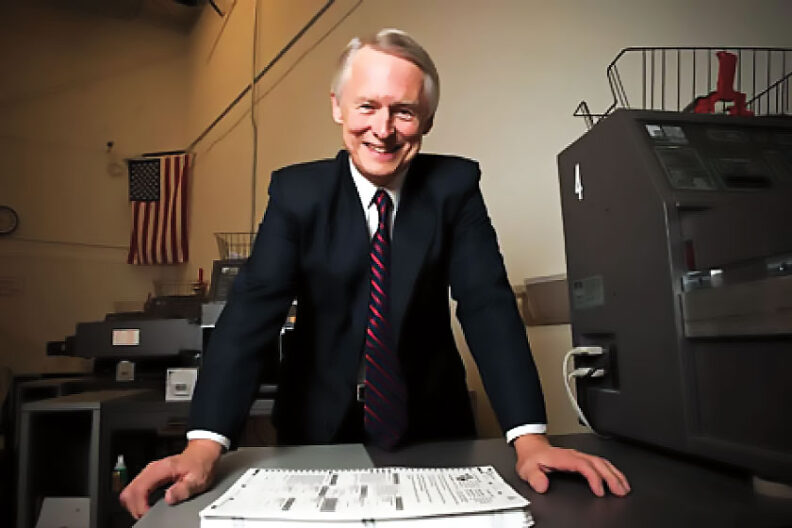
“I felt that when you run for office and you’re elected, you’re serving all the people, not only the people who voted for you. It’s incumbent upon you to be very fair and very balanced in your governance,” says Reed, a Republican who served from 2001 to 2013 as secretary of state. In that role, he was the state’s chief elections officer, chief corporations officer, and supervisor of the Washington State Archives.
“I fought the Democrats when I thought they were wrong. And I fought the Republicans when I thought they were wrong,” he says in the book.
Published in 2024 by Legacy Washington of the Office of the Secretary of State, the slim but well-researched volume covers recent Washington state history in which Reed was heavily involved: the controversial Chris Gregoire–Dino Rossi gubernatorial recount, the saving of the Washington State Library, and the creation of the country’s first state digital archives. It’s written by former journalist John C. Hughes, who joined the Office of the Secretary of State as chief historian in 2008 after 39 years at the Daily World in Aberdeen.
Throughout the project, the two men sat down for several in-depth interviews and shorter follow-ups, says Reed, who retired in 2013 and turned 84 in January. Work on the book, delayed by the COVID-19 pandemic, started in 2020.
“It was a great honor and privilege to serve the people of Washington as secretary of state,” Reed says. “I’m eternally grateful, and I want to share that with other people who are interested in public service.”
The milestone that he says brought him the most visibility in his 45 years in public service—including 35 as an elected official—was conducting the 2004 Gregoire-Rossi recount, “the closest gubernatorial election in the history of the nation in terms of percentages.” Rossi, a Republican, was declared the winner in the first two automated counts. After a third count, this time by hand, Gregoire, a Democrat, won by 129 votes, or 48.873 percent compared to Rossi’s 48.868 percent. Rossi didn’t concede until June 6, 2005, five months after Gregoire was sworn in that January 12.
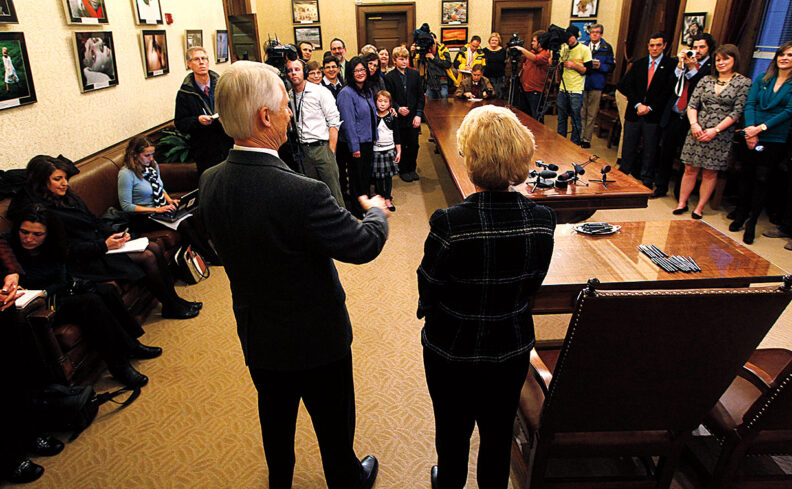
(Photo Elaine Thompson/Associated Press)
“It went back and forth,” Reed recalls. “Both parties were angry with me at some point. I was just getting hit by every side, and the news media was after me all the time. I was getting calls at six in the morning until eleven at night. I was asked by the news media at some point: How are you sleeping at night? The answer was I sleep fine because I know how to do a recount, I am doing the right thing, and I’m doing it fairly. In the end, I received several awards for it.”
Another moment of which he is proud took place in 2002, his second year as secretary of state. “For reasons I still don’t quite understand, Governor Gary Locke decided to close the Washington State Library and disperse the books to universities and colleges,” Reed recalls. “I used the library a lot, so I spoke up. I wrote an op-ed column for the Seattle Times.” Reed was able to get the management of and budget for the Washington State Library moved to the Office of the Secretary of State, where it remains.
“To this day, I have people walk up to me in the street or sometimes when I am working out and say, ‘You’re Sam Reed, aren’t you? I just wanted to thank you for saving the Washington State Library.’ Of all the things I did, that’s the one people are still thanking me for,” Reed says.
He also championed a bill that led to the creation of the state’s digital archive, which—in a full circle moment—Hughes used in his research for the biography.
Reed, known for his fairness, names Governor Dan Evans among his role models.
Reed was working in Olympia as a young man when Evans taught him what he calls “a great lesson.” Reed was “really hot” over Democrats’ reaction to proposed legislation and suggested an aggressive response. But he recalls Evans telling him, “You have to respect their position. You have to handle this in a civil way. In the long run, that’s what’s going to get you results.”
That advice became the bedrock of his tenure. “I never introduced a bill as secretary of state that did not have both Democrats and Republicans on it, and I tried to get an even number,” Reed says. “That’s one of the reasons I was successful. If you’re going to get something done on a permanent basis, you need to work on a bipartisan level.”
Assistant secretary of state and longtime friend Steve Excell is quoted in the book, saying, “He left the agency stronger than when he arrived. That’s what you’re supposed to do when you’re elected to public office.”
Reed grew up in Wenatchee in a Presbyterian family of dedicated Republicans. Sam Sumner, his grandfather, was an attorney who chaired the Washington State Republican Party, served in the state House of Representatives, and was elected prosecuting attorney of Chelan County. He had a profound influence on the future secretary of state. “We’d go over for Sunday dinner and he would tell us stories from his life and about the Constitution and Theodore Roosevelt. Politics was his highest calling, and you might think, Well, wouldn’t that be boring for kids? But he had a way of telling stories and talking about America that was so inspiring.”
Reed arrived in Pullman in 1959, the same year Washington State College became Washington State University. He joined the Kappa Sigma fraternity, of which famed broadcaster Edward R. Murrow (’30 Speech) also had been a member. In 1962, Reed learned Murrow was slated to give WSU’s commencement address and wrote him a letter, inviting him to have dinner at the fraternity. “He came and had dinner with us, and then we went into the living room and sat and talked for hours about World War II, the Blitz in London, Winston Churchill, Joseph Stalin, and Franklin D. Roosevelt. It was just amazing,” Reed recalls. “That evening was just very, very inspiring to me.”
Reed is a member of the advisory board for the Thomas S. Foley Institute for Public Policy and Public Service at WSU, the namesake and advisory committee chair for the Sam Reed Distinguished Professorship in Civic Education and Public Civility, and the recipient of the Alumni Achievement Award, the highest honor presented by the WSU Alumni Association.
In retirement, he has also chaired the boards of directors for the Olympia Arts and Heritage Alliance, YMCA Youth and Government, TVW, Thurston County Mainstream Republicans, and Mainstream Republicans of Washington. He describes the last two groups as “the moderates of the party. We recruit candidates, help with fundraising, and offer mentorship. I’m very experienced in campaigns and can coach them and line up endorsements.”
According to the book, “Reed is confident the center will again regain its equilibrium. … Reed notes that the pendulum swings routinely in American politics. ‘As it swings back from populism worldwide, the traditional principles of the GOP will prevail once again,’ he predicts.”
Reed remains active in the Kiwanis Club in Olympia, where he lives with his wife Margie. They have two adult children and two grandchildren. He stays physically active, playing tennis and working out three times per week.
And he’s proud to keep connected to WSU. “My years at WSU are so important to me and mean so much to me,” he says.
Learn more
Watch: Inside Olympia: “Mr. Mainstream,” Sam Reed (TVW, November 7, 2024)
From the archives:
Civility in politics and campaigns (Winter 2010)
Gallery: Washington Secretary of State Sam Reed’s office
Opinions: Sam Reed and Sam Hunt in the 1966 Daily Evergreen (Winter 2010)