
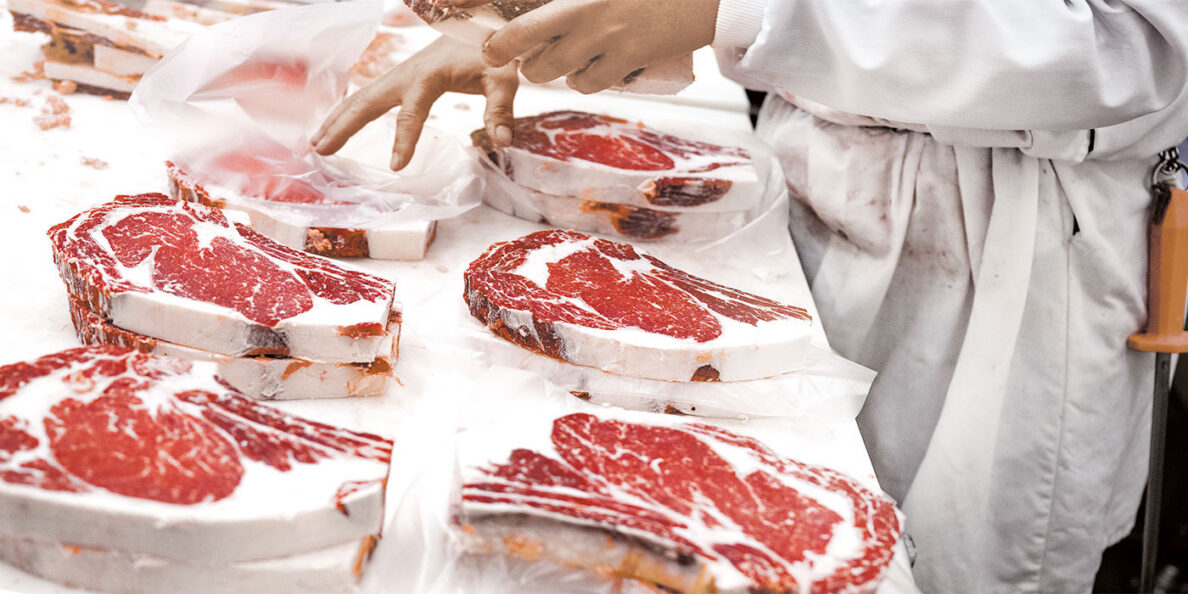
Cougar Quality Meats is full of customers on Thursday and Friday afternoons. They leave the small retail shop with ribs for the grill, brisket for the smoker, steaks for a special dinner, or packages of hamburger and bacon for their freezers.
Open two days per week, Cougar Quality Meats is the public face of Washington State University’s USDA-certified meats lab. While customers know it as a go-to place for locally sourced meats, the WSU Pullman lab has a much larger mission of teaching students about meat science.
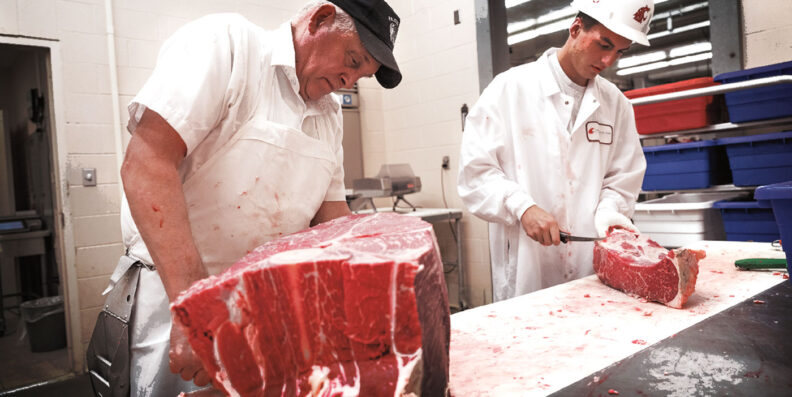
“Washington has a robust livestock and meat industry, particularly for the region west of the Rocky Mountains,” says Blake Foraker, a former assistant professor in the College of Agricultural, Human, and Natural Resource Sciences who is now at Texas Tech University. But with an increasingly urban population, fewer US consumers have direct experience with food production, especially as it pertains to livestock, he says.
“Meat production has become a mystery to many consumers,” Foraker says. “Some people think inhumane practices are involved. That couldn’t be further from the truth. We do things very much the right way to produce these animals and not only honor their life but honor the meat products they provide.”
In the lab’s classrooms, students learn about animal care, feeding, genetics, and meat traits important to the consumer experience, such as flavor and tenderness. The beginning meats class focuses on carcass evaluation and the metrics that determine the market value for three major livestock species: cattle, hogs, and sheep.
“They learn how to evaluate animals in terms of their market readiness, such as fat deposition, muscularity, and weight,” Foraker says. “Then they learn how those traits define the value of the animal and its meat products.”
The classes’ applied nature makes them favorites of students, whether or not they plan to work in the meat industry. Foraker gave weekly anatomy quizzes and, for one of their assignments, students in the advanced class selected a lesser-known cut of beef, researched how to prepare it, and cooked for their classmates.
Ashley Gunning (’23 Ani. Sci.) started WSU on a pre-veterinary track but was looking for other career options when she took a class at the meats lab and competed on WSU’s award-winning meat judging team.
“It opened my eyes to the animal sciences community and the variety of jobs it supports,” says Gunning, who works at a cattle-related research and development facility in Parma, Idaho.
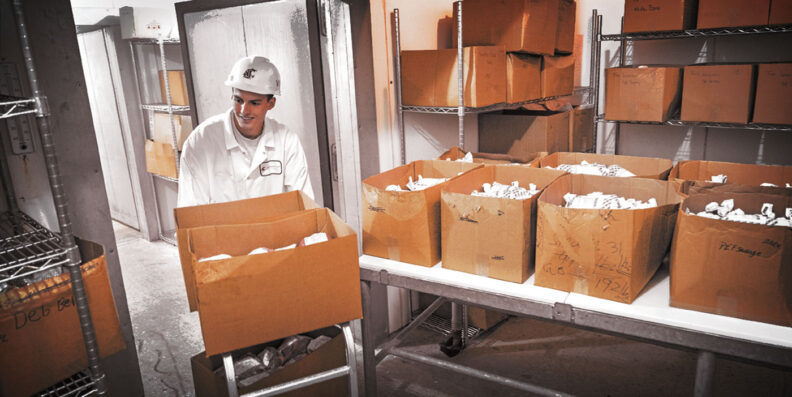
At WSU, she also worked part-time in the lab’s processing facility under General Manager Dan Snyder, packaging and labeling meat. When Snyder, a 38-year WSU employee, started working at the university, many of his student employees grew up on farms, but that’s increasingly rare. Now most come from urban backgrounds.
“I hope they learn as much as possible,” Snyder says of the student workers. “They help put equipment together, debone meat for ground beef, grind and package it, and wrap cuts for retail sales. By the time we finish up, they understand how much work goes into this.”
Nearly 500 animals were processed last year in the lab, which has its own USDA inspector. Beef and pork account for the majority of Cougar Quality Meats’ sales, with occasional sales of lamb. The lab also works with the local Muslim community, which orders halal meats processed according to specific requirements.
“I had never thought about what goes into processing meat and how we classify it for sale,” says Grace Lieuallen (’23 Ani. Sci.), who was also a meats lab student and judging team competitor. Now in her second year of veterinary school at WSU, Lieuallen says, “It helps you understand what producers value. And that knowledge is good to have in my repertoire.”
Cougar Quality Meats is open from 3-5:30 p.m. Thursdays and Fridays, 2155 Wilson Road, east of the Lewis Alumni Centre, in Pullman.