
First, cook the onions.
This simple instruction starts innumerable recipes. Whether cooking onions until just translucent or golden or brown or fully caramelized, this step marks the beginning—of soups, sauces, stews, stir-fries, braises, casseroles, and more.
“It is hard to imagine a civilization without onions; in one form or another their flavor blends into almost everything in the meal except the dessert,” wrote culinary legend Julia Child.
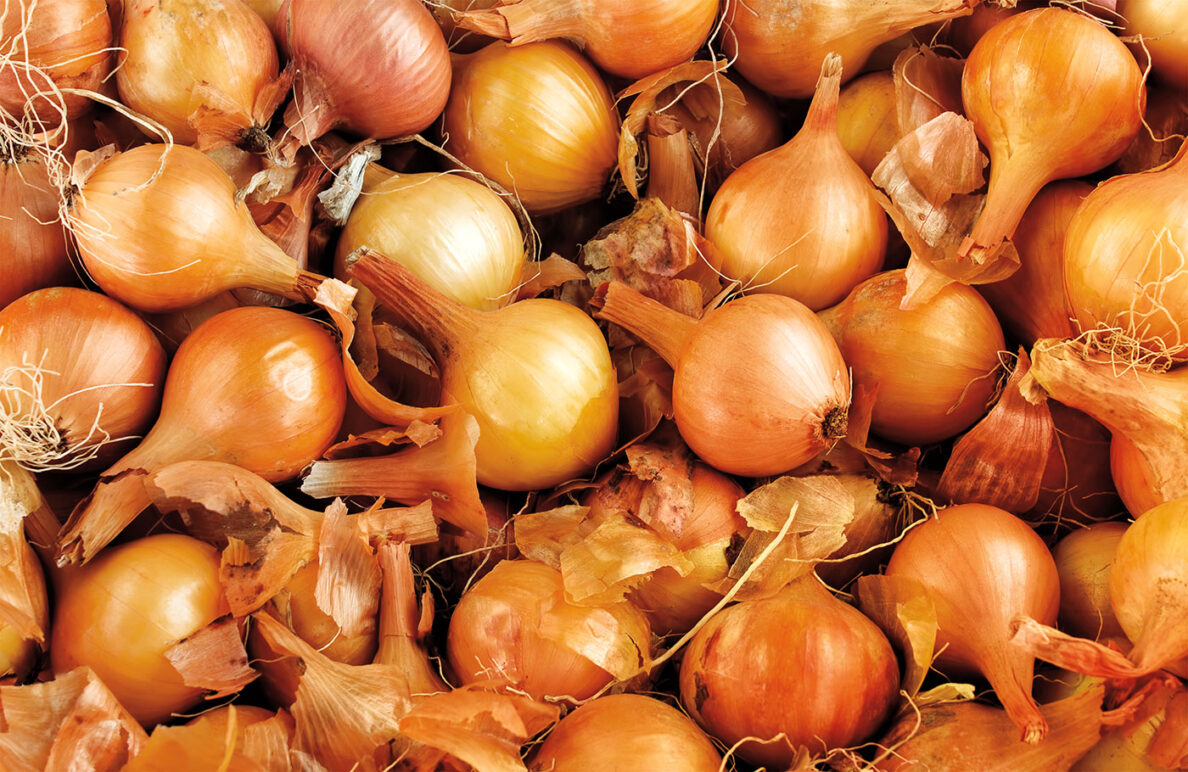
Almost everything, it seems, starts with onions. Yellow onions, to be precise.
Yellow onions make up a majority of this country’s onion crop—approximately 85 percent, according to the National Onion Association. They are most popular for good reason. Yellow onions are quite possibly the perfect flavor builder. The humble bulbs lend richness, depth, and complexity to oh-so-many savory dishes.
“I like nothing better than to have the smell of cooking onions in the kitchen. It’s the best. That’s what I want my kitchen to smell like,” says Brad Jaeckel, manager at Washington State University’s Eggert Family Organic Farm. The farm grew yellow and red onions for 18 of the 20 years he’s been in charge. He also grows his own yellow onions in his home garden. His household typically goes through 50 pounds of yellow onions during a winter.
Americans annually eat about 20 pounds per person, making onions among the most consumed vegetables in the country. While not as potent as garlic, they belong to the same family—along with leeks, chives, and shallots. And they are incredibly versatile.
“If I don’t know what to cook, I’ll just start cooking an onion and go from there,” Jaeckel says. “It could be a pasta dish. It could be a Mexican dish. It could be an Asian dish. Anytime I’m going to make a stir-fry, I always start with an onion.”
Washington state is one of the country’s top four onion producers, along with Oregon, Idaho, and California. Together, the three Pacific Northwest states account for more than half of the onions produced in the United States. WSU plays a major role in onion research, hosting an annual Onion Field Day, which draws researchers and commercial growers to evaluate cultivars. Its current onion variety trials date to the mid-1980s. For home gardeners, WSU Extension provides planting and storage information and tips.
Yellow onions are harvested in mid-August. With the exception of sweet onions, like Walla Wallas, they store extremely well. In fact, they’re often referred to as storage onions. They’re keepers—if you treat them right. That is, store them in a cool, dark, dry, ventilated place.
Grandma grew her own, cultivating rows and rows for decades, and keeping the hardy and robust amber-brown globes in wooden bins in her garage. They lasted all winter. And winter is when we need the essential yellow onion the most.
It’s the base upon which belly-warming, cold-weather, often one-pot dishes are built. It’s one of three ingredients found in the French culinary foundation of mirepoix, along with carrots and celery, and the bulk of the famed fragrant “holy trinity” of Cajun and Louisiana Creole cuisine—with a ratio of two parts onion to one part bell pepper to one part celery. In modern Spanish cuisine, recipes are built upon aromatic sofrito, made up of garlic, onions, and peppers.
Although its exact origins aren’t known, the onion (Allium cepa), a member of the lily family, is believed to have originated in Central Asia or the Middle East. The National Onion Association notes onions may have been among the earliest cultivated crops, dating back some 5,000 years. Before that, wild onions were a dietary staple of prehistoric peoples.
Olympic athletes in ancient Greece prepared for competition by eating onions. The ancient Roman writer and philosopher Pliny the Elder noted 27 remedies featuring onions, which he believed cured everything from insomnia to poor vision and toothaches. Onions were funeral offerings in ancient Egypt, where they were painted on walls of pyramids.
These days, yellow onions are typically cooked in butter or oil. The more they cook, the more they mellow. Some cooks add brown sugar to speed up caramelization, but it isn’t necessary. In fact, fat isn’t necessary, either. Simply add small amounts of water, one to three tablespoons at a time, while cooking onions over low heat. This process isn’t difficult, but it is time-consuming—at least 45 minutes to an hour. And it’s imperative to watch the pot or, in this case, heavy-bottomed pan, and stir, stir, stir—not perhaps to the degree of stovetop risotto, but almost—to avoid burning the onions.
Add caramelized onions to burgers or patty melts, pasta or risotto, panini or grilled cheese sandwiches, mac and cheese, dips, or holiday stuffing. Use them to top steak, pizza, flatbread, crostini, bruschetta, cheesy polenta, or Polish or Italian or German sausage. Mix them into a quiche, frittata, strata, or other egg dishes.
Onions aren’t simply a side, condiment, or component in a dish. They can be the star. Consider French onion soup, stuffed roasted onions, or an onion tart or pie.
Onions are good sources of fiber, folate, and vitamins B6 and C. They’re also low in calories—unless, of course, they are battered and deep-fried. And who doesn’t love a hot and crispy onion ring—or six—or a bloomin’ onion?
Another plus: Onions are, like cabbage and potatoes, generally inexpensive. The famed Chilean poet Pablo Neruda, in “Ode to the Onion,” referred to the root vegetable as a “round rose of water upon the table of the poor.”
Disregard how its paper-thin skin is often used to illustrate shallowness. Think about the rest of the indispensable orb. Without that barely-there covering, the onion is the same through and through, pungent and
perfect.
The onion, as Neruda wrote, is “destined to shine.”
Web exclusives
Planting, growing, and curing yellow onions
From the archives
Onions (Winter 2012)
Walla Walla Sweets (Fall 2010)
Choosing the right onion—and some onion lore (Winter 2012)
Onions: Why do they make us cry? (Ask Dr. Universe)