
I write to express my appreciation for the life of Donald A. Dillman, professor of sociology and rural sociology, and former president of the Rural Sociological Society, who passed on June 14, 2024. Others will tell of his extraordinary career, the national and international acclaim his formulation of the “total design method” of survey research has received, his monumental contributions via books, scientific articles, research grants and contracts, leadership in university administration and professional organizations, unparalleled recognition through awards and accolades, and teaching and service to Washington State University.
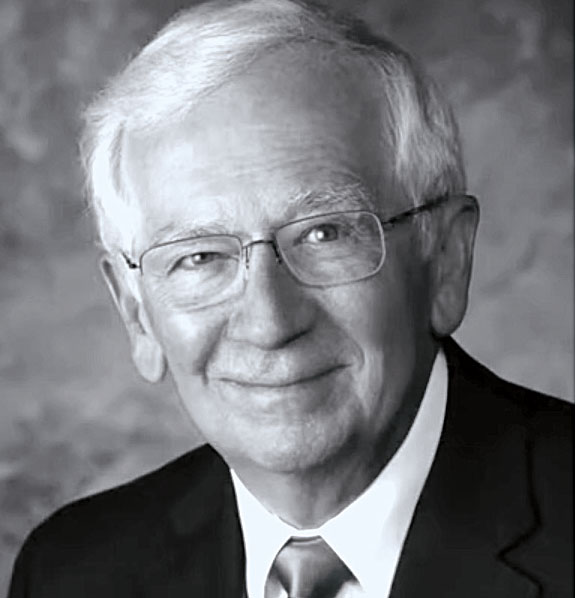
(Courtesy Simpson United Methodist Church)
Before it was recognized as a national imperative, Don Dillman, through his employment practices and support, promoted a rural sociology department dedicated to agriculture, environmentalism, and the impact of climate change on farming systems throughout the world. These are only a few of his immense accomplishments. He was my advisor, mentor, employer, and friend. He directed his influence not only to the highest levels of academia but reached down to those of us at the first step on the ladder.
My association with Dr. Dillman began nearly 50 years ago when I was struggling to complete my doctoral studies in sociology. I was a “walk on” graduate student, without a sponsor, without financial support, and with almost no direction to my academic career. Pursuing a serendipitous enquiry, I approached the Department of Rural Sociology at WSU to ask if any temporary work was available. A thin, slightly balding man about my own age, nicely dressed, wearing glasses, and evidencing his always pleasant demeanor—in contrast with my rebellious long hair, denim bell bottoms, and wrinkled shirt from my recent “California hippy days”—allowed me to interrupt his conversation with the department secretary to make my enquiry. She quickly informed me of the proper way to apply for funds and turned her attention back to her boss. He finished his talk with the department secretary and asked me to come to his office down the hall. The sign on the door indicated he was the department chair.
“Hi. I’m Don Dillman.” Those turned out to be the four most important words in my academic career and ultimately influenced the course of my personal life. He sat back and said, “Tell me a little about yourself.”
I related my rural Minnesota state college education resulting in degrees in English, three years of teaching experience, work in California following a 2-year Peace Corps stint, and my plan to escape the turn on, drop-out bent of my generation. Since arriving at WSU, I had worked in another college, taught in Chicano studies, written a pair of training grants, and completed most of the course requirements for a degree in sociology. Prelims and a dissertation remained to be accomplished. “I’m looking for a way to support myself while I finish my degree,” I said.
“Maybe I can help you. We have an incoming assistant professor who is bringing a contract to assess four agricultural leadership programs. He needs a research assistant. Would you be interested in that?” Yes, I certainly would. Subsequently, not only was I provided with full employment, but I was also accorded an opportunity to access a data set that allowed me to write a dissertation under the direction of Dr. Dillman, who graciously became my PhD advisor and the chair of my doctoral committee.
After submitting the first chapter of my dissertation to him, he said, “Ivan, this is a good beginning. Now, when you bring the next draft to me, it won’t look anything like this one, but it will have a lot more thought and care.” I got the message; my dashed-off first draft hit the wastepaper basket. Two years and several drafts later, he shook my hand and said, “Congratulations, Dr. Weir.”
I was used up, burned out, and at the end of my graduate employment. Academia had entered a period of retrenchment, so there were few jobs to be had. I broached my plan to recover with a retreat to the northern Idaho mountains to build a log house. “Not a good career move,” said my steadfast advisor. A year later, penniless and with only a few logs dragged out of the woods, I again approached Dr. Dillman, wondering if he knew of any employment prospects. Without the least bit of judgment or “I told you so,” he found funds to employ me while I applied for every conceivable academic position. At the same time, he put me in an office space with his very attractive project secretary.
My dozens of applications resulted in one invitation to interview for a job at a small eastern college. Just before I bought an airplane ticket, Dr. Dillman summoned me to his office. “Ivan, I’ve just finished talking to Dr. — upstairs who needs a project manager for a (million dollar!) research grant. Go upstairs to his office right now and talk to him.” I did and, thanks to my advisor’s promotion, was employed as a grant administrator for four more years during an academic employment depression. Also, during that time, Dr. Dillman’s very attractive project secretary became my wife and a few years later we had a wonderful daughter who has embarked on an impressive research and publication career herself.
Near the end of my four-year upstairs administrative gig, I was again staring at unemployment. In the nick of time, an opportunity mediated by the good graces of Dr. Don Dillman and his colleague, Dr. Robert Howell, became another stint in research administration on a national leadership study. There were two more years of full-time employment, successful publications, and a continuing round of applications with overly generous recommendations from my advisor and ever-so-accommodating chief mentor.
The computer skills and research experience gained from the prior jobs enhanced by Dr. Dillman’s never-ending faith, generosity and goodwill landed me a non-tenured job in Kentucky at the University of Louisville. Three years later, I moved to a position at a college in northern Minnesota. Dr. Dillman again helped me by coming to my new destination to present a master’s class lecture for the social science faculty explaining the theory and utility of his “total design method” of survey questionnaire construction. He helped solidify my entry into a permanent career job.
Dr. Dillman was the key enabling success factor at every stage of my academic career and was a major influence even since my retirement. While working, I used his total design method to construct dozens of surveys and as supporting evidence in applications for several research grants and evaluation contracts. He insisted on reciprocal research integrity—the understanding that respondents’ time is valuable and if the researcher is honest with them, they will supply honest answers to research questions. This precept not only guided his work but that of generations of students and colleagues he influenced. Research integrity, he taught, comes not from the pen but from the heart.
After I retired, I decided to write a book of autobiographical sketches for my daughter. I sent a copy to Dr. Dillman to show what I’ve been up to lately. He thanked me for the book and said it encouraged him to record some of his own seminal experiences. Finding non-academic writing enjoyable, I thought I would write a murder mystery novel and again sent a copy to Don. He wrote back that my book brought tears to his eyes. (I hope they were good tears!) On a writer’s high, I decided to try a second novel based on my Peace Corps experiences and sent a copy to Don. He wrote back that he loved the book and encouraged me to continue to write. Not a week later, he received his devastating health diagnosis.
I completed a third novel and hearing that his cancer was in remission sent a copy to Don who was planning a trip to Hawaii. He wrote he was putting a copy of my book in his suitcase and looked forward to reading it. He was gracious, to the very end. The last word I heard from him was spoken with his distinctive kindness and generosity.
Don Dillman was one of the nicest, charitable, and sincere men I have ever known. Not only did he help me at every important stage of my educational and professional career (not to mention trusting me with his beautiful secretary) but he did so with uncommon grace and selfless charity. It was the defining trait of his life.
I happened to run across him the day following the Mount St. Helen’s eruption which spewed ash across much of Washington state. Many of us fearfully watched a foot of ash fall like snow and were worried about the personal effects the pumice would have on our lungs, family, homes, cars, and physical well-being. Don was thinking about the devastation it represented for the farmers, loggers, and animals in the affected region. He was born and raised in the rural Midwest, absorbing the values and mores of Iowa agriculturalists whose whole existence is given to the health and welfare of others. That was his life. That was the Don Dillman I knew.
— Ivan Weir
Celebrating Don Dillman
Remembering international survey methods pioneer Don Dillman (WSU College of Arts and Sciences)
Video: Celebration of life for Don Dillman (August 23, 2024, Pullman, Simpson United Methodist Church)
From the archives
A century of WSU sociology (Spring 2024)
Video: The First Hundred Years of Sociology at WSU and Sociology’s Future at WSU with Dr. Don Dillman
Going postal (Winter 2017)
The survey expert (Fall 2002)