
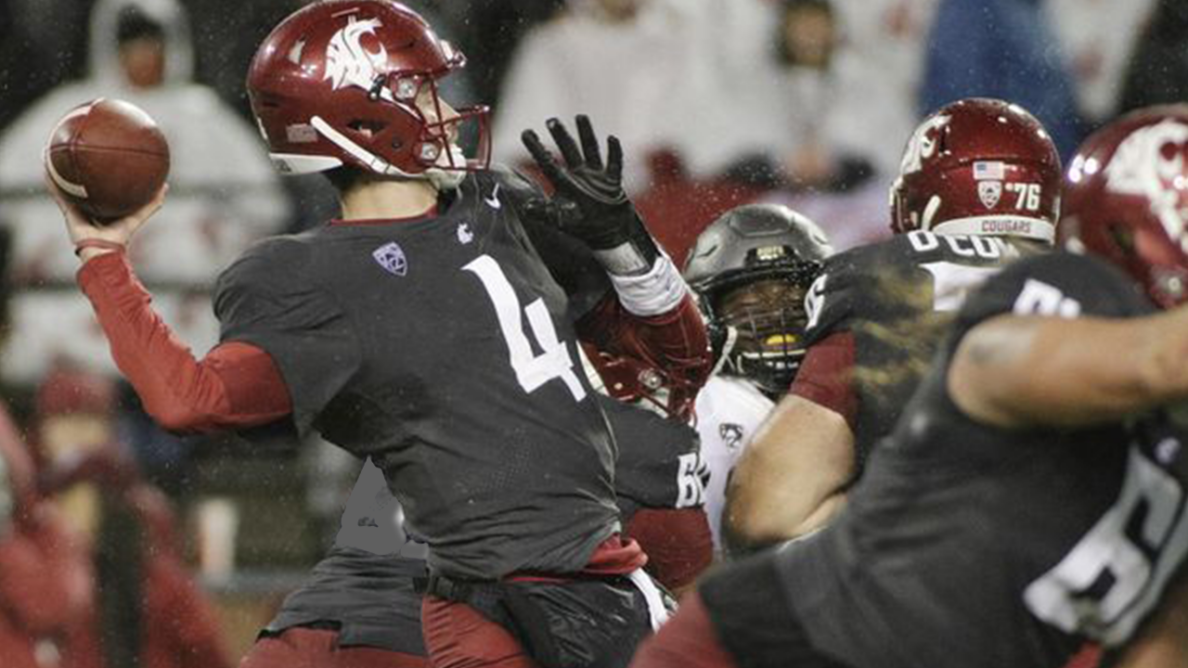
He was a fifth-string walk-on with a big dream.
The Washington State University freshman wanted someday to be the starting quarterback for the Cougs. But during the 2013 season on the football team—his first—he was redshirted. He was, he says, “invisible.”
A year later, Luke Falk (’17 Soc. Sci.) was the Pac-12 Offensive Player of the Week for the first of six times. He went on to start in 40 games, setting a WSU record with 27 wins. In 2017, his final season with Coug football, Falk won the Burlsworth Trophy, awarded to the nation’s top former walk-on.
These achievements were possible, he says, because he trained not only physically but mentally. “The most powerful skill is the ability to master your inner world,” Falk says. “It doesn’t come down to physical talent. It comes down to mind strength.”
After an abbreviated NFL career and a couple of years coaching college football, Falk is now focusing on sharing the secrets to his college-ball success: mind strength. He authored The Mind Strength Playbook: Master Your Mind. Elevate Your Game. (2025, Maison Vero), a self-development guide that underscores the need for athletes to train not only their bodies but their minds.
“Mind strength is the ability to master your inner world so you can handle anything the outside world throws at you,” Falk says. “It’s not about perfection. It’s a tool in your toolbelt.”
The Mind Strength Playbook offers strategies for mastering mental aspects of competition. It also provides behind-the-scenes perspectives on Falk’s journey from walk-on to Pac-12 star. In all, Falk appeared in 43 games and set records for both the Pac-12 and WSU, including throwing 14,486 passing yards and 119 passing touchdowns.
“Basically, I wrote this book for my younger self,” says Falk, now 31, a husband, and a father of a young daughter with a son due this summer.
In college, he says, “My identity was wrapped up in football and outcomes and achievement and what people thought of me. I had tremendous success, and then I quit doing the things worked for me and found myself very quickly booted out of the sport that I love.”
After short stints playing for the Tennessee Titans, Miami Dolphins, and New York Jets, Falk coached football at North Carolina’s Wingate University and the University of Northern Iowa.
In summer 2024, he returned home to Logan, Utah, and got to work writing a book proposal. By early 2025, he had an agent—and a total of seven chapters to write. The Mind Strength Playbook published October 24, 2025.
The entire process was “super quick,” says Falk, noting, “One of my favorite classes in college was a creative writing class,” taught by longtime WSU professor and nonfiction author Buddy Levy, who co-wrote a book with the late, legendary Mike Leach.
“Leach was a treasure,” Falk says of his former Cougar football coach who looms large in The Mind Strength Playbook. The manual highlights strategies Falk used when he was playing college football—including those developed by Leach.
“He was a guy who marched to the beat of his own drum,” Falk says. “He didn’t care about how people viewed him. He thought outside the box. He was brilliant. He was a master at being able to cut away the excess noise and get us to do our jobs.”
There’s plenty of “noise” facing collegiate athletes these days, Falk notes. With “NIL, the transfer portal, sports betting, social media, plus everything else that’s going on the world,” student athletes might need mind strength skills and support now more than ever.
According to a recent NCAA Student-Athlete Well-Being study, the number of college athletes reporting mental health concerns is one and a half to two times higher than before the COVID-19 pandemic. The survey, released in 2022, analyzed the experiences of nearly 10,000 college athletes. Mental health concerns were highest among women, student athletes of color, those reporting family financial hardship, and those identifying on the queer spectrum.
In 2019, a year before the pandemic, Falk was released from his last NFL team. “I went through a quarter life crisis,” he says. “I was 25. I was no longer getting 500 text messages after a game. I was wondering, ‘Who am I if I’m no longer playing football? What am I going to do now?’ Because I have these skills, I was able to handle it. It’s not about perfection. It’s about practice. So many people work on everything but their minds.”
Falk likens mind strength training to the repetition in exercises such as lifting weights or practicing yoga or habits such as brushing teeth. “If you don’t work on it daily,” he says, “it will rot.”
As a coach, he uses the strategies that worked for him as a player, the same strategies he highlights in his playbook. “They’re not my ideas,” Falk says of many of the tips in his manual. “They are things that worked for me, and I put them in a format that I think it accessible.”
They include suggestions from Craig Manning, author of The Fearless Mind: Five Essential Steps to Higher Performance, as well as Wayne Dyer, self-help author and motivational speaker, and John Wooden, author and famed UCLA basketball coach.
While Falk loved playing football, he says coaching is his true calling. He especially loves giving talks. “It’s like a performance for me,” he says. “It’s like having the opportunity to play on Saturday night again.”
He particularly enjoys talking with young people and, of course, student athletes. “I’m young enough where I joke with them and I can relate to them,” he says. “There’s a certain credibility there. I’ve been in their shoes. I know what it’s like.”
In those talks as well as in his book, Falk shares personal stories and doesn’t shy away from talking about his shortcomings. “My path was not all sunshine and rainbows. I was a kid who really struggled with insecurity,” Falk says. “I’ve also been very fortunate. I was able to have great mentors”—including Leach—“who could shift my mindset. It didn’t happen overnight. It happened over a period of time. But I’ve actually done what I’m talking about here, and I’ve done it at a really high level.”
In addition to the hard copy, an audio book and other digital resources are available as an online mastery program. The package includes coaching videos, exercises, guided breathwork, a pre-game visualization, quizzes, and the opportunity to earn a certificate of completion. “Most people read a book, gain knowledge, and never apply it,” Falk says. “The goal is to build a national mind strength movement, one that strengthens the inner world of the next generation so they’re prepared to thrive in an increasingly unpredictable external one.”
While student athletes, coaches, and parents of athletes are his main audiences, mind strength “is really for everyone,” Falk says. “It doesn’t matter if you’re a business owner or a single mom or a stay-at-home mom. These skills can help a lot of people. They’re universal truths, in my opinion. But if you don’t know how to apply them, they don’t do you any good.
“At some point,” Falk says, “whether you’re an athlete or somebody in business, you’re going to have a fork in the road. Are you going to rise to the moment or are you going to unravel?”
Read a review of The Mind Strength Playbook.
Listen to a conversation with Falk on the webisodes podcast.