
After many years of service, wildlife biologist Betsy L. Howell (’87 Wildlife Mgmt.) wrote about her calling in Wild Forest Home: Stories of Conservation in the Pacific Northwest (The University of Utah Press, 2024).
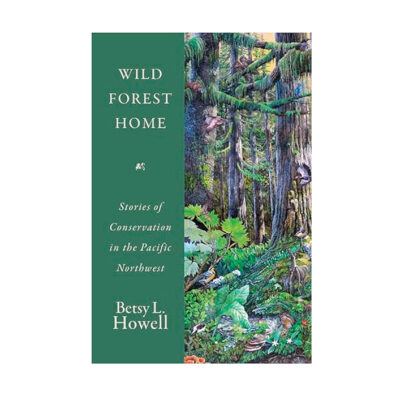
Howell talks with Washington State Magazine about her career, conservation, and time at Washington State University.
Talk about your time at WSU. How well did it prepare you for your career? Who were your mentors? What are your favorite WSU memories?
I feel like it prepared me quite well for a career with the US Forest Service. In addition to many classes on wildlife, I had a variety of other management-related classes focusing on forestry, range, recreation, soils, and botany. Working as a field biologist in national forests requires knowing a little bit about a number of different topics, so this diversity of coursework provided a great foundation for getting started with the agency. I remember all of the professors in the wildlife department very well, including Charlie Robbins (who is still at WSU), Margaret O’Connell, and Jim Hallett. Fred Gilbert was my advisor, and I remember him as a rather gruff mentor. Two things in particular that he told all of us in his advanced wildlife management class were: 1) habitat is the key to wildlife, and 2) wildlife management is all about people management. I recall some of us being doubtful about this last piece of wisdom but, of course, he was absolutely correct.
There are many wonderful memories from my years at WSU. Having grown up on the west side of the Cascade Range, I loved being in eastern Washington and in a smaller town. It was great to have snowy, cold winters and to explore the Palouse. One particular favorite memory was instigated by being at WSU but didn’t take place there. This was a trip I organized to see the University of Idaho’s research station at Taylor Ranch in the Frank Church–River of No Return Wilderness. I did this because I was writing my senior wildlife management paper (for Fred Gilbert’s advanced wildlife management class) on the population of mountain lions living in that area. I had met with Maurice Hornocker of the Hornocker Wildlife Institute at U of I and got permission to go to Taylor Ranch, which involved flying there from McCall, Idaho, in a small plane with skis. We landed on frozen Big Creek, and I spent four days over Valentine’s Day weekend in 1987 at the station, interviewing researchers and going out with them in the mountains tracking mountain lions. I had never done anything remotely like this, and it was a wonderful adventure. This effort was my first doing environmental journalism and it has been the kind of work I’ve done much more of in recent years.
Talk about the process of writing Wild Forest Home. Was it difficult to communicate complex ecological ideas in a way that would be approachable and engaging to general readers? How did you balance storytelling with science writing?
I wrote the first essay that appears in this book in 2003, so the process of writing Wild Forest Home has been a very long one. After publishing that one in an anthology, I continued writing on different topics of natural history, including experiences with the Forest Service and other volunteer endeavors doing surveys and environmental education. Most of these I didn’t get published at the time, but I kept writing. Then, in 2013, my wife, also a writer as well as an editor, suggested I might organize these into a collection of essays that reflect the amazing diversity of the Pacific Northwest’s temperate rainforests. As my life and work kept unfolding, I kept writing about both and by the early 2020s I had 25 essays to share. I did rely on field notes, my journals, and memory to construct the scenes and conversations from long ago.
It is a challenge to communicate ecological ideas and controversies in ways that are engaging and informative, so some essays required many drafts. But in this book, I also wanted to share some of my story as a field biologist working in national forests along with the complexity of the ecosystem. Thus, I didn’t feel like I had to go into super detail about science but rather give people a taste that might pique their curiosity to learn more about any topics that particularly interested them.
What did you learn about yourself and your relationship to the land and other creatures during the process of writing this book? Did you discover anything new about the Olympic National Forest, Olympic Peninsula, or their ecosystems through reflection on your own experiences?
I think every time I go into the forest I learn something new, and I usually end up with more questions than answers. Seeing a change in landscape conditions or observing a species where I don’t expect it to be, or at a different time of year than I’d expect. For example, once I found a rough-skinned newt traveling over the snow. Usually amphibians are hibernating during the winter, so this was unusual (I carried the newt to a snow-free area where it could find shelter). Writing Wild Forest Home really helped me understand even more how important the forest is to me personally, how key the forests are for all of us, and how amazingly complex these ecosystems are. I’ve known all of these things since I began my career, but there’s nothing like trying to find the words to explain reflections, experiences, and growing knowledge to really make the concepts clearer in one’s mind.
Which species or ecosystems are most vital to maintaining the region’s ecological health, and why?
One ecological truth I’ve learned over and over again is that all species and ecosystems are vital to the functioning of the whole—from the microscopic creatures to the largest carnivores and herbivores. One essay in Wild Forest Home describes the crucial role of the ensatina salamander, a small, terrestrial species of amphibian. Ensatinas are key in the carbon cycling of temperate rainforests, and this has been shown by some fascinating work done in northern California by a research scientist named Michael Best. Ensatinas consume invertebrates beneath the forest floor and invertebrates consume leaf matter, which is 50% carbon by weight. When these insects breathe, they are releasing carbon into the atmosphere. Research has shown that plots in the forest with ensatinas, which are consuming the insects, have more carbon stored because more leaf litter remains compared with plots where ensatinas have been temporarily removed and the insects aren’t being predated.
So, forests (and the little-known ensatina) are vital to the region’s ecological health, through carbon storage as well as habitat for many, many species, including humans who find the forests nourishing their spiritual, emotional, and physical health. Other ecosystems are also vitally important as well, such as prairies and riparian systems like wetlands, rivers, streams, and bogs.
Are there any lesser-known or endangered species that you think deserve more attention, both scientifically and in terms of conservation efforts?
Based on the work I’ve been involved with, I would say that amphibian and reptile species can always benefit from more people gaining a better understanding and appreciation for them. There has been, and continues to be, a lot of important science happening with these taxa, including research using environmental DNA and remote cameras, but conservation efforts focusing on habitat protection and connection are always needed. The 2023 Supreme Court ruling that lessens protections for wetlands is particularly problematic for many of these species, not to mention other groups, including humans, all of which need clean water to live.
What are the biggest threats to wildlife and wilderness on the Olympic Peninsula and in the Pacific Northwest in general, and how should they be addressed going forward? How have the impacts of climate change affected the wildlife and ecosystems of the Olympic Peninsula in your experience? And do you see any hopeful trends or signs of resilience in these environments?
Currently, habitat removal from stand-replacing, mega wildfires is a big threat to numerous species, though these haven’t happened on the Olympic Peninsula, as are the impacts of invasive species and disease. Habitat loss and fragmentation from other sources, such as human development and sprawl, continue to be the number one challenge facing many wildlife species. The increasing pressure on our wildlands from human visitation can also be counted among the issues that land managers are facing; for example, timber theft and the dumping of garbage affect many animals, including threatened and endangered species.
And, of course, climate change is a big factor, the impacts of which are evolving rapidly. On the Olympic Peninsula, snowpacks have been variable in recent years and generally declining, and glaciers are rapidly shrinking, both of which have impacts for different wildlife such as Olympic marmots and Pacific martens as well as water resources that are needed during the ensuing summers. With less snow in the high country, some typically lower-elevation predators, such as coyotes and bobcats, are moving into these higher areas and having greater impacts on smaller animals. Coyotes in particular are exerting predation pressure on marmot populations that these alpine rodents have not had to deal with before (not least because coyotes aren’t actually native to the Olympic Peninsula and only appeared in the last century as wolves were eradicated). I feel we need to prioritize resources to monitor these changes and then take action, based on the best available science, to improve the capacity of ecosystems to weather these rapid changes.
In terms of resilience and hopeful signs, I wish I could point to some broad positive indicators. From what I’ve observed, environmental conditions are changing so quickly and there is much uncertainty along with some documented trends. At spatially smaller scales, say, along a stretch of river, or in a meadow or other opening, there are definitely positive signs with habitat work that I’ve been involved with. The removal of invasive plants and the planting of native ones has brought in native pollinator species. Returning large wood to rivers on the Peninsula for fish habitat has yielded benefits for anadromous and resident fish species. Of course, the removal of the Elwha dams in Olympic National Park has been a huge game changer for that ecosystem, a story which is still very much unfolding.
How has living on the Olympic Peninsula shaped your worldview and approach to wildlife biology? And what do you love about it—from both personal and professional points of view?
I grew up in Tacoma and have long loved the Pacific Northwest. I served in the Peace Corps in Argentina for two years, lived in Oregon for nine years and, of course, was in Pullman for four years. Otherwise western Washington has been my home. As a child, I always wanted to live and work in Africa, which I tried to make happen, but in the end it never worked out. I think the Pacific Northwest was always meant to be for me, and I couldn’t be happier about that. There’s something amazing about being in one area for a very long time, seeing the changes and getting to know the land and its inhabitants in an intimate way.
I love these forests! They were my refuge as a child, and they still are in some ways. I know them as a biologist and as a person, and I feel so fortunate to have been able to spend my life here. I love the rain—truly!—as well as the way the clouds hang up in the trees, the dampness everywhere, and the sheer magnitude of the life in these landscapes, from the 300-foot trees to the small ensatina salamander and the invertebrates the ensatina eats. In Wild Forest Home, I quote the ecologist Frank Egler, who said, “Ecosystems may not only be more complex than we think, they may be more complex than we can think.” I agree with this, that we can study these forests all our lives and we will likely only understand a small part of their intricateness. This should lead human society to approach the utilization of forests with great humility and care.
For those who might be unfamiliar with the Olympic Peninsula, what are some specific places or experiences you’d recommend that would help them understand the region’s uniqueness?
There are so many different kinds of habitats here and all are important for appreciating the uniqueness of the Olympic Peninsula; there’s nothing quite like this landscape in any of the coastal mountains of the continental United States. I think the wetter west side is a fabulous place to visit, from the national park’s coastal strip to the Hoh, Queets, and Quinault Rivers. These rainforests are magical places with ancient trees and are well worth visiting. Far above, the alpine country brings one in contact with species that prefer a more open landscape, including marmots, an iconic animal of the high elevation country. If one has time to do longer backpack trips, then you can experience the dense rainforests and later emerge into the wildflower meadows in the upper watersheds. It’s all amazing!
What is your hope for readers who pick up your book? What key messages do you hope resonate with them the most?
I have told people that if I had to describe my book in one word, that word would be “community.” This includes the community of full-time forest residents as well as the community of wildlife researchers and managers and volunteers and citizen scientists, all of whom have been involved in important Northwest conservation efforts in recent decades and whom I’ve had the pleasure of knowing and working with these many years. I’d like to think Wild Forest Home could contribute to the chorus of voices encouraging people to really understand the interconnectedness of everything and that we must support these relationships in order to have healthy, functioning ecosystems, for other species and for ourselves.
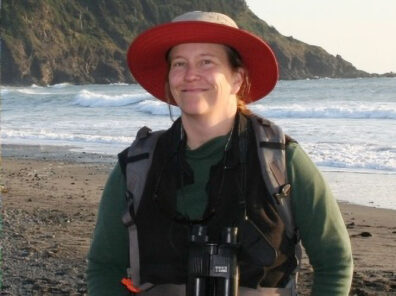 Betsy Howell (Courtesy Village Books)
Note: The views expressed by Betsy Howell in this interview are hers and do not necessarily represent the views of Washington State University, the US Forest Service, USDA, or the United States.