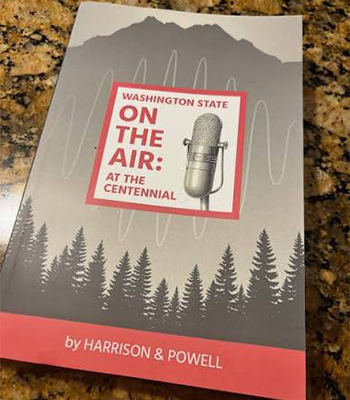
Burt Harrison’s original version of Washington State on the Air detailed the history of broadcasting at Washington State University through the early 1990s.
The update includes the original work, to which Albert Powell integrated his own experience and research from 1968 onward. His voice overlaps with Harrison’s through the early 1990s then continues on its own through present day.
Here, Powell discusses how the update came about, challenges to writing the book, and more.
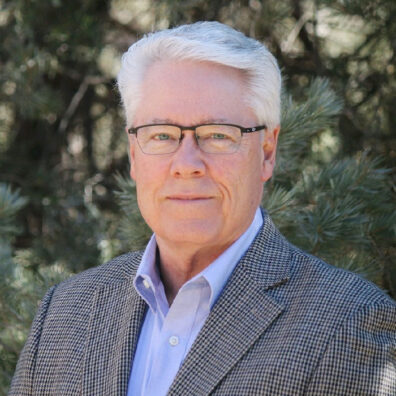
How did you come to update Washington State on the Air?
During COVID, I had some spare time and decided to re-read Burt Harrison’s book front to back; I hadn’t opened it in years. I immediately realized that the centennial of KWSU radio was coming in 2022 and thought “Someone needs to update this for the centennial!”
I talked with a few people and looked around, but I couldn’t find anyone I thought as qualified as I was to update it. I’ve kept in contact with the broadcast operation and Edward R. Murrow College of Communication at WSU since I graduated in 1973. I decided I’d be dumb enough to volunteer, not realizing what a challenge it was.
Once I decided to incorporate both the existing book and my update in a second edition, the title became easy—Washington State on the Air: At the Centennial. I wanted it to be as easy as possible to find, so I made it available through Amazon as both a paperback and an ebook.
Why did the update take five years? What challenges did you face in updating the original version?
I didn’t go about the project in an organized way but started by asking questions of people who knew something about time periods I didn’t know much about. My starting points were Burt Harrison’s book, a number of events I remembered as a student, and my contacts with fellow members of the Murrow Professional Advisory Board. The project was on and off as time was available, and working through it took years.
I thought talking with past station managers would help, but I couldn’t find any list of them. However, Kerry Swanson came to the rescue. He came to WSU in 2009 and had been directly involved in much of the timeline I needed to add; he was the leader in building much of the radio network. Kerry Swanson was very supportive and gave me names and leads that I might never have found without him. He had even reprinted a limited run of Burt’s book in the in the 2010s, so he understood the project and knew what I was up against. Kerry Swanson was with KWSU for 14 years, and his fingerprints were all over the radio network expansion.
Besides Kerry Swanson, the other person who provided the most comprehensive information and people to contact was Dennis Haarsager. He came to WSU in 1978 and was head of radio-TV services for 30 years; in his position he was the key player in the technical evolution that built KWSU from a single analog radio station into a radio and TV network spanning the entire state with analog and digital programming.
Every time I got a new name from someone, I’d ask what that person had done, then call them to learn more. Many of the good stories in the book came from those leads. One person led to the next, and each person led to new stories. I also spent a great deal of time reading online resources such as Washington State Magazine, old student newspapers, and commercial newspaper clippings. Mark O’English in the Manuscripts, Archives, and Special Collections (MASC) at WSU was extremely helpful in finding historical photos.
I especially wanted to establish a timeline of the radio station’s management, since some of the people involved were friends of mine. I never found a list of radio or TV managers, but I built a pretty coherent timeline of the management on both sides; I added that information to the tables in the back of the book as a historical reference.
I had an unusual dual challenge with this book: first, to try and be as good a storyteller as Burt was in carrying the narrative on after his work and, second, to build a historical narrative that would be a reliable reference for a complex era. This is the only historical document I know of that chronicles the history of KWSU and Northwest Public Broadcasting, so I wanted it to be both “a good read,” and a historical reference that’s accurate as I could make it.
I was convinced that to make the book readable, it had to be based on stories. No one really cares much about what year a station joined NWPB, but they may be interested in the story of why and how that happened. We care about people, not statistics, so I thought finding the stories behind the changes was the way to make the book readable.
Talk about your process. What did the research entail? Who were some of your favorite interviews?
The process wasn’t well organized. It was really like doing field research for a documentary. Every name could lead to a new story, but there was an overall focus on telling the story as completely as possible and not leaving big gaps in the narrative.
Some of my favorite interviews were Kerry Swanson because of his extensive knowledge, Kathy Dahmen because of the informal way she was hired, and Rick Simon, half of the Rimar Sports Network. Rick Simon is a friend, so I knew about his and Mark Kaufman’s network. I was really surprised that Burt Harrison didn’t include the Rimar Sports Network in his original book. It’s a great story, and a unique one.
What surprised you the most during your research for the update?
I was a bit surprised that the events I was asking people about have generally faded from memory. I started at WSU in 1968 and graduated in 1973, and those years are still pretty clear in my mind. But that’s more than 50 years ago, and even though many people stay at universities for a long time, I was constantly reminded that most people at WSU came there long after I graduated. I’m sure this is a common occurrence for everyone as they age, but there was a steady stream of “that was before my time” that was a bit frustrating. People move in and out of jobs all the time, and that makes it important to find the few who have stayed and have the institutional memory to help.
Talk about your favorite memories doing radio at WSU. What and who stands out?
For many years, KWSU was Pullman’s primary station. My mom had KWSU radio on all day, every day, and that wasn’t unusual in Pullman.
One of my favorite stories is about KWSU’s classical music director Elmer Erickson. He listened to KWSU all day, and he was particular about students pronouncing composer names correctly and playing the right music. It happens that I played upright bass in high school, and one of my favorite compositions was George Frideric Handel’s Music for the Royal Fireworks. One day I was running a classical program of Handel’s Water Music, but when I pulled the LP out to cue it up, I saw the flip side had the Royal Fireworks. I started listening to the Royal Fireworks on the audition channel and then forgot to flip the LP when the program began, so I played the Royal Fireworks live. The phone rang immediately; it was Elmer Erickson telling me the wrong music was playing. I explained that I loved the Royal Fireworks and played it by mistake. I could tell that he didn’t know how to respond to a student making a mistake because they loved a classical piece. Instead of chewing me out, he paused, then said “Well, don’t do it again.”
WSU forms long bonds. I’m still in contact with some of my fellow broadcast students and friends like Al Eltvick (’72 Comm.), Brooks Burford (’75 Comm.), Rick Simon (’71 Comm.), Mike Conklin (’72 Comm.) and Ted Warren (’72 Comm.).
It was a lot of fun to be an undergrad at WSU in the late ’60s and early ’70s. The world was changing, and college campuses were at the front of it. All of it was shifting—dating, parties, the campus atmosphere—and the people I ran around with made it interesting all the time. On any day I might be in class, go to the CUB and talk about the Vietnam war with an ROTC Ranger friend, then head to the station, pull news from the teletype and read a newscast to begin my shift at KWSU.
What do you love about radio and public broadcasting in general?
I’ve never found anything that’s more fun than doing live radio. In addition to KWSU, while in college I worked at KPUL in Pullman, KCLX in Colfax, and KRPL in Moscow. I enjoyed every minute on the air, especially when I got to provide all the commentary and select the music. That’s what a lot of disc jockeys got to do in the ’70s, although radio has changed since then and what I call the “Clear Channeling of America” has resulted in too many automated stations with no local connection.
Public broadcasting is a great idea that I think reflects the idea of democracy; informed citizens make better choices, and public radio without political influence and constant commercials is an equalizing source of information.
With enormous federal cuts, how hopeful are you for the future of public broadcasting?
I think public broadcasting is here to stay for two reasons. First, I think there will be enough ongoing donation support to keep it operating, although I expect it will be at a lower funding level than before. Second, I think the current MAGA-ization of the country will recede and some level of public funding will be restored, although it may be at the state rather than federal level.
How important is public broadcasting to WSU and the country in general?
I believe that it’s the only reliable broadcast source where the public can get nonpartisan news and information. To be very clear, I regard the conservative complaints of public broadcasting as liberally biased as nothing but political noise. To have an informed public, you must have balanced news reporting. Public broadcasting provides some of the best.
What do you hope readers take away from the book?
I hope that people feel they’ve read good stories that are well told, and that they learned some history in the process.
What else is important for people to know?
The biggest challenges in this book were to try and tell stories as well as Burt Harrison did and to manage the incredibly complex timeline.
The changes in communications technology that Burt Harrison dealt with between 1922 and 1993 were trivial compared to the new technologies which emerged after 1990. The first 70 years basically just included AM radio, then TV, then FM radio. Satellites did appear, but very late in the process, and digital technology in broadcasting was still young.
In the last 30 years, we’ve added numerous digital media, streaming, fiber optics, podcasts, digital data for radio, and TV has gone entirely digital. Covering the technology, telling stories of the people involved, and explaining the changes in academics, including creation of the Edward R. Murrow College, was extremely challenging.