
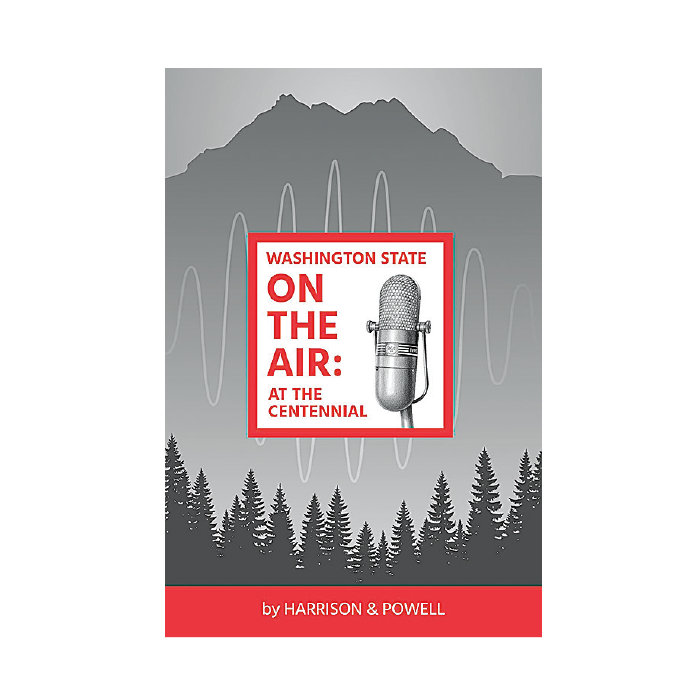
Burt Harrison and Albert Powell ’73 Comm., ’79 MCE
KWSU Radio-Television Services and the Edward R. Murrow College of Communication: 1993, 2026
Radio at what’s now Washington State University traces its roots to the humblest of beginnings. When the college station first went on the air in late 1922, its microphone was an old telephone mouthpiece amplified by coils encased in a soup can. The can “had been painted black to give it a professional look,” according to Burt Harrison’s original version of Washington State on the Air, detailing the history of broadcasting at Washington State University through the early 1990s.
That anecdote is also included in the update by Albert Powell. It includes Harrison’s original work, to which Powell added his own experience and research from 1968 onward. His voice overlaps with Harrison’s through the early 1990s then continues on its own through present day. Harrison, who worked in radio at WSU from 1949 to 1976, died in 2004 at 87. Powell, grew up in Pullman, worked at KWSU and other local stations, and earned a degree in broadcasting.
The new edition of Washington State on the Air contains the original foreword, Harrison’s original author’s note, and a new author’s note from Powell, a member of the Murrow College Advisory Board. Together, they tell the story of how a small, college-town station produced a string of famous broadcasters, including the legendary Edward R. Murrow (’30 Speech), and became a cross-state media network.
Radio was growing in popularity—and largely unregulated—in the early 1920s, when Washington State College started its station. That souped-up soup can wasn’t its only reused or recycled component. Most of the equipment was second-hand, scrounged from the dismantling of the school’s ham radio station or borrowed from the Department of Mechanical and Electrical Engineering’s laboratory supplies.
The scrappy station broadcasted three nights per week, eventually evolving into a public radio and TV network with 24-hour programming, smartphone apps, Internet streaming services, and more. The past three decades of Northwest Public Broadcasting, in particular, feature tremendous change in technology, media usage, faculty and staff, and funding. Fallout from 2025 cuts to the Corporation for Public Broadcasting included the discontinuation of KWSU-TV as well as operational reductions. However, while call letters, content, frequencies, and more have changed since the station began broadcasting just over 100 years ago, WSU has remained on the air.
Read more
Albert Powell talks about Washington State on the Air: At the Centennial