
Former NASA astronaut on two space shuttle missions, former director of space for the US Air Force, and WSU Regents’ Distinguished Alumnus Award recipient John M. Fabian (’62 Mech. Eng.) epitomized pioneering spirit, selfless volunteerism, and the get-it-done Coug attitude.
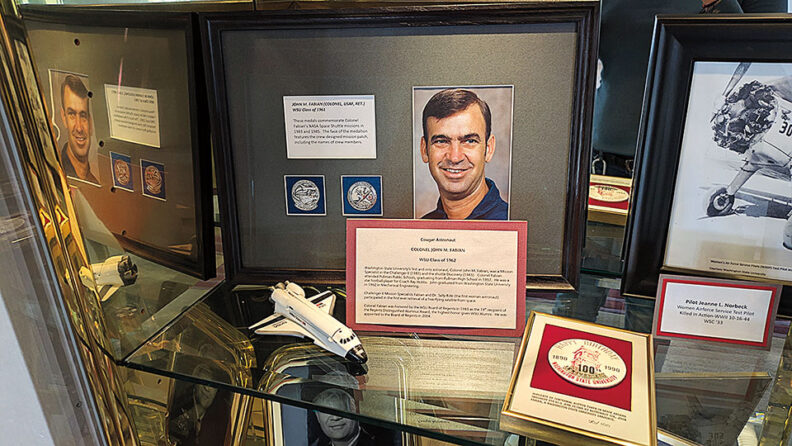
Fabian died May 21, 2026, age 87, in Port Ludlow.
He was born in Texas, but considered Pullman his hometown after his father took a job teaching at WSU and moved the family there.
Fabian studied mechanical engineering and joined Phi Sigma Kappa fraternity and Air Force ROTC at WSU. He was commissioned after graduating and spent five years flying KC-135 refueling tankers, including 90 combat missions during the Vietnam War.
He received a doctorate at the University of Washington, then served four years on the aeronautics faculty at the US Air Force Academy. It was there that he was accepted by NASA as an astronaut candidate in 1978, one of 35 out of 17,000 applicants.
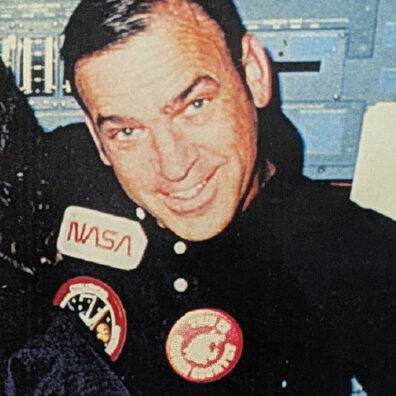
Fabian’s interest in space exploration was sparked in college. “I was a freshman at Washington State University in October 1957, when Sputnik went up, and obviously we all know that changed the world,” he told NASA historian Jennifer Ross-Nazzal (’04 PhD History) in 2006. “I followed with great interest the early flights of the American space program, first the unmanned and then the manned flights.”
However, he previously hadn’t considered becoming an astronaut because he was too tall at six-foot-one for previous missions. That changed with the shuttle program.
In 1983, he became the first person to deploy and then retrieve a free-flying satellite, while aboard the space shuttle Challenger as a mission specialist with Sally Ride, the first US woman to enter space.
His second mission was aboard space shuttle Discovery in 1985, deploying satellites. He logged 13 days, 4 hours, and 3 minutes in space.
Fabian had been scheduled to fly on Challenger in May 1986. Instead, 27 days before the shuttle tragedy, he left NASA to become the director of space and deputy chief of staff, plans and operations for the US Air Force.
He retired from the Air Force with the rank of colonel in 1987 and joined Analytic Services, a nonprofit aerospace public service research institute. He retired as president and chief executive officer in 1998.
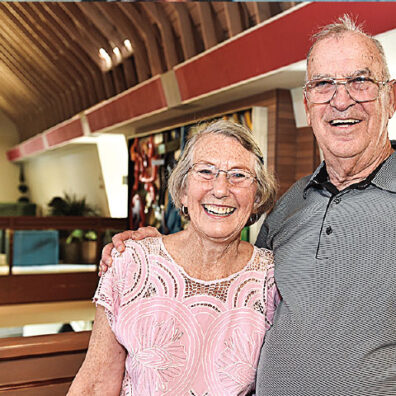
Fabian then became a public speaker, volunteer with the Association of Space Explorers, and environmental advocate as founder of the Hood Canal Coalition. He and wife Donna (’63 Math.) also volunteered with WSU Foundation, and established the John and Donna Fabian Scholarship in Engineering and the Association of Space Explorers Scholarship.
Fabian received the NASA Space Flight and Exceptional Public Service medals, among many other honors. WSU awarded him the university’s highest honor, the Regents’ Distinguished Alumnus Award, in 1983.
Fabian is survived by his wife, Donna; two children, Michael and Amy; and three grandchildren.
More about John Fabian
John Fabian, NASA astronaut who was first to catch a satellite, dies (Collect Space)
John M. Fabian (Wikipedia)
Kennedy Space Center profile of Fabian
“It’s all about the derivative” (2013 article from Voiland College of Engineering and Architecture)
NASA oral history with Fabian (interviewed by Jennifer Ross-Nazzal ’04 PhD History in 2006)
Space Cougs (Washington State Magazine, Summer 2017)