Abdi Warsame was twelve when his older cousins invited him into the city. They were in their 20s and wanted to fetch belongings from the apartments they had fled in central Mogadishu, Somalia. Warsame wanted adventure.
“My instant reaction was ‘Yes!’” says Warsame, who didn’t tell his parents about his plans. “As a young kid, I looked up to my older cousins. Any time I spent with them was bonus time.”
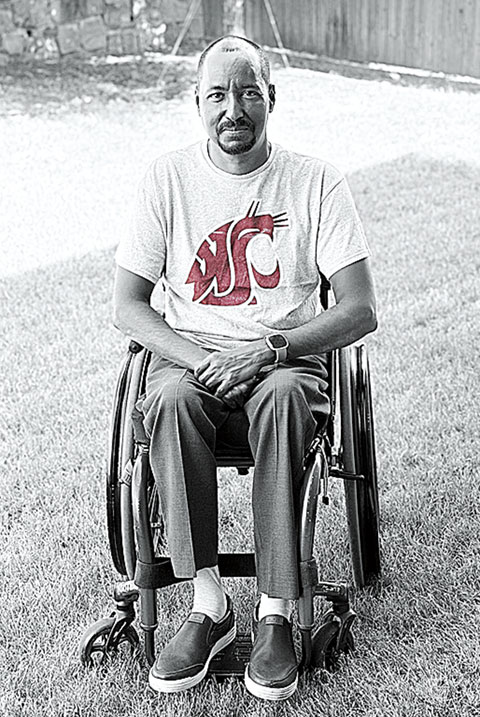
(Courtesy Abdi Warsame—derivative from original)
It was January 12, 1991. The Somali Civil War raged around them. But Warsame didn’t really comprehend the danger until he heard the distinctive sound of bullets flying and saw soldiers lying dead in the street. On the long walk back to the suburb where Warsame lived with his family, the trio encountered sniper fire, shelling, and a rocket explosion. One moment, Warsame remembers darting across an open field. The next, he was lying on the ground.
“I blew into the air and landed on my tailbone,” Warsame recalls. “I looked to my right, and the younger of my two cousins was face down. His hip was wide open and bleeding. I tried to get up and run, and I noticed my legs were strangely soft. I looked to my left and saw my other cousin in the distance. I yelled, ‘Please come back!’ I wished to see my mom and dad again.”
Texas-based Warsame (’24 MBA) was born in Somalia and came to the United States as a teenager in 1995 with the dream of being able to walk again. What followed was rigorous physical therapy and many milestones: enrolling in American high school, earning a driver’s license, becoming a US citizen in 2002, graduating from college, getting a job at a telecom company. But walking again wasn’t an option.
“The doctors said, ‘There’s nothing we can do.’ That was a knife to my heart,” Warsame says. “I was completely demoralized. I lost hope. And I am not one who loses hope easily.”
A paraplegic who advocates for other differently abled people and chairs a foundation to aid disadvantaged youths in his native Somalia, Warsame now sees what happened to him as destiny. There’s no use in regretting going into the city that fateful day, he says. “It was meant to be.”
Still, leaving his homeland was one of the hardest things he’s ever done. “People don’t love to leave their homes and their communities. It’s one of the most difficult decisions they could make to say goodbye to loved ones and the places they have known all their lives. It has to be something dramatic that makes them say, ‘I can’t stay here; I have to go.’”
Warsame’s hope was reignited when he met a representative for a mobility company who was professionally dressed and navigating life in a wheelchair. “I was taken by his look,” Warsame says, recounting their exchange at the inpatient treatment center where he was undergoing full-time physical therapy.
Through a mixture of hand gestures and limited English, “I said, ‘How did you get here?’ And he said, ‘I drove.’” Then he showed Warsame his two-door sedan with hand control, which, Warsame says, “is exactly what I use today. He said, ‘I have a full-time job. I have my own apartment and car. I go anywhere I wish.’ That was the first and last time I saw him. I wish I could find that guy. He gave me a road map for success.”
Determined to be independent like the young professional he crossed paths with at the rehabilitation center, Warsame studied extra hard during summers. Learning English was difficult. So was navigating high school in a wheelchair and experiencing culture shock. But Warsame persevered.
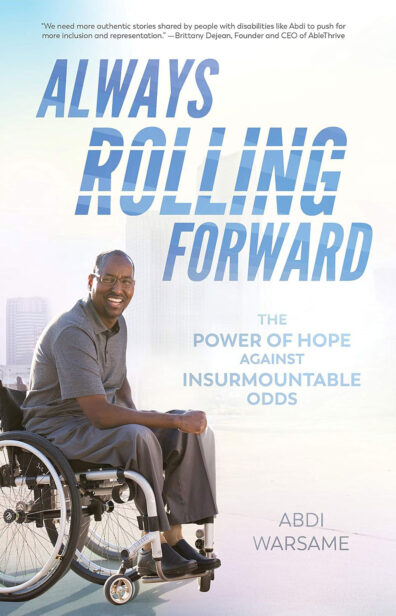
He details his experiences in his 2018 memoir Always Rolling Forward: The Power of Hope Against Insurmountable Odds. In the eight years since the book published, he’s earned his MBA online without visiting a physical Washington State University campus. “I wanted to further my career and expand my knowledge base,” says Warsame, who worked full-time while going back to school. He’s worked for two decades at AT&T, where he’s held multiple roles. Today, he does financial analysis, managing a portfolio of more than half a billion dollars.
“I always want to go above and beyond what I’m doing,” Warsame says. “And I was missing some of the leadership skills that would give me an edge. The online MBA wasn’t an easy thing. But it was a good experience, and I enjoyed it.”
Serendipitously, he learned his neighbor and now best friend, fellow Somalian Guled Ali (’06 Ag. Econ.), is also a Coug. “He talks about all the experiences he had in Pullman,” says Warsame, who’s hoping to visit campus for the first time this fall and watch his first Cougar home football game.
Also serendipitously, Ali happens to share the same first name as the foundation Warsame helped launch while still in graduate school. In 2021, he cofounded the Guled Foundation, which works to educate Somali youth with the aim of lifting them out of poverty and increasing the country’s literacy rate.
“Guled in Somali means success,” says Warsame, chair of the foundation. “It’s a popular name in Somalia, where education has been privatized. That’s why we organized: to fill the gap for kids who can’t afford to go to school. Education is the most important development one could have. If I were not educated, I can only imagine what my life would have been.”
The foundation plans to build a school in central Somalia with the capacity to educate more than 700 students.
“These kids are what inspire me the most,” says Warsame, who served one term on the Rehabilitation Council of Texas. He’s also a past president of the Dallas–Fort Worth chapter of AT&T’s Ability employee resource group and advisory board member of To Be Like Me, a nonprofit disability awareness program, as well as AbleThrive, which offers resources for people with spinal cord injuries.
“You don’t have a choice. You don’t get to say, ‘I’m not going to be disabled tomorrow,’ and have that be true. It’s part of your life,” Warsame says. “But I’ve always felt ambitious and as hardworking as anybody. So that’s been my life: to push the envelope. I don’t even think on a daily basis about my disability. I keep rolling forward.”