
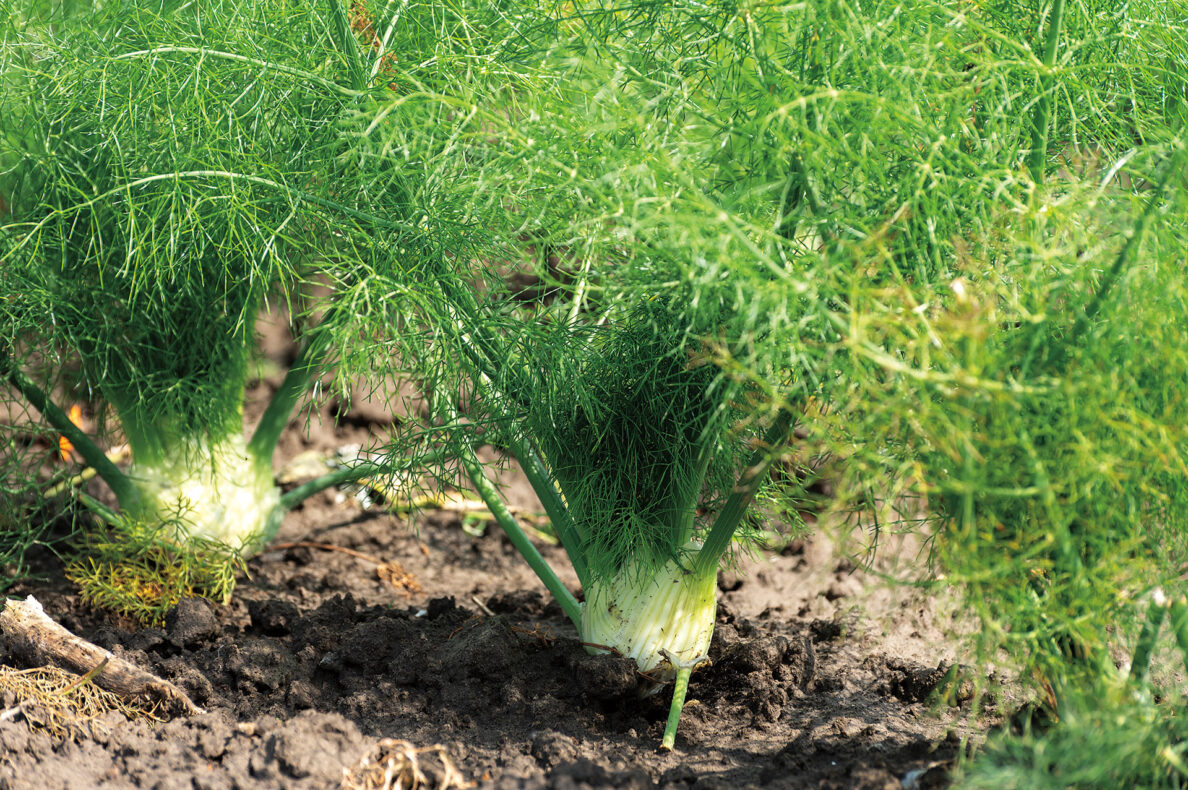
It’s a whimsical-looking, somewhat intimidating sort of vegetable, with green feathery fronds sprouting from long white fingers emanating from a bulbous, also white, human heart–shaped base. Its appearance might be a reason it’s often overlooked—although it shouldn’t be.
For its wispy, herbaceous leaves, reminiscent of dill. For its celery-like stalks. For its crisp, licorice-scented, swollen, layered stem. For its punch-packing seeds that imbue a gently sweet, grassy flavor with a hint of anise.
Fennel is edible, foot to flower. It acts like a spice, leafy herb, and root vegetable—
although it grows aboveground and isn’t a true bulb. The versatile, ancient crop enjoys multiple uses and a long season. In Washington state, it’s generally available from late spring through late fall.
“I always say northwest Washington could be the fennel bulb–producing capital of the US based on the quality we can produce here. But the market demand is not present yet,” says Carol Miles, Extension vegetable specialist at Washington State University’s Mount Vernon Northwestern Washington Research and Extension Center (NWREC).
She encountered an abundance of fennel, or finocchio, while working on a US Department of Agriculture grant in Sicily, one of Europe’s high-volume fennel producers. “I was there in March, and it was being harvested. Every meal had fennel in it,” she says. “When it’s in season, they put it in everything. My favorite was fennel topped with pork. They were baked together, and the fennel had a very subtle flavor.”
In the late 2010s, following the Sicily trip, Miles led two fennel trials at NWREC to identify the best cultivars, seeding dates, and planting methods for northwest Washington. In all, she and her team evaluated 16 fennel types. Findings showed five cultivars had the greatest production rate, yield, and quality—and are well-suited for production in the region. Another finding: Direct seeding yielded better results than transplanting starts.
In Sicily, seeding starts in November or December, with harvest in March or April. But, “for us,” Miles says, “it’s too wet.” Plus, she says, “Sicily doesn’t get as cold as we get. Our March is like their December.” In northwest Washington, seeding starts in April or May, with harvest in September or October. “Then, it’s a matter of keeping the bulb tender. You don’t want it to overmature and become woody,” Miles says.
Recently, during a free WSU Extension San Juan County Master Gardeners workshop on growing vegetables, Miles asked audience members if they eat fennel. “About 50 percent of them raised their hands, and I was amazed,” Miles says, noting the response prompted her and a graduate student to craft a fact sheet on fennel for home gardeners. “I personally think fennel is an easy crop to grow. It grows like a carrot: slow and small until it’s about a month old. Then it’s off and running.”
Fennel likes full sun, consistent watering, and moist, organically rich, well-drained soil.
India is the global leader, producing more than half the world’s fennel, mainly in seed production for the spice market. Egypt, China, Turkey, and Syria are the next top producers. While Italy ranks sixth, it dominates Europe’s fresh market. Production centers around southern Italy, particularly Puglia, Calabria, and Sicily, where, Miles says, the growing climate is similar to Mount Vernon.
“We’re about the same latitude. We’re not hot and dry; we have a mild Mediterranean climate: cool and humid. We also have long day length, which leads to bolting for some varieties. If you want seed, you want bolting. But if fennel is bolting, you’ve lost your bulb. The flower stalk is woody, and the entire bulb is no longer palatable. It’s about choosing varieties that aren’t going to bolt.”
Florence fennel, the most common type of bulb fennel—the variety found in grocery stores—doesn’t grow well in northwest Washington. “It just bolts for us,” says Miles, who evaluated “every seed variety that I could get—every one sold in the US plus some sent to me from an Italian company.” She and her team identified varieties that grow well in northwest Washington: Finale, Orazio, Preludio, Solaris, and Tenace.
Fennel (Foeniculum vulgare) isn’t related to licorice. A member of the carrot family, it’s a cousin to cumin, coriander, caraway, dill, parsley, and—no surprise here—anise. Its flavor comes from anethole, an aromatic oil shared by fennel and anise as well as licorice.
Fennel has been used in Europe, Asia, and North Africa since ancient times. In Greek mythology, a fennel stalk concealed the spark of fire Prometheus stole from the gods. The modern marathon race comes from fennel’s Greek name: marathos or marathon. According to legend, the Greek herald Pheidippides was sent running to Athens from the fennel field upon which the Battle of Marathon took place to announce the outnumbered Athenians’ win over invading Persians in 490 BCE—a distance of about 26.22 miles.
Pliny the Elder outlines fennel’s medicinal uses—an aid in digestion and treatment for snakebites and poor eyesight—in his Naturalis Historia (Natural History), written in the first century AD. De Re Coquinaria (The Art of Cooking), attributed to Marcus Gavius Apicius and also written in the first century AD, features fennel seeds—along with crushed pepper, wine, broth, and other herbs and spices, in sauces for boar and stag.
A rich source of dietary fiber, raw fennel has just 27 calories per cup and a crisp, cool, neutralizing bite, making it a natural palate cleanser. It’s perfect between courses or mixed into salads. Classic combinations include fennel and blood orange or grapefruit, and fennel and apple or pear. Add arugula and feta or goat cheese.
Use fennel’s delicate, frilly, threadlike fronds as garnishes or as a substitute for dill. Add whole seeds to pickling liquids. One of the main ingredients in Chinese five spice, fennel seeds are also fantastic for seasoning sausage, pork, beef, fish, and bread. They lend depth to marinara, meat, or pizza sauces. Don’t forget the flower; sprinkle sweet, earthy fennel pollen on, well, almost anything.
Roasted or braised, fennel mellows much like sautéed onion, its flavor becoming light and delicate. Make mussels with lemon, garlic, white wine, and thinly sliced fennel. Try pureed fennel soup or fennel fritters. A 15th century recipe for fennel fritters from Martino da Como, Italy, largely considered the Western world’s first celebrity chef, notes “…You can take all the little branches or leaves one by one, or two by two if you’d like, tossing them well in … batter. Then fry in good lard, or in a mixture of half oil and half butter.”
Add fennel, along with a whole chicken, potatoes, leeks, celery, and carrots, to a Dutch oven for a classic French poule au pot Sunday dinner, famously referenced by “Good King Henry” IV of France in his 1662 biography. His promise, loosely translated, was “a chicken in every pot.” Don’t forget fenouil, or fennel, a fundamental element in modern French and Italian cooking.
“It’s good in soup, like a white bean cassoulet,” says Miles, noting her favorite way to enjoy fennel is “simple, flavorful, and crisp” — in a salad with blood orange slices, served with homemade vinaigrette, salt, and pepper. “And, if you’re open to it, very thinly sliced red onion. It’s very refreshing.”
[It should be noted that while Foeniculum vulgare is classified as noxious by the Washington State Weed Control Board, Florence fennel (Foeniculum vulgare var. azoricum) is not. But letting it flower creates hundreds of viable seeds that easily self-sow and escape your garden and become an invasive plant. To enjoy the bulb without the weed risk, simply remove the flowering stalks (bolt) as soon as you harvest the bulb.]
Recipes for all parts of fennel
Classic poule au pot helps you eat like a king (Spokesman-Review)
Oven-Roasted Vegetables (Barefoot Contessa)
Balsamic Roasted Fennel and Carrots (Healthy World Cuisine)
Roasted Fennel Soup With Potatoes & Apple (Walder Wellness)
Fennel, Fig and Salami Sandwich with Goat Cheese (Food 52)
Blood orange, avocado, and shaved fennel salad with saffron lemon dressing (Brooklyn Supper)