
Kevin Peterson studied the London Underground, the world’s oldest metro, as part of a Washington State University architecture study abroad program in England in 1974.
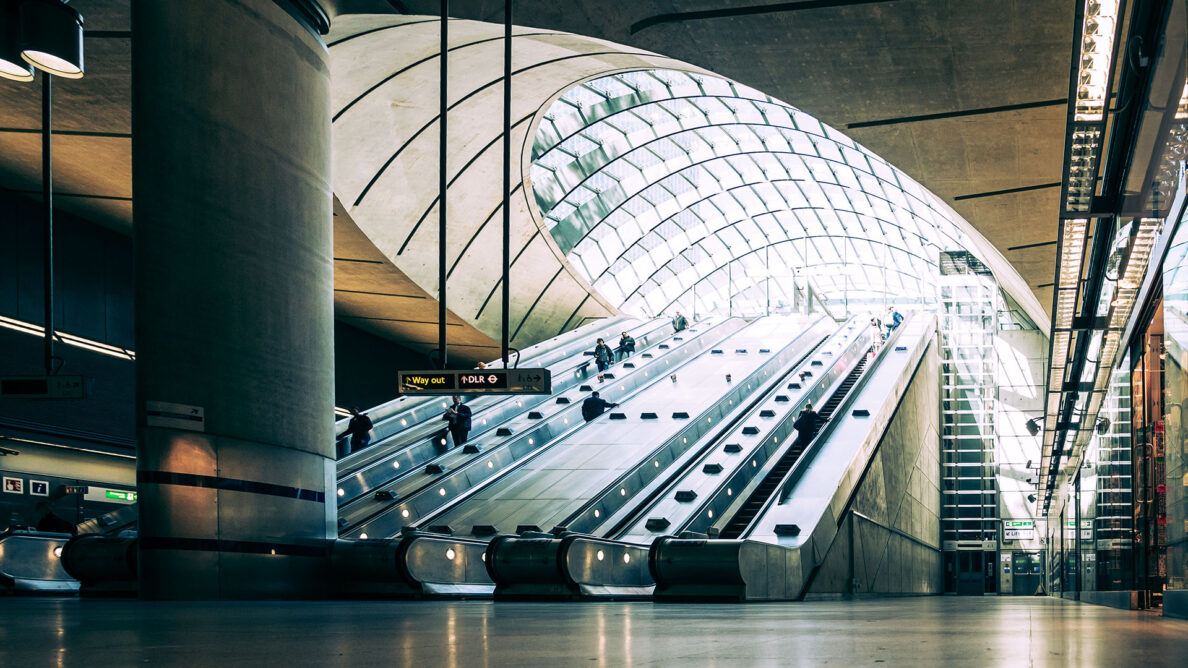
Sixteen years later, Peterson (’76 Arch.) returned to London in a lead architectural role establishing station layouts for the Jubilee Line Extension, the first major improvement to the London Underground since World War II.
Connecting Westminster with the new subcenter at Canary Wharf, the effort involved a deep tunnel under the River Thames, intermediate stations, and the celebrated Canary Wharf station, designed to serve up to 20,000 passengers an hour. Peterson prepared concepts for Parliament to approve before local architects and engineers took over.
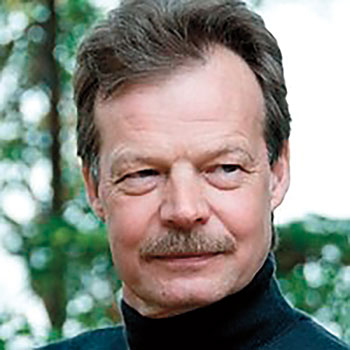
Peterson is a big-picture transportation architect. His international reputation encompasses transit systems and urban design in every continent but Antarctica. And he credits two WSU professors—Jack Jackson and Bob Patton—with launching his career.
“My career would not have been possible if not for professors Jack and Bob at WSU,” Peterson says. “Jack taught me the importance of sketching. Bob taught me the importance of responsive design serving the needs of people.”
As an apprentice architect, Peterson worked in the greater Seattle area, including projects to restore Boeing Plant 1 headquarters and design the Alderbrook Resort on Hood Canal.
When licensed, he joined the Seattle office of the international planning and design firm Parsons Brinckerhoff, now part of WSP Global. This allowed him to fulfill his interest in “the spaces between buildings, transportation, infrastructure and the urban fabric.”
Peterson began his 21-year career at Parsons Brinckerhoff with a project in Tacoma, where he was born. “Pierce Transit was creating a bus system where passengers could easily transfer between one line and another at transit centers,” he remembers.
As a young project manager and architect, Peterson did everything from initial concepts to design and construction supervision. “We created a friendly shelter design integrating Asian and Northwest Native imagery,” he says.
Peterson also helped with the design of downtown Seattle’s underground metro system as a “coordinator,” assisting more senior architects and engineers. “I learned a lot,” he says. “Then I began getting calls from across the nation—Los Angeles, Atlanta, and Denver among many. I soon got a reputation as someone who could quickly and responsively solve problems. Often, I did the basic, conceptual design helping projects get started.”
He met his wife, Ann (English Bevens) Peterson (’75 Int. Des.), when she was designing a space for the old Sheraton Hotel in Billings, Montana. Peterson helped with architectural aspects. Their Coug connections span three generations, including his mother-in-law, Shirley (English) Bevens (’41 Music) and their daughter Mari (Peterson) Schillios (’14 Hum.).
Newlywed, he embarked on his first international project: the design of eight elevated stations and about 20 kilometers of elevated guideway in Singapore. “I was tasked with taking the project from dots on a map—three of those dots in the jungle designated as future subcenters—to construction drawings. Today, thousands live in these subcenters where stations are the heart of the community. This was a challenging and fun experience that took just over six months.”
When the project ended in 1984, the Petersons spent three months traveling across China, the Soviet Union, and Scandinavia.
Next stop was Taipei, Taiwan, where Peterson was instrumental in establishing the design philosophy for the largest mass transit system then being developed in the world. The Petersons lived in Taipei for two years. “And I aged 10 years,” Peterson says.
Directing a staff of 80 architects and planners, Peterson led the architecture and urban design effort. This included planning three lines, preparing preliminary designs for two, and creating the final design of four underground stations, six elevated stations, and eight at-grade stations.
“The soil was terrible,” he recalls. “Sometimes we had to dig down 30 meters to find solid ground. We had to change local laws to allow international bidding, and there was historic cultural bias that needed sensitive and creative mitigation.”
Years later, while helping conceptualize Taiwan’s high-speed rail investment, he visited one of Taipei’s stations and saw a fashion shoot. “Asking why they selected a transit station for the photoshoot, I was told the station was one of the most beautiful places in Taipei,” he recalls.
Later, Peterson created conceptual designs for the Marmaray metro rail line connecting the European and Asian sides of Istanbul, Turkey, across the Bosporus Strait. At its deepest, the tunnel sits 60 meters down, the deepest submerged rail line in the world.
The project included designing an 11-city block multi-modal transportation facility, meant to move more than 100,000 people each hour, within the Roman walls of the World Heritage City.
In Istanbul, Peterson expanded his second career track: urban planning and design. Some of his most interesting urban design projects, such as Jubail, were in Saudi Arabia.
Started in the 1960s, Jubail turned a fishing village on the Persian Gulf into one of the Middle East’s largest industrial cities. The new city was planned for 600,000 residents, but only 30,000 lived there in the early 1990s.
“The original plan imposed a 1950s’ social utopia onto a Bedouin culture,” Peterson says. “No one wanted to live there. They wanted a city with multi-generational neighborhoods and traditional urban activities.” Many changes resulted, but—as of 2022—Jubail housed 474,000 residents.
Peterson’s next project was designing transportation and infrastructure for a major high-density development above the Kaaba in Mecca, Islam’s most sacred site. “As a Christian, I couldn’t go there, so they sent people to walk the streets and videotape the cityscape and send me the CDs.”
In all, Peterson has logged some 5 million miles of international travel. In fact, one year alone, he commuted between Seattle, London, and Singapore. Together, he and his wife have lived in London, Singapore, Taipei, Istanbul, and Sydney.
Peterson left Parsons Brinckerhoff in 2001 to join his wife in Peterson Design. As a consultant, he continued helping clients in Istanbul, Singapore, Bangkok, Sydney, Kuala Lumpur, and Manila, among other places. In Dubai, United Arab Emirates, he helped with the prototype design of more than 20 elevated stations. In Izmir, Turkey’s third largest city, he helped define a metro system and major urban projects, including redeveloping the old port into a modern, mixed-use civic effort.
Projects in Washington state include rail stations, transit centers, and infrastructure planning in Friday Harbor, Bellingham, Olympia, Everett, and Kirkland. In Seattle, Peterson helped select the King Street Station as the site for the Amtrak and commuter rail terminal in south Seattle and helped plan options for Boeing Field.
“For the Alaskan Way Viaduct replacement, I was asked to work with the state legislature to explore non-tunnel options,” says Peterson, who is also consulting on modifications to the long-delayed Columbia River Bridge replacement between Vancouver and Portland, Oregon. “A huge joy is being involved with local projects,” he says.
National projects include a pedestrian “under-bridge” for Phoenix’s Camelback Road, station ideas for Honolulu’s rapid transit program, planning for the Fort Lauderdale cruise ship terminal and airport connection, stations concepts for Bay Area Rapid Transit, and station design in Los Angeles. He has also helped plan and design airports as well as facilities for the Superconductor Super Collider and the Tokamak Fusion Test Reactor.
Then there are the bridges, which often allowed Peterson to collaborate with engineers and artists to create “pleasing and practical ways to move people and vehicles.” He helped design the West Seattle Swing Bridge, Gibbon Falls Bridge in Yellowstone National Park, the T.J. Meenach Bridge Replacement in Spokane, and the Gibbs Pedestrian Bridge and Vancouver Avenue Bridge, both in Portland, Oregon.
“Growing up an average kid in Washington state and attending WSU resulted in an international career helping shape how millions of people live,” reflects Peterson, who is still called upon to advise government officials, including lawmakers, on transportation issues.
“The most interesting thing in my career was, and is, helping conceptualize complex …urban design and infrastructure ideas,” Peterson says. In fact, “I just got a phone call to help the Suquamish Tribe and Navy design a pedestrian bridge in Bremerton. The career continues!”