
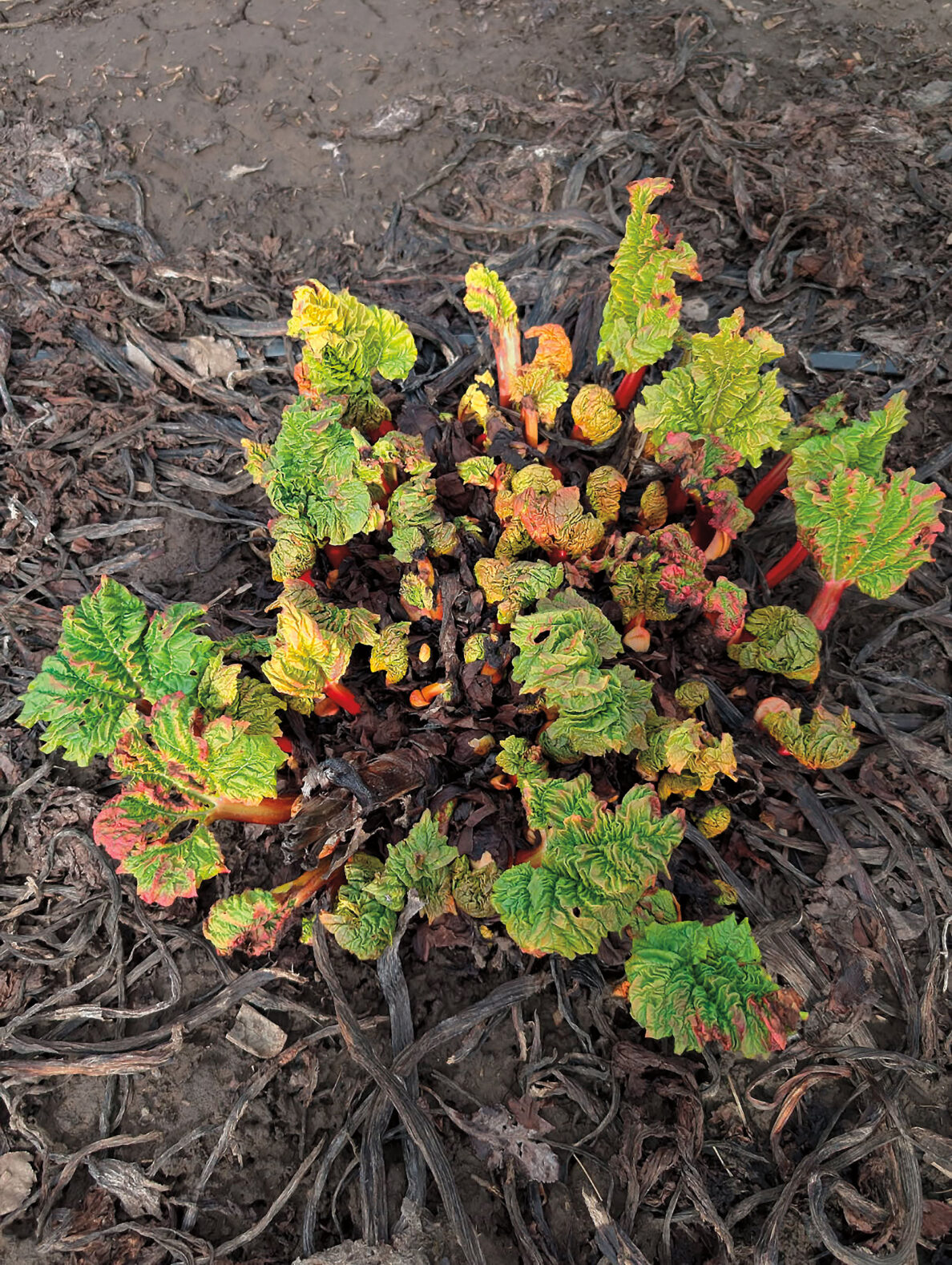
Rhubarb simply sings of spring.
Its pretty pink stalks emerge earlier than most crops in the Northern Hemisphere, signifying the end of the dark, barren winter and start of earth’s annual reawakening. Stalks blush beautifully—from light rose to deep crimson, although there are green and green-red varieties. Whatever the coloring, rhubarb symbolizes renewal, resilience, and hope.
Still, it’s a strange and difficult fruit: mouth-puckeringly tart, and topped with toxic leaves. In fact, it’s not even really fruit at all, rather a vegetable treated as one. As early as April, find it baked into cobblers and upside-down cakes, cooked into compote to top vanilla ice cream or swirl into Greek yogurt, and, of course, tucked into tarts and pies—perhaps coupled with strawberries, a classic combination.
Sugar is a must.
“No spice is required, but sugar may be put in as long as your conscience will let you, and a handful afterwards,” Jane Cunningham Croly writes under the simple title of “Rhubarb, or Pie Plant” in the 1878 edition of Jennie June’s American Cookery Book.
Lydia Maria Child also emphasizes the fact that rhubarb pies “take an enormous quantity of sugar,” so much so that she doesn’t provide an exact measurement in 1844’s The American Frugal Housewife. “There is no way to judge (the right amount) but by your own taste,” she surmises.
In fact, the “pie plant” didn’t become popular with the masses until the mid-1800s, when sugar became more affordable in Europe and America. Mostly used for medicinal purposes until then, rhubarb (Rheum rhabarbarum) was reborn as a filling for desserts.
Fortunately for us, the Evergreen State is a national leader in rhubarb production. Only Oregon harvests more acres of rhubarb. According to 2022 data from the United States Department of Agriculture, 145 farms harvested 464 acres of rhubarb in Washington state, with the crop from all but four acres bound for the fresh market. That compares to 1,727 rhubarb acres nationwide and 571 rhubarb acres in Oregon.
Rhubarb’s roots stretch back generations near Sumner, the “Rhubarb Pie Capital of the World.” The Pierce County town celebrates its annual Rhubarb Days Festival in June with plenty of rhubarb pie, rhubarb crisp, freshly cut rhubarb, and rhubarb-infused beer. Pierce County is the state’s largest rhubarb producer with 398 acres. In second place is Skagit County with 35 acres.
Pullman also has a special connection to the “pie plant.” Since 2012, the USDA’s rhubarb collection has been maintained at its Western Regional Plant Introduction Station on the Washington State University campus. The outpost is part of the larger National Plant Germplasm System (NPGS), which maintains one of the world’s largest germplasm collections.
“This is a living seedbank,” explains Carol Miles, WSU horticulture professor and Extension vegetable specialist at the WSU Mount Vernon Northwestern Washington Research and Extension Center. She served for 12 years as the WSU liaison to the NPGS, through which research scientists from all over the world can request plant materials.
The NPGS contains nearly 624,000 entries. One-sixth of the total collection, or some 101,000 entries, is maintained at WSU. This includes 55 rhubarb specimens, with another 10 waiting in the wings—er, fields—thanks to Ann Kowenstrot (’23 MS Ag.), Alex Cornwall (’10, ’25 PhD Hort.), and Miles, who served as their graduate committee adviser.
A few years ago, the trio traveled to Alaska to collect wild and landrace rhubarb samples, which were then sent to a commercial lab to be analyzed. As a result, the WSU researchers identified 10 varieties that were not yet part of the USDA collection. Soon, they will be available to researchers around the world, says Cornwall, who joined Pullman’s USDA unit in 2011 as the field technician for horticultural crops and now works as one of four collection curators on the Pullman campus. He oversees nearly 14,000 entries, including garlic, beets, and First Foods such as biscuitroot, wild onion, and wapato, or duck potato.
“Our main mission is to preserve the diversity of plant life, especially with agricultural crops and their wild relatives,” Cornwall says. “We never know when a new pest might threaten our food security. Researchers can mine these materials for genetics to determine if any are resistant to the new pathogen or insect.”
But, he says, “Not many researchers are interested in rhubarb. It hasn’t had the marketing like other crops have. I feel like once people realize how versatile it is, it could become more popular.”
Most of the demand for the collection’s rhubarb comes from growers and nurseries, including a mail-order seed company that had donated one of its proprietary varieties to the collection decades ago. When it was recently in need of the material, “we were able to supply it back to them,” says Cornwall, who partnered with WSU’s Department of Horticulture to start a Rhubarb Rumble last year on the Pullman campus. The cook-off included rhubarb panna cotta, rhubarb lemonade, and rhubarb salsa that “would go well with mango” and “could definitely be used in a restaurant setting,” according to Cornwall, who prepared it.
For this year’s competition at the end of May, Cornwall is considering rhubarb-infused French macarons. He’s also interested in trying a traditional springtime Persian rhubarb-and-lamb stew, typically served over rice. “We’re trying to showcase what this crop can do,” he says. “It’s more than people think. I find it fascinating that we can use it in sweet compotes and pie fillings as well as savory stews.”
The springtime staple is ready for harvest in April or May in Washington state and then, gloriously, throughout the summer—though stalks are most tender in spring. Good news for home gardeners: Rhubarb freezes well and is exceptionally easy to grow. “It doesn’t require a lot of attention,” Miles underscores. “It’s not a demanding crop and can withstand the worse winter weather, emerging early in the spring.”
The hardy perennial thrives in mild climates with damp springs and moderate summers, such as western Washington. It grows well in eastern Washington, too, but favors locations with afternoon shade to alleviate extreme summer heat. Researchers in Alaska have been especially interested in rhubarb, a good source of vitamin C, because of its “amazing cold hardiness,” Miles says. “It’s one of the only food crops that survives in those winter conditions year after year.”
In her 2021 publication, “Growing Rhubarb in Home Gardens,” Washington State University Extension specialist and professor emerita Linda Chalker-Scott recommends growing rhubarb “as a landscape plant rather than in an annual bed” because of its size. “The diameter of a single rhubarb plant can reach eight feet or more, so give each plant plenty of space in full sun for best production,” she writes.
Chalker-Scott also notes rhubarb does “best when planted in the fall when the plant is dormant” and “performs best in a well-drained, aerated soil.” But, once established, rhubarb “requires little care other than maintaining a mulch layer and irrigation.”
Cornwall’s favorite varieties are the bright red Crimson Cherry and dark red German Wine, known for its thick stalks. He recommends keeping the earth around them weed-free and, when they get too big, breaking up the crown and replanting the pieces to rejuvenate them. In fields he maintains, he ensures rows are “well-irrigated” using a drip-system “so we’re not having to expend a lot of water to keep these plants happy.”
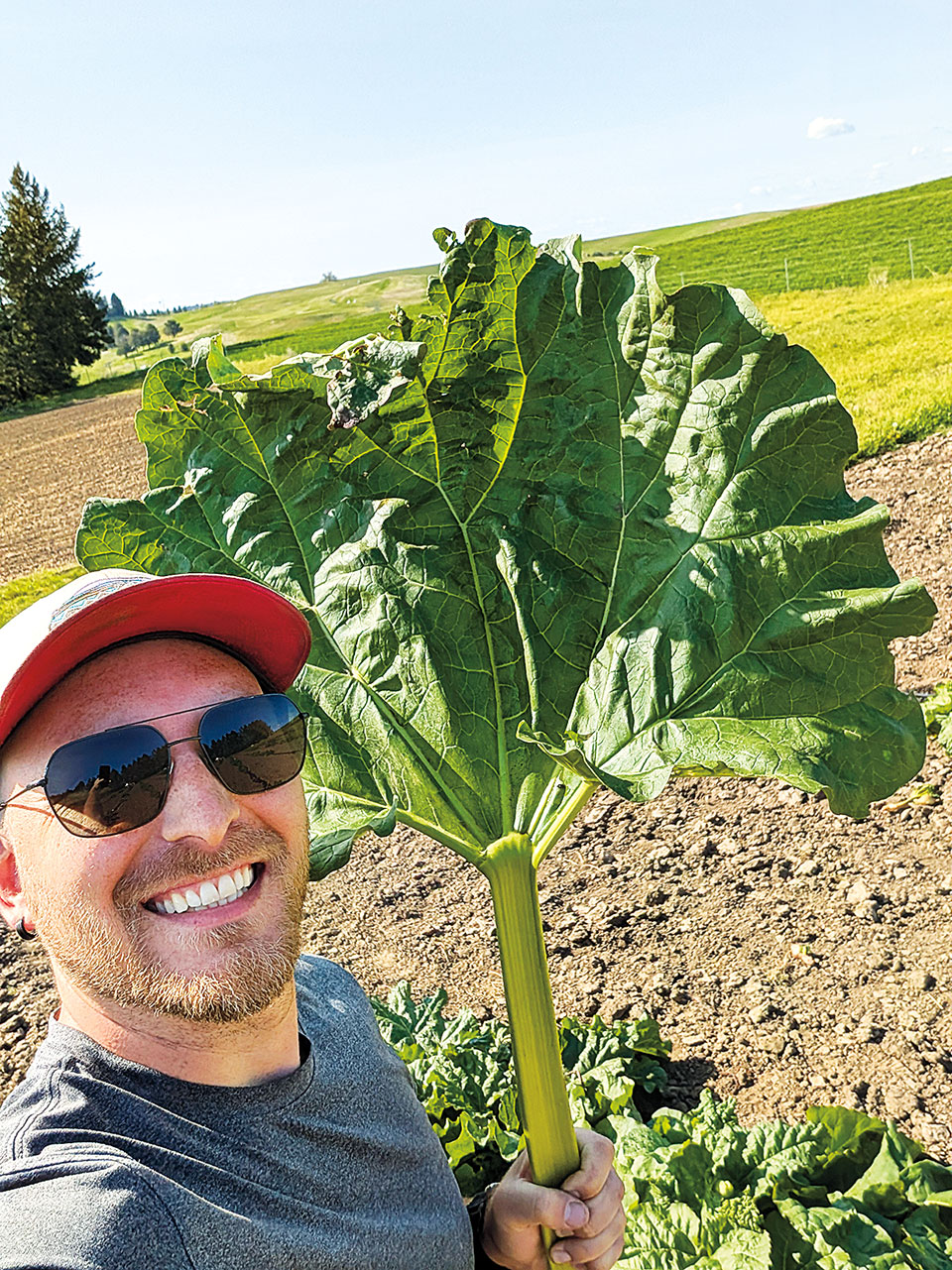
Just don’t eat the leaves, loaded with oxalic acid. According to the USDA’s Agricultural Marketing Service, “Only the leafstalk of rhubarb is suitable for human consumption. The leaf blade…can be quite poisonous.”
Ancient Greeks called the plant rha barbaron, or foreign rhubarb, likely because of its origins in ancient Asia, where—especially in China—its root was highly sought after for use as a laxative. The Silk Road brought rhubarb west. It arrived in Europe by the thirteenth century, reaching Great Britain by the 1500s. Fun fact: William Shakespeare references rhubarb in Macbeth, written in the early 1600s.
In 1742, English cookery writer Hannah Glasse published a simple tart recipe in The Compleat Confectioner, recommending stalks be cut “the size of goosberries (sic)” and the tarts made “as you do goosberry (sic) tarts…These tarts may be thought very odd, but they are very fine ones and have a pretty flavour…
A hundred years later, rhubarb went from “very odd” to very popular. The oldest variety still commonly cultivated is Victoria, introduced in 1837 in England in honor of Queen Victoria’s coronation—and largely credited with England’s rhubarb craze. Victorians were obsessed with rhubarb, considered a symbol of passion and desire. They often included the “pie plant” in recipes, such as stewed pork with rhubarb, meant to impress a potential sweetheart.
Colonial botanist John Bartram is credited with being first to cultivate the crop in what’s now the United States, using seeds sent to his Philadelphia-area farm by British merchant and fellow plant enthusiast Peter Collinson in the 1730s.
American writer Sarah Josepha Hale noted the English called rhubarb “spring fruit,” which, in her opinion, was “a much more relishing name than rhubarb.” Her pie recipe, published in 1839’s Early American Cookery: The Good Housekeeper, likens the dessert to apple pie and recommends “plenty of brown sugar, you can hardly put in too much.”
Croly, who refers to rhubarb as “one of the greatest spring luxuries,” calls for an entire pound of brown sugar to four pounds of rhubarb in the 1866 edition of her cookbook.
One cup of rhubarb has about 26 calories. One pound, about 97. But one cup of granulated sugar has 774 calories. One pound, about 1,800. So, it’s probably best not to add that extra handful, even if you have a sweet tooth or, like Miles, make your own jams.
“I love rhubarb,” Miles says. “I think it’s a great crop for its resiliency and flavor. The jam I’m working on now is cherry rhubarb. My feeling—and I personally take this very seriously—is embrace the bitterness. Embrace the lack of sweetness. If you add too much sugar, you lose the rhubarb flavor.”