
A conversation with historian Matthew Avery Sutton about Christianity in America
Christian faith has always played a significant part in American public life. Today nearly two-thirds of Americans identify as Christian, even if many don’t regularly attend church. The story of the United States is intertwined with the religion despite being a nation with a secular Constitution.
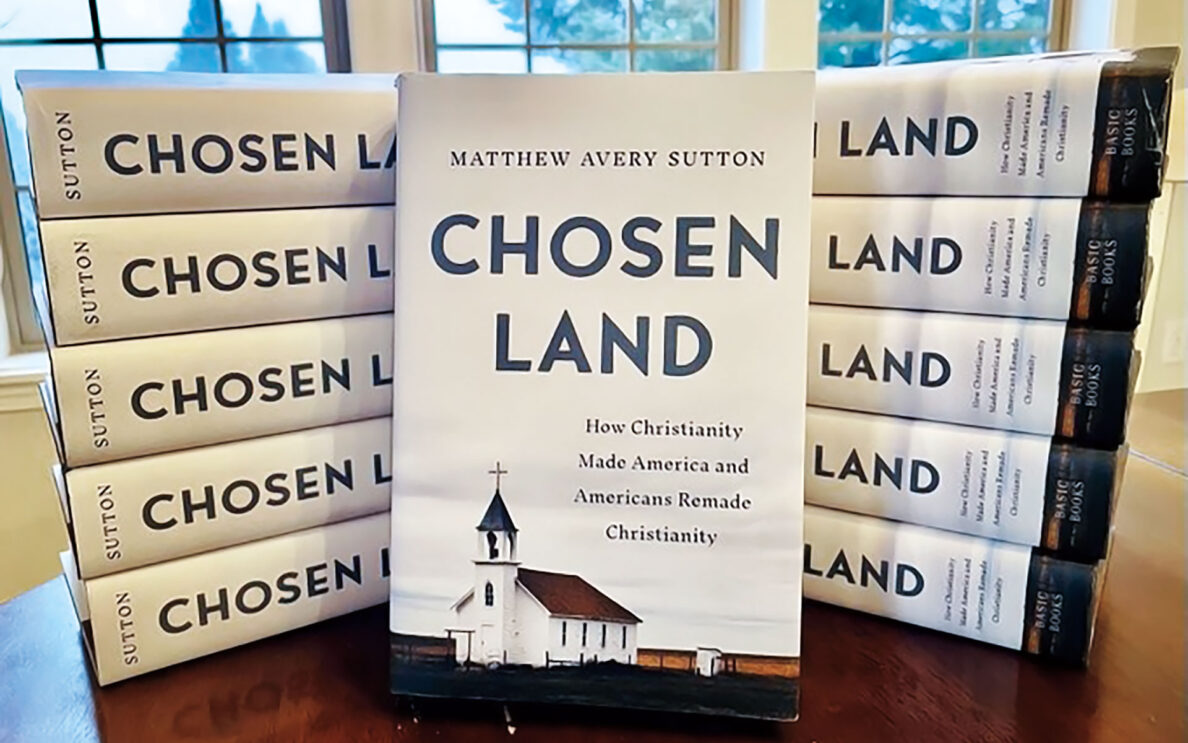
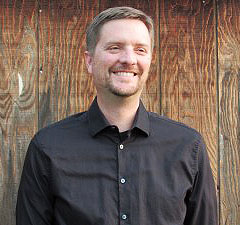
Matthew Avery Sutton, Claudius O. and Mary Johnson Distinguished Professor and chair of the Department of History at Washington State University, explores that story in his book Chosen Land: How Christianity Made America and Americans Remade Christianity (Basic Books, 2026). His expansive history of Christianity in America shows the prominent role of Christian faith and practice in politics, education, popular culture, and law through many examples from all eras of US history.
A sweeping history of the effort to transform North America into a new holy land, Chosen Land chronicles the rise of American Christianity and its continuing influence. A crucial part of that growth came from evolving strains of Christianity battling for potential adherents, because the nation’s lack of a state religion “was not a barrier to religious influence, but stimulated religious innovation, expansion, and integration in every part of American life,” Sutton writes.
Sutton talked about the book and its ideas with Washington State Magazine.
Can you talk about how Christianity is so ingrained in America and America’s consciousness?
As a historian who specializes in religion, I’ve always been struck by how much more religious we are than our competitor nations, such as Canada and much of western Europe. So what I wanted to try to understand was, how did the country really become so Christian? And why does that matter? I think contemporary politics tells us it does matter. Then the question became, where did this come from? And to tell the story, I realized we have to go back to the First Amendment and what the founders were trying to do in crafting the Constitution. They explicitly and intentionally created a secular Constitution. They looked at European establishment church models, and they realized there’s no consensus on religion in the colonies, and you need to organize everyone together to fight the revolution. So you can’t choose Presbyterians over Anglicans over Baptists over Congregationists.
When they approached drafting the Constitution and especially the First Amendment, they realized that they needed to do something that would essentially appease all parties and keep people from killing each other. They didn’t want to repeat the religious wars of the previous centuries in Europe. The designed a secular Constitution and a First Amendment that says we’re not going to choose a winner and a loser. We’re not going to establish a national religion like they did in Europe.
This approach sparked a substantial series of unintended consequences, and it opened the doors for those people who already had power, mainstream white Protestant leaders, to consolidate and expand their power. They seized the opportunity to grow their influence. Sometimes they did it individually, sometimes they did it collectively, but what happened over the first few decades of the early republic is that you have the emergence of what I call in the book the unofficial Protestant establishment, made up of Methodist-Baptist-Presbyterian-Episcopalian-and-Congregationalist churches. They work together to consolidate power, but because there’s not a state mechanism for providing financial support for them, they have to go out and be relevant, they have to offer the people something they want.
So I start this story in the colonial period by focusing on the rise of this Christian diversity, this Christian pluralism from the Puritans in New England, to the Catholics in the southwest, to the Quakers in the Middle colonies and Anglicans in the South. Then in the early republic, there was a concerted effort by these mainstream Protestants to find ways to stay relevant, because if they don’t stay relevant, they’re going to have to close their doors. There is no government funding for them like in Europe.
As a result, they became more effective than Christians in many other parts of the world because they had to tap into Americans needs, desires, interests, and entertainments. They had to make faith palatable. So that then sets the stage for them to influence the culture to maintain their relevance, and to influence laws. They worked to influence pop culture, to influence foreign policy. They fought to influence education. They knew that having influence in all of these spheres was going to help ensure their own longevity. And of course, it was never easy. There were always religious competitors, always people on the outside, pushing to become part of the inside.
What are some of those key events and key figures that helped keep Christianity infused in society, from pop culture to politics? How they were able to do that?
I opened the book with this Methodist revivalist, Peter Cartwright, because he’s campaigning for a seat in Congress against Abraham Lincoln. The challenge for Lincoln was that he was pretty unorthodox and Cartwright knew it. Lincoln was very much outside of the mainstream; he didn’t attend church regularly. He was kind of skeptical about the Bible, about Jesus. So, Cartwright made religion central to the Congressional campaign and essentially forced Lincoln to put out a hand bill. Today, it would be a publicity release, basically affirming that he was pro-church, pro-Christian, pro-God and that he would never do anything as a political leader to undermine the power of establishment Christianity.
But Cartwright wasn’t just working through politics. He was also working through schools. He had been trying to draw Methodist teachers to what was then the West to try to make sure school children were being raised in Methodism. He was also very entertaining. He wrote a memoir. He would tell these kind of fabulous stories to get attention from journalists to make sure he got good newspaper coverage. And so we see all these themes coming together, media, innovation, entrepreneurship, and politics in his life and in this historic campaign against Lincoln, and then we fast forward and see Billy Graham and Martin Luther King, Jr. doing the same thing.
We can also see these same themes at the center of American life today. President Trump, at this point in his second presidency, has demonstrated that in terms of his own life, he doesn’t take Christianity all that seriously. He doesn’t believe in sin or salvation. Yet in his recent speech at the national prayer breakfast he demonstrated that he understood how important Christianity is to the United States. And he knows it is an effective tool in American politics. Some Christian leaders have found him to be a powerful ally for their agenda. The president and the religious activists have built a relationship where they’re working with each other to accomplish shared goals. President Trump is the perfect example of somebody who recognizes this powerful traditional Christianity in the United States and recognizes that even though he was never much of a true believer himself, it was essential to his political career. He golfs on Sundays, he doesn’t worship. But it was essential to his success, and so his presidency demonstrates for good or for bad that you can’t exercise substantial power in the U.S. without making Christianity central to your agenda.
My other favorite example is Barack Obama because he recognized that the Democratic party had lost this thread. The Republicans had been able to essentially claim a monopoly on religious faith and religious adherence, and President Obama thought this was a problem, both because he was a Christian, but also because integrating faith and politics was important pragmatically, politically. The Democrats needed to talk about their own Christian values, their own Christian faith, and he was concerned that too many Democrats didn’t want to discuss faith. Hillary Clinton, for example, a devout Methodist—like Peter Cartwright—very much believed in the “social gospel,” but she didn’t want to talk about it publicly. Their reticence was undermining what the Democratic party could do, and the way that faith had functioned historically in U.S. history. And so, Obama talked about King. He talked about Reinhold Niebuhr, a leading mid-century theologian. He talked about Dorothy Day, a Catholic radical and social activist in the 1930s. About William Jennings Bryan, the populist leader and presidential candidate from the 1890s. Obama told Democrats they had a deep tradition of progressive Christianity, and they should use it.
My point is that whether you’re Donald Trump or Barack Obama, both equally understood that the Christian faith is central to American politics and culture. For the Christians in the United States, they know, of course, that faith mattered. Yet many folks, especially in the Pacific Northwest where religious adherence tends to be lower, think religion doesn’t really matter. But no, it really, really does. In my work I am trying to show how it matters historically and also up to the present day. It’s maybe even more important than ever that we understand this as we move towards the 250th anniversary of our independence.
The framers of the Constitution built into the First Amendment two parts: the free expression of religion and no establishment of state religion. How does the book address this idea?
Today, most Americans think that the Constitution separates church from state, that it erects a high and impenetrable wall between the two. Personally, I prefer this interpretation of the First Amendment, and the way the courts have interpreted it in the last few decades. I think this works best in our democracy, with the kind of religious diversity we have here in the United States.
But in the 19th century, the courts didn’t interpret the First Amendment that way. They understand the amendment as a tool for maintaining mainstream Protestant power. The justices were part of this Protestant mainstream, and they read the Constitution in a way that support their own beliefs and ideas. But if you were outside the mainstream, if for example you were a member of the Church of Jesus Christ of Latter-day Saints who believed in polygamy, you didn’t get to practice religious freedom. If you were an Indigenous leader who wanted to practice the Ghost Dance, you didn’t get to practice religious freedom. It was only certain folks whose religious freedom was protected.
The court’s shifted with the Everson decision in 1947. In that case the justices resurrected language that Thomas Jefferson had used in a letter to a group of Baptists where he described the First Amendment as erecting a wall of separation between church and state. But that, of course, is not in the Constitution. That’s not the language of the founders; that was what Jefferson thought it should be. So, only in the second half of the 20th century did the courts view the amendment as building a wall between church and state.
And now that might be changing again. The Roberts court seems to be reinterpreting the amendment in a way that is more consistent with those 19th century jurists than with those who championed strict church-state separation. The Roberts Court, especially Neil Gorsuch, is returning to earlier ideas. Gorsuch has made it very clear that if American leaders in the 19th century believed something was acceptable in terms of religion, then perhaps we should consider it acceptable today.
What about other branches of Christianity, like Catholicism, that have spread in the United States with immigration, and their role among White Protestant domination of Christianity?
Immigration very much plays a major role in this story. The United States experienced a massive wave of immigration in the late 19th century, and many of those immigrants were Catholic and Jewish, and they made the nation more diverse and they also threatened Protestant power, inspiring a wave of anti-immigrant movements.
In the 1920s Congress passed new legislation that massively curtailed immigration. By the 1950s, the children and grandchildren of those earlier immigrants had acculturated. Americans came to see their nation as “tri-faith,” consisting of three faiths, Catholic, Protestant, and Jewish.
Then the floodgates opened again in 1965 with the Immigration Reform Act under Lyndon Johnson. This led to a massive surge in religious diversity, yet even then, the vast majority of immigrants, both documented and undocumented, have been Christian. But there are enough Buddhists, Hindus, Muslims to be apparent. We can see mosques being built. We can see temples being built, and so in recent decades some white Christians have grown increasingly on the defensive, afraid that what they see as the nation’s Judeo-Christian values and culture are under threat. Today’s anti-immigrant politics is driven in part by a kind of a doubling down on protecting this idea of a white Christian nation and what that means.
But there are other groups of Christians who view the issue of immigration very differently. I try in the book to highlight the voices of those who have an alternative version of Christianity. These are people I call Liberationists, people who see Jesus as a social radical, as a revolutionary who liberated the captives and who set the enslaved free. There’s a strong Indigenous tradition that’s using Christianity as a tool to protect Indigenous rights. There is a strong tradition of Black activists who have grounded their fight for civil rights in their faith. There are preachers all over the country using Christianity as a tool to fight for social justice.
In the book I try to give voice to diversity, to the many Christianities practiced in this nation, but I also recognize power and how power is exercised. I highlight both those who can call the shots, and those who push against those in power.
You note historical precedents of “Christian nationalism,” which is often in the news these days. Where does this idea come from?
It depends on how we define Christian nationalism. In general terms, when I use the term, I am referring simply to people of faith trying to shape law, customs, society, and culture on the basis of their faith. From this definition, there are many kinds of Christian nationalism.
Some people believe that everyone should segregate their faith, that they should separate it from the public sphere. But that’s an impossible ask. If you believe something fervently it is going to influence the way you want to raise your children, the kind of culture you want to see, the kind of politics you want to embody. So, the question really then is: What are the values and ideals you’re trying to use to drive the country? Then we can have that debate, whether or not it’s about gay or trans rights, or race and racism, or economic justice, or health care.
Today, “White Christian nationalism” has become really popular among journalists as a way to explain the Trump phenomenon. And there are a lot of rightwing Christian activists leaning into that term, linking it with the MAGA movement. And so the predominate form of Christian nationalism today is very much about a very particular kind of politics. But over time we can see other versions of Christian nationalism that have taken root in American life.
Polls say if you believe X, Y, and Z, you’re a Christian nationalist. And that’s probably true. But we could also use most of the same questions in those polls to call Martin Luther King, Jr. a Christian nationalist, because he very much grounded the Civil Rights Movement in his vision of Christianity, in his vision of the gospel of Jesus Christ. Most folks who are most concerned about Christian nationalism are not concerned with the idea of Christian nationalism itself but the form it is taking in this era, its current expression.
I’m trying to offer a nuanced historical definition. But there are other folks who are using it for different reasons, and they’re using it effectively to grow their influence. Certainly what they’re doing is not what Martin Luther King Jr. was doing. I try to explain complicated stuff in ways that people can understand, which is the challenge of being a professional historian who also tries to write for a general audience in such polarized times.
America has an increasing number of people who say they’re not really all that interested in religion and don’t practice Christianity, or they say that they don’t have a religion. Yet it feels like Christianity has become more entwined with politics. How do you see this connection between politics and religion proceeding in this environment?
That’s a question I’ve spent a lot of time trying to understand. I think the answer is that if your power is pretty substantial, you don’t have to assert it. It’s all consuming. That religion is so central to our recent politics demonstrates that something is changing, that some groups are on the defensive. In recent years Protestants have allied with Latter-Day Saints and Catholics in ways that they never would have in the 19th century or even much of the 20th century. Meanwhile polling data shows that Christian adherence, that church adherence, is down. More and more people claim to be “nones,” people with no religious identification.
So, what we’re seeing are culture wars grounded in different visions of faith, or no faith at all. Some say that the Bible tells us to build the wall and be anti-immigrant, or that gay marriage should be outlawed. But those making these arguments know that not all Americans agree with them. If most Americans agreed with them, then they wouldn’t have to work so hard to spread their ideals, right? And so they’re making an argument.
It may be that we are witnessing the end of this idea of Christian dominance in the United States; we might really be on the verge of a shift towards more secularization, like we see in Canada and in England, and we may be headed into a future of more secular politics where people really do compartmentalize their faith.
Or it may be that religion will become even more infused into the culture. I see us at a pivotal moment where we could really go either way. My suspicion, which could be very wrong, is that Trump has so operationalized faith for what are clearly secular, and in some ways crass political ends that it’s very jarring to the true believers. Reagan, and especially George W. Bush, linked faith with their politics in ways that seemed authentic. They seemed to believe much of what they were saying, and they were using Christianity in ways that you might disagree with politically, but you could recognize that when they were crafting policies, most of the time they believed what they were saying.
That doesn’t seem to be the case under Trump. If I was a religious leader in this country today, I would be really worried about my young people because they can smell hypocrisy. They can smell insincerity, and so I think in adopting Trump’s transactional approach to using Christianity, they may be sowing the seeds of their own destruction.
It may also be that we see a revival of more social justice movements grounded in Christianity. Watching the Democratic campaign for the US Senate in Texas with James Talarico, he is really doubling down on his Christian faith. As a historian of religion, it’s fun for me to watch that play out and see what’s going to happen there.
We continue to see these different versions of Christianity in competition, in a kind of battle royale. I end the book by talking about essentially three groups. There are what we think of as white Christian nationalists, those who are really trying to exert power in society, imposing their ideas, their theology, and their religion on everybody else. Then there are the liberal progressive Christians, who are trying to double down on ideas of Jesus as the liberator, the emancipator, the human rights activist. And then there are those who really just want to separate religion from politics. Who will gain the most influence will be the story of the next few years.
Is there a figure in US history similar to Trump, who uses religion in a very transactional way?
Many American leaders in the past tended to take their religion a little more seriously than Trump. Some didn’t. One of the kind of funny things about George Washington is that he was very much an Anglican, but his faith was very much tied to his social status. You weren’t going to lead a Virginia plantation, play a major role in Virginia politics, and not be an Anglican. But he seems to have refused to kneel at church because he didn’t want to humble himself before God. I mean, he thought that was a sign of servants, and he wasn’t interested in being one of those. It isn’t that he was insincere, but for him it was not like a heartfelt individual religion that it would be for a Billy Graham or a George W. Bush.
Franklin Roosevelt is another one who was similar to George Washington. FDR saw religion as very practical. His advisors were telling him when the US was moving towards intervening in World War II, that a lot of Americans didn’t want him to do that. A lot of Americans were isolationists. Roosevelt’s advisors were saying Americans are very religious, you need to make sure the religious freedom argument is central to why we intervene. So he made it one of the Four Freedoms: freedom from fear, freedom of religion, freedom of speech, and freedom from want. This was intentional because FDR recognized that he had to use religion to shape what he wanted to do politically.
How has the United States changed Christianity?
The forms and rituals that Christianity takes in the United States is always changing. For example, take the Christian reformed tradition. It is very strong today in Moscow, Idaho. But what it looks like there is very different from how it looked in 1920s Grand Rapids, Michigan, which looks very different than in 1750s Philadelphia. If you brought colonial theologian Jonathan Edwards into a suburban modern megachurch he would not recognize it as the same Christianity he practiced.
How specifically have Americans changed the faith? Hyper-individualism is one part of it. Our democratic system elevates the common person and the idea that the individual should have autonomy. Individuals should have power and choice. We don’t need kings, we don’t need emperors. We don’t need to defer to our betters. So, there’s the rise of a kind of democratic politics that helped inspire a kind of democratic Christianity, a version of the faith that’s hyper-individualistic. You can see it happen in one form in the early republic and in another form today. In the modern U.S. many children do not stay in the church of their parents but venture out on their own. Or if you move to a new town, you don’t necessarily just go to the Presbyterian church because you went to the Presbyterian church in the previous town. You go to the one that’s going to meet your needs. You church hop and you church shop.
Another way that Americans have remade Christianity is to make it a popular form of entertainment, which gets back to the discussion earlier about disestablishment. Protestants have made Christianity a form of entertainment. They must attract an audience. It’s ironic that even American Catholics have had to adapt to Protestant norms, so Catholics have their own celebrities, figures who go on the radio, on TV, who launch popular magazines. Bishop Fulton Sheen in the 1950s and 1960s, for example, recognized that church leaders had to create forms of Catholicism that were Protestant-like, that used the best technology and communications techniques.
Talk about the offshoots of Christianity, new denominations, new belief systems in the US, such as Latter-day Saints.
The Church of Jesus Christ of Latter-day Saints is a great example because its members are so distinctively American, believing that the Garden of Eden was here in North America. They teach that the lost Jewish tribes sailed to what becomes the United States, and that God gave these holy scriptures to the angel Moroni who buried them in upstate New York (which then became the Book of Mormon). It’s an American religion through and through. The First Amendment provided enough room for Joseph Smith to build his faith, and yet he faced constant persecution and violence.
But the incredible thing for me is how, over the course of the 20th and 21st centuries, the Saints have integrated themselves into the center of American life, to the point that Mitt Romney could run for president in 2012. They provide an interesting case study of moving from the margins near the center, whereas other groups like the Jehovah’s Witnesses are still on the margins. Meanwhile groups like the Shakers are almost gone. It has been difficult for most groups to challenge the mainstream from the outside.
Are there other key points for someone who picks up and reads Chosen Land?
The Constitution is a secular document. Those people who want to say the founders were all God-fearing Christians are on weak historical ground. Yet they crafted a First Amendment that was vague enough that it created space for mainstream white Christians to impose their will and their values on this nation for much of its history. The founders did not separate church from state but created the context for the rise of an unofficial but very powerful protestant establishment.
I also hope through the book to convince those who are more secular to take American Christianity more seriously. I think too often it’s so much the air that we breathe, we fail to see it. I’m trying to point a light on it.
For those who are Christian, I hope they will come away from the book understanding that history is complicated and that there have always been competing versions of Christianity. Certainly every individual thinks their form is the right form, or they wouldn’t espouse it. But that there are always these competing versions of Christianity pushing back.
At the heart of the book is the argument that many Americans perceive the United States as the new Israel, the new chosen land, and that God is essentially using America to spread his vision to the rest of the world. Reagan believed it, and this idea is at the center of the idea of Manifest Destiny and it was at the center of the colonial project. It’s a reoccurring theme that has shaped our country in profound ways.
Even though we’re a seemingly secular, global superpower, we’re still really extraordinarily religious. I’m trying to explain why that is and how that influences our culture, our politics, our foreign policy, and our domestic policy and how we see the rest of the world.
Christianity is central to all of the things that both unite and divide us. And if we don’t recognize that, or understand that, then I think we won’t be as effective at building the kind of future we want to build, regardless of what that future might look like.
Read more
WSU’s Sutton named Carnegie Fellow for project on Satan in American politics (WSU Insider, May 5, 2026)