
Producing enough energy for a rapidly changing world is what’s called a wicked problem in design thinking. It’s a description used for complex issues that involve multiple stakeholders and defy quick solutions.
It’s also a description of what we do at Washington State University.
As a land-grant university, we have decades of experience working with private and public partners to translate our research into real-world solutions.
This is especially true in energy. WSU has experience and expertise in nuclear energy, hydropower, sustainable aviation fuel, hydrogen, solar, wind, and energy transmission. It’s part of our heritage.
It’s also one of the things that drew me to the university, since most of my career has been spent working at the intersection of energy security and national security.
Take nuclear energy. While there’s new interest and enthusiasm about nuclear as a power source, WSU has operated a nuclear research reactor for 65 years. We’re embarking on a major expansion of the research operation and educating professionals to work in the industry now and in the future. We have the capacity to make a big difference in this field.
We’re also a national and international leader in the effort to transition the airline industry to clean energy. WSU researchers in multiple colleges are exploring energy sources, testing, supply chain logistics, and policy in the effort to reduce aviation emissions. Earlier this year we announced a collaboration with Boeing, Alaska Airlines, Amazon and other partners to create the Cascadia Sustainable Aviation Accelerator in Everett.
The electric power program at WSU is considered among the best in the world in power systems research and power engineering education. Researchers are focused on making sure power gets where it needs to go safely and efficiently. WSU’s important and longstanding connection with Schweitzer Engineering Laboratories has been instrumental in this work.
We partner with local, state and federal agencies, and with national research laboratories, notably Pacific Northwest National Laboratory.
We make these connections because these projects are too big for any one entity to tackle alone. This has been our approach since the early 1900s, when our scientists and graduates were essential to the development of the state’s hydropower system and the ability to deliver electricity across the state.
New sources of energy, clean energy, safe energy—these are long-term challenges. But Washington State University brings a long-term perspective, along with excellence in research, education, and outreach. So bring the wicked problems. They’re no match for Cougs.
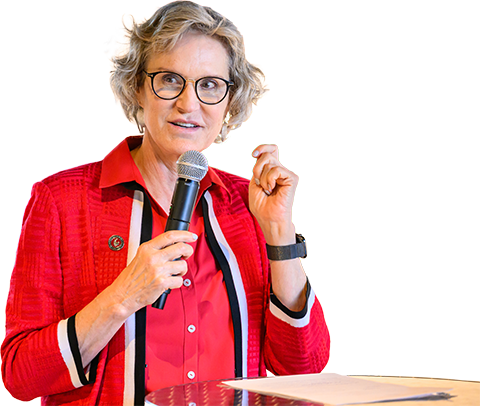 WSU President Betsy Cantwell