
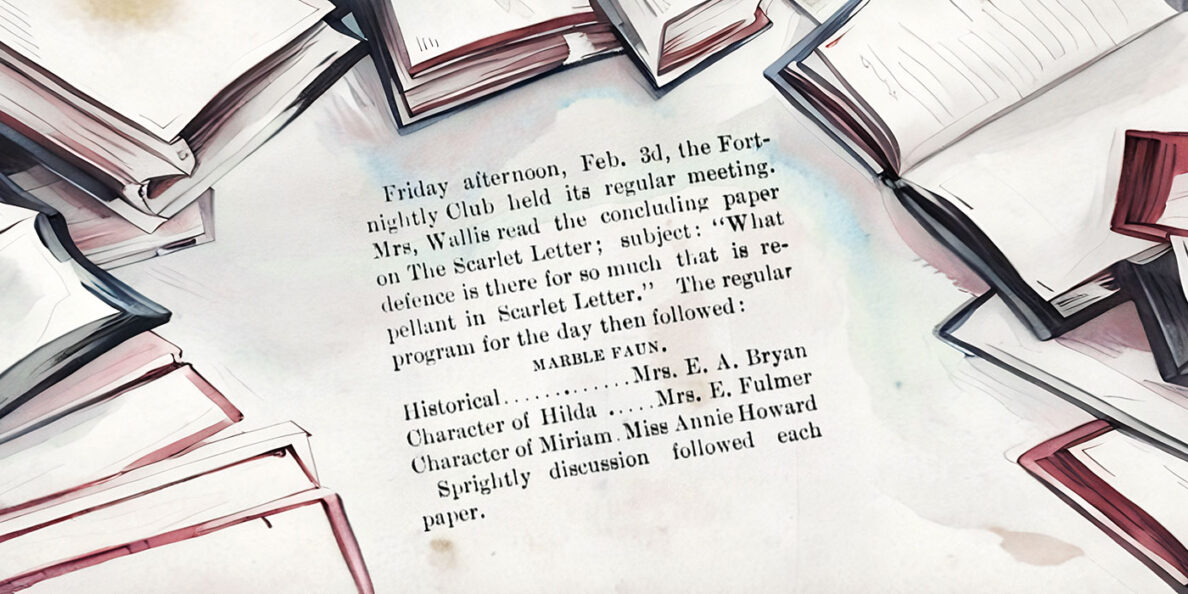
Shakespeare was an early and repeat visitor.
So was Robert Browning, William Butler Yeats, and Ralph Waldo Emerson. Oscar Wilde and Virginia Woolf popped in, too.
Booklets with PFC embossed on the covers name every author who has appeared at Pullman Fortnightly Club since its inception, and it’s an impressive list.
Sophocles. Dante. Percy Shelley. Charles Dickens. Emily Dickinson.
Just to name a few.
Reading selections show the academic fortitude of the generations of women who founded, participated in, and continue to keep alive the longtime Washington State University-related literary tradition. Established in 1893, the Fortnightly Club is the oldest continually operating book club in Pullman. It’s also one of the oldest in the Pacific Northwest and the entire country.
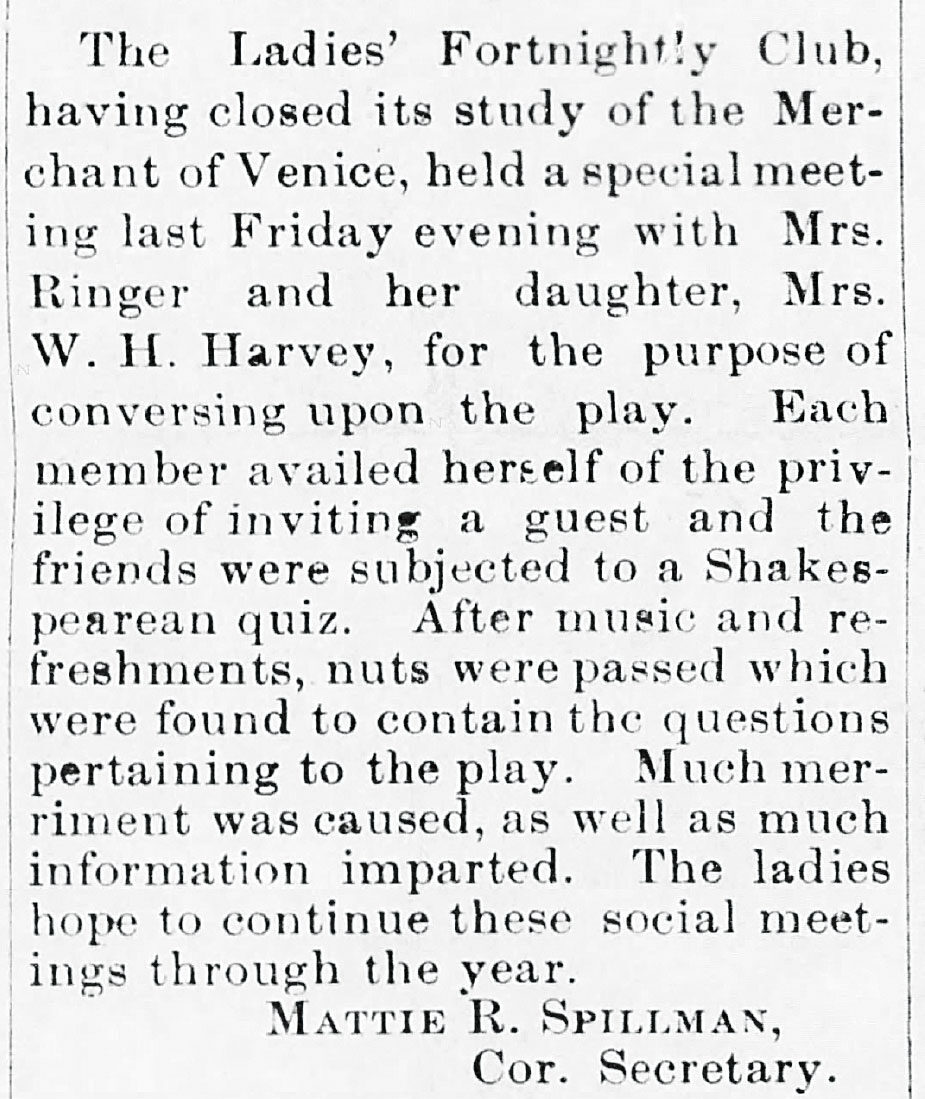
Newspaper clipping from The Pullman Herald, November 9, 1895 | Source: newspapers.com
“I love the history of it,” says former WSU registrar Julia Pomerenk, who joined the club in 2011. “Any organization that’s 132 years old is pretty remarkable.”
The early roster reads like a Who’s Who of the founding of the university. Its membership rolls feature women who share names with buildings on campus: Nancy Van Doren, Ida Bohler, Helen Fulmer, Belle Waller, Charlotte Kruegel, Peg Eastlick, and, of course, founder Harriet “Hattie” Bryan, wife of the third—but first long-term—president of the small agricultural college that would become WSU.
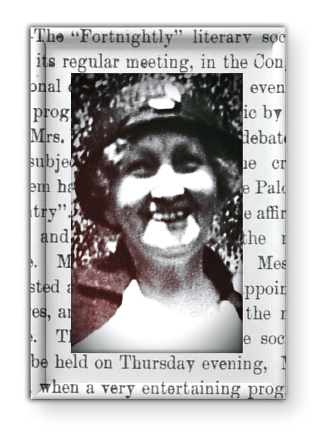 Hattie Bryan
“The story is that when they arrived, she thought, ‘We need some culture for women in this town,’” says Barbara Hammond (’80 MS, ’83 PhD Psych.), who joined the club in 2010, a year after she retired from WSU as the director of counseling and testing services. “I’m a newbie,” she quips.
Other current members joined in the 1980s and ’90s. Karen Kiessling, the first female mayor of Pullman, joined in 1972.
“When I was invited to join, I accepted immediately,” Kiessling recalls. “What could be better than being part of a club that stressed literary merit, assigned you a topic, required an hour-long presentation on that topic, and was made up of a remarkable group of women who could handle such assignments?”
“I think everybody really enjoys the tradition of it,” Hammond says. “It’s like a salon.”
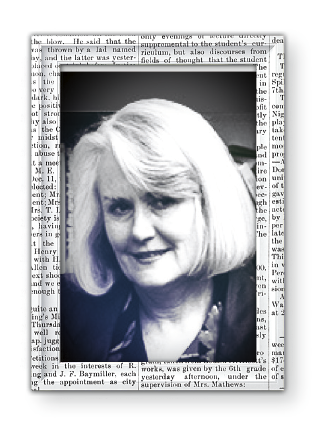 Barbara Hammond
The highly organized club has much in common with private social gatherings, dating at least to sixteenth-century Europe, in which attendees discussed literature, art, and other intellectual topics. Salons were often hosted by well-connected and well-to-do women, patrons of the arts who gave writers, artists, and intellectuals platforms to connect and share ideas.
While Fortnightly includes time for socialization, it also resembles a college-level course. There’s plenty of reading and homework. In1898, the club even administered quizzes. That practice didn’t last long.
Even so, Fortnightly hasn’t changed much since its inception. The club still meets twice a month during most of the academic year. Dues are paid annually. Meetings adhere to Robert’s Rules of Order. Members are expected to show up, accept any office they are asked to fill, and complete assigned book reports, formally presented to the members—nowadays, sometimes aided by PowerPoint.
“It’s been for me a very satisfying experience,” says Pomerenk, who recently moved back to Pullman from Oregon where she joined meetings via Zoom. Fortnightly was part of the reason she returned to town.
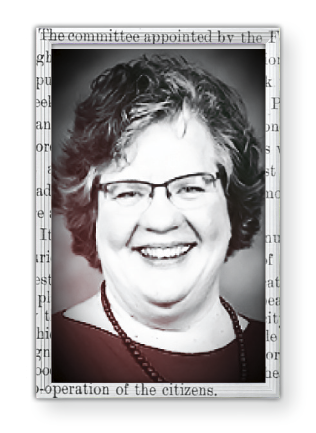 Julia Pomerenk
“I joined when I was close to 50, and some of the women are 10 and 20 years my senior,” she says. “It was lovely to be in the company of women who were older and, like an aunt or grandmother, called you ‘dear.’ It was also lovely to meet in someone’s home and share tea and cookies and conversation after listening to an in-depth presentation and thinking deep thoughts. I just love the civility of it and that sort of old-fashioned graciousness.”
The first program was held December 8, 1893, at the home of Margaret Morrell, and explored The Scarlet Letter by Nathaniel Hawthorne. Bryan discussed Hawthorne’s life. Fulmer gave a synopsis of the novel. Annie Howard led a character study. Ella Jackson led a study of the prologue. The four presentations were followed by discussion and music. Discussion continued with four more presentations on the same book during the next meeting, held two days before Christmas Eve, also at the Morrell residence.
Early on, the club spent several weeks on a particular author or book and read works by mostly male authors. Geoffrey Chaucer. William Wordsworth. Honoré de Balzac. George Bernard Shaw. Joseph Conrad. Thomas Mann. Eugene O’Neil. Robert Louis Stevenson.
Members also completed weeks-long studies of modern American poetry, Russian literature, French literature, English literature, and fairy and folk tales of Ireland. December 12, 1904, they discussed “The Lack of Humor in Norwegian Literature.” Both meetings in April 1910 addressed “the suffrage question.” During the 1911-1912 academic year, they devoted three meetings to A Midsummer Night’s Dream.
In recent history, members have been making an effort not only to not duplicate titles but to read contemporary books by women and authors of varying ethnicities and nationalities. “We read a graphic novel a year or two ago, and I think that was kind of edgy for us,” Pomerenk says.
The club aims to read about eleven books each year. By the end of this year, that roughly totals some 1,450 volumes.
“Fortnightly is touchable joy,” Kiessling says. “It’s by far the most intellectually stimulating thing I do during the course of a year.”
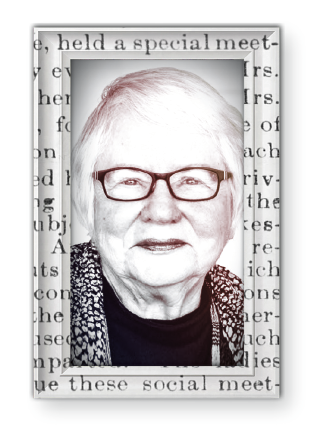 Karen Kiessling
Bryan arrived in Pullman three years after the founding of what was then Washington Agricultural College and one year after the institution welcomed its first students. She traveled from Indiana, where her husband had been president of Vincennes University and she was a member of a women’s literary circle, founded in 1891, also dubbed Fortnightly, and part of a larger trend.
Fortnightly societies, named for how often the clubs met, were springing up across the country, which was—when Bryan came to the Palouse—overcome with widespread despair caused by the Panic of 1893, the worst economic depression in history before the Great Depression. Spokane and Whitman Counties were hardest hit in eastern Washington. Silver and wheat values plummeted. Railroads were debt-ridden. And Pullman, founded five years earlier, was in its infancy, with only some 900 residents.
“The campus was then a cornfield,” Bryan recalled 15 years later. The “village,” as she referred to Pullman, had just three telephones—“one at the college and one at each railway station.”
It was pouring rain and extremely muddy the day she arrived. That night, there was a murder in downtown’s new Artesian Hotel. Pullman, she quickly surmised, needed a women’s study group.
Pullman Fortnightly Club was born in a rented house on Sunnyside Hill, where Bryan gathered “a few choice spirits” in late autumn 1893 to help her organize a “Ladies Literary Club” over cups of tea. Article II of the group’s constitution, adopted that November 27, clearly states its purpose: “the mutual improvement of its members and the study and enjoyment of literature.”
Through Fortnightly, Bryan—like many of her contemporaries as well as club members from throughout the thirteen decades since— found “a source of strength, and light, and a better intellectual life.”
Fortnightly was formed during an era when married women were referred to by the honorific Mrs. followed by the first and last names or initials of their spouses. Perhaps the best part of Fortnightly, Pomerenk says: “It had nothing to do with their husbands.”
“A hundred and thirty-two years ago, there weren’t so many organizations that women were in charge of,” Pomerenk continues. “Having officers and roles gave them formality and leadership and structure and purpose.”
The club’s founding 12 members required strict commitment. Failure to complete assigned books, presentations, and other tasks were considered automatic resignation. These days, though, there’s a little leeway; if missing work is “satisfactorily explained to the executive committee,” members might be let off the hook.
The club is run by a president, vice president, treasurer, recording secretary, and corresponding secretary, elected each year. The executive committee, plus the president ex officio, selects the annual theme and readings. Each book must be read by at least two committee members to be eligible for approval. And sometimes the committee reads dozens upon dozens of books to arrive at their final selection.
Past themes have included immigration, Israel and Palestine, Indigenous writers of the Pacific Northwest, women and work, women writers, US presidents, favorite American authors, favorite Canadian authors, humor, betrayal, and the presence of absence. The theme for the 132nd year is “Surviving the Journey.” The first two books are The Narrative of the Life of Frederick Douglass, An American Slave by Frederick Douglass and Montana 1948 by Larry Watson.
The theme, readings, and assignments are revealed at the spring luncheon, the last meeting before summer break. Until then, Hammond says, “It’s all a big secret.”
Bylaws have loosened throughout the decades. But there are still plenty of rules. Smoking is forbidden. Handwork, such as embroidery or knitting, used to be entirely outlawed; now—and this was a compromise—it’s only barred during meetings with guest speakers, although most members these days don’t partake anyway. Charitable contributions are limited to Pullman’s Neill Public Library.
The club has always been invite-only. A candidate must be proposed by two members and voted in by a simple majority. A unanimous vote used to be required. The club was more “exclusive” back then, Pomerenk says, adding, “I love the formality of it. It almost seems a little old-fashioned, and that’s part of its charm.”
Former and life members, longtime members who are no longer required to pay dues or host or present programs, are always welcome. Other than that, only family or friends visiting from out of town may be invited. Twice a year, there are exceptions: a special fall meeting, at which a guest speaker is allowed, and the annual spring luncheon, in which plus-ones—usually spouses—are allowed along with a guest speaker. Guest speakers have included Trevor Bond (’17 PhD History), WSU Libraries’ interim dean; Richard Law, husband of member Fran Law and retired WSU professor of English and director of general education, and the late Nicolas Kiessling, retired WSU professor of English.
Miss three meetings in a row for reasons other than illness or out-of-town travel, and members once risked being dropped; today, those unable to attend are required to inform the host. Members may also apply for a two-year leave, something that’s handy for faculty members taking a sabbatical, teaching overseas, or doing extended research on a fellowship outside of Pullman. But, Hammond says, she knows members who plan vacations around meetings so as not to miss them.
During the first third of its longtime tenure, the club hosted two or more presentations per meeting, which ran from 2:30 to 5 p.m.—without any refreshments, late longtime member Catherine Friel noted in 1963, during a talk marking the 70th anniversary of the club. That system endured more than 40 years before programs were limited to just one report and the meeting was shortened to two hours. The start time moved up from 2:30 p.m. to 2 p.m. then 1:30 p.m.
“Many of our members are over 65, and they don’t want to drive at night,” Hammond explains.
“Quite a few folks join after their retirement because they don’t have time in the middle of a Tuesday afternoon to go to a meeting,” Pomerenk also notes.
Plus, it’s a lot of work.
Compared to other contemporary book clubs, the format is, in a word, well, “rigid. There have been people in the club who have decided it’s not for them because they wanted a freer form,” Hammond says. “For people who liked school, this is fabulous. It works for those of us who stay in it.”
She compares the book reports to writing and presenting seminar papers. “Usually, people include background information about the author, historical or geographic context, and a summary of the book,” she says.
Pomerenk thinks of them as term papers. “Some of the women have talked about being very nervous before their first presentation,” she says. “I was an English major and I give a lot of presentations, so it never bothered me as much.”
Her style is “less formal.” But, she says, some members “present a paper like they are at an academic conference.”
For her first presentation—on 1971’s A W.E.B. DuBois Reader, edited by Andrew G. Paschal—Kiessling donned a replica of a dress from the year of the author’s birth: 1865. The theme was people whose ideas were ahead of their time. The year was 1974. The dress: purple taffeta with a high neck, long sleeves, bustle, and pleated, floor-length skirt.
“You are reading and reading and reading,” Kiessling says. “It’s hard work, but it’s worth it. You benefit because you meet writers you never would have met on your own.”
To liven up one of her presentations, Hammond, club archivist and a psychologist, delivered her talk “as if it were a therapy case. I wrote an intake report, then talked about what the author might have brought into therapy as part of the narrative.” The book: 2017’s You Don’t have to Say You Love Me: A Memoir by Sherman Alexie (’94 Amer. Stu.), a former student of her husband, Alex Hammond, an emeritus associate professor of English at WSU.
“All books are supposed to be of literary merit,” Hammond notes. “I love it because it forces, or encourages, me to read things that I never would never have selected on my own, and I end up just being fascinated by them.”
That’s one of the reasons many remain members for life. That, and, Pomerenk says, “being in the company of these very accomplished, very lovely women.”
Says Kiessling, “These are very precious friends to me.”
Catherine Friel, a member from 1929 until her death at 101 in 2003, concluded, “Memberships in Fortnightly are usually of very long duration because of the happy fellowship of minds. Time itself has proved to be the greatest factor in the slowly, but ever-changing personnel of the Fortnightly Club.”
There have only been about 300 members in all, low for a 132-year-old institution. But membership has always been limited to 25 active members. And they had to have a Pullman address. “You still do, actually,” Hammond says, adding, “We’re discussing that.”
Early on, the club hosted meetings dedicated to musical performances and appreciation. In addition to these musical matinées, there was even an official club song. At some point the annual breakfast—to which women wore white dresses—became a luncheon, complete with a book exchange and the distribution of the annual booklet. Since the start, the yearbook has been peppered with literary quotes as well as the upcoming calendar.
Gustave Flaubert: “Be regular and orderly in your life, so that you may be violent and original in your work.”
Francis Bacon: “Read not to contradict and confute, nor to believe and take for granted, nor to find talk and discourse, but to weigh and consider.”
Dolly Parton: “Never get so busy making a living that you forget to make a life.”
Shirley Chisholm: “If they don’t give you a seat at the table, bring a folding chair.”
The yearbooks, Pomerenk says, are “one of the most charming artifacts. I think it is so pleasing to have a little booklet noting everything we will read for the year.”
Every five years, the club hosts a special anniversary dinner. The fourth anniversary dinner—celebrating 20 years and hosted by the Bryans—was held in 1913 at the President’s Residence, now the Ida Lou Anderson House. A hundred years later, in 2013, the 120th anniversary dinner was also held there.
The 125th anniversary dinner in 2018 was held at the Black Cypress restaurant, located in downtown’s Webb Block building. Built in 1891, it once held the Pullman Herald office, a barber shop, jewelry store, and realty office. The club chose the location because the Bryans likely visited the building in their day.
Regular meetings are held in members’ homes or meeting spaces, such as church fellowship halls and credit union conference rooms, and take place on the second and fourth Tuesday of the month—except in November, December, March, and summer, following the WSU calendar.
The COVID-19 pandemic halted in-person meetings. But 9/11 didn’t stop the ladies of the club. On September 11, 2001, Kiessling was scheduled to present Bill Bryson’s 2000 travelogue In a Sunburned Country at 1:30 p.m. Another member called, asking if the meeting should be canceled.
“My immediate response was no, that when terrorists and their acts disrupt our lives and make us hide from normal activities, they win,” Kiessling writes in “Reminisces of Members,” a publication prepared for the club’s 110th anniversary in 2003. “We did meet, and we laughed heartily at the adventures and misadventures of this entertaining man. We did need relief, and I believe that the first members of Fortnightly might have well made the same decision.”
The theme for that dinner: “Would our Great Grandmothers Have Been Amazed?”
Pomerenk thinks so. “They would be delighted that a group of women still meets every other week during the school year to talk about books. I think they would be so pleased that it’s still going on, even now that women are more integrated into society. I would like to think they would also say, ‘Of course the world is more inclusive now.’ And I think they would be happy that that’s true.”
Hammond thinks so, too. “They probably didn’t think it would still be going.”
Photo sources for portrait insets in illustrations (from top):
WSU Manuscripts, Archives, and Special Collections, Washington State Magazine file photo,
University of Oregon, Moscow-Pullman Daily News