
Robert Catena’s pregnant wife fell in the restaurant kitchen where she was working shortly after he finished his postdoc. Neither she nor their daughter—born three months later—sustained lasting injuries, but her coworker was less fortunate. She miscarried after a similar fall.
Catena was already specializing in biomechanics in workplace settings. Reducing the risk of falls during pregnancy through balance control became an ongoing research area for him.

“It opened my eyes to the plight of pregnant individuals, particularly if they are low-income and working in jobs with hazardous conditions,” says Catena, now an associate professor of kinesiology at Washington State University. “They might have to choose between getting a paycheck and doing what’s safest during their pregnancy.”
Research suggests that about one in four women will fall during a pregnancy. During the early weeks, the uterine walls and amniotic fluid help cushion the fetus. But the likelihood of falling increases dramatically around the seventh month of pregnancy, when the potential for serious harm also escalates. Falling can trigger early contractions or detachment of the placenta, or can lead to chronic back pain for women.
At WSU’s Gait and Posture Biomechanics Lab, Catena and his graduate students are working to prevent falls by understanding how balance changes during pregnancy. More than 200 pregnant women have taken part in the studies.
At the laboratory, reflective sensors are attached to the women’s joints and other body landmarks. Cameras in the lab send out infrared lights, which bounce back to show where the sensors are. As study participants perform routine tasks like walking on a treadmill, sitting down, or standing up, the cameras capture their movements. Participants return every four to six weeks so changes can be detected as their pregnancy progresses.
“It’s the same sort of system used to create animated characters in movies and video games,” Catena says. “We use this system because it’s so accurate at measuring motion. It detects changes we can’t perceive visually, down to fractions of a millimeter.”
The research challenges some previous assumptions about falls and pregnancy. Balance issues in pregnant women, for instance, are often equated with obesity.
“That’s fairly common for researchers in my field,” Catena says. “They want to attribute the increased risk of falling to an individual’s increased weight. That may be a bit true, but it’s not the whole story.”
The mechanics of women’s posture and gait change during pregnancy. Their pelvises tilt forward, their knees hyperextend, and the curve in their back increases. Their center of gravity shifts as they gain weight in their abdomen, thighs, and breasts. In addition, things like changing hormone levels and lack of sleep affect balance, which is itself a highly complex area.
The lab also studies how brain function, overall fitness, and body awareness all contribute to balance.
“Balance involves your vision, the vestibular system of the inner ear, and the ability to understand where your limbs are without looking at them,” Catena says. “All of these things are providing us feedback about our mechanics, which we process through our nervous system to maintain our balance.”
After peaking around the seventh month of a pregnancy, the risk of falling tapers off. Researchers have attributed the drop to women being less active during their final weeks of pregnancy. But Catena’s findings question that.
“Our current hypothesis is that balance improves during the third trimester,” he says. “By then, women have gained the majority of their pregnancy weight and have lived with it for several months.”
Bolstering that theory, Catena and his students documented that women in their second trimester underestimated how high they needed to step to match the height of potential obstacles. The faulty perception increases the risk of tripping in real-world settings, Catena says. But by the third trimester, the women’s perception had improved, and they were lifting their feet high enough to clear the obstacles.
Another study found that women’s sense of balance temporarily declined in the first month after they gave birth. Women are suddenly carrying less weight, their hormone levels are rebalancing, and caring for newborns often leaves them sleep-deprived.
The insights gained from studying balance during and after pregnancy could help other groups, such as people with artificial limbs and older adults. For instance, waddling—or walking with a wider stance—appears to improve balance during pregnancy, Catena says. Instead of discouraging waddling, physical therapists might consider potential applications for patients with artificial legs.
Catena eventually wants to develop a calculator doctors and nurses could use to talk to pregnant patients about their individualized fall risk. Part of that discussion might involve lifestyle changes or workplace accommodations.
“We want to help obstetricians have informed conversations with their patients,” Catena says, “with the outcome of fewer falls and safer pregnancies.”
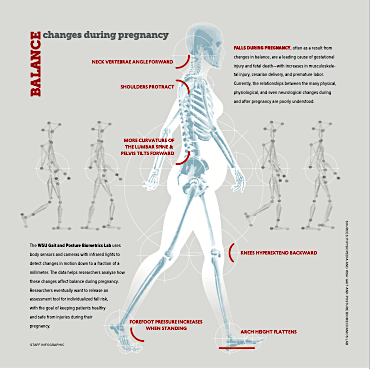
Infographic: Balance changes during pregnancy (PDF)
Listen to the infographic audio version View the infographic text-only version