
The tardigrade is a weird animal. Nearly indestructible, not quite microscopic (almost the size of the period at the end of this sentence), and surprisingly adorable, this eight-legged creature has super-survival strengths.
Chemistry professor Gary Pielak (’83 PhD Biochem.) studies tardigrades and says he thinks they may hold secrets that will revolutionize how vaccines and other medicines are made and shipped.
Often called water bears, tardigrades (from tardigrada or “slow stepper” in German) look like water balloon beasts. They graze high in the Himalayas, adore jungle heat, romp in lawns on campus, and are easily found under a simple microscope.
“Everybody loves tardigrades,” says Pielak, who teaches at the University of North Carolina–Chapel Hill. “We keep a colony in the lab just to show people because they’re so cute.” A blue tardigrade plushie adorns his desk.
Their seeming squishiness belies genetic powers a superhero would envy. They shrug off temperatures up to 300 degrees Fahrenheit and down to –450 degrees Fahrenheit (near absolute zero). Mega-blasts of radiation leave them unfazed. European scientists tested it in 2007 when they sent 3,000 tardigrades into orbit on the outside of a rocket and 68 percent survived.
Some incorrectly label tardigrades as an extremophile, a creature that lives in extreme conditions. Extremotolerant might be more apt. When faced with dire conditions, tardigrades curl like roly-poly bugs and dry up. Some have been revived decades after tuns, the scientific word used to describe their dormancy.
Evolution clearly favors tardigrades that wither better than others. Their DNA has an amazing ability to repair itself. That’s why some sensational press reports claim tardigrades’ secrets may one day help humans age better or endure long space voyages.
Pielak has more practical and achievable goals. Today, many pharmaceuticals must be chilled to prevent their active ingredients from spoiling, a huge and costly problem when drugs are shipped to remote areas. The Ebola vaccine, for example, must be kept at –140 degrees Fahrenheit or lose potency.
“We spend billions of dollars every year keeping biological drugs—protein-based drugs—cold, but if you could dry them out, you wouldn’t have to keep them cold,” Pielak says. “Tardigrades have the weirdest proteins I’ve ever worked on. If they help tardigrades survive, can they help other proteins survive?”
He recently put their proteins in the bloodstreams of lab mice who experienced no ill effects. His goal? To see if tardigrade protein is toxic to mammals. “Let’s face it,” Pielak says. “If it killed mice, it wouldn’t matter how effectively it protected a medically relevant product.”
Because water bears are transparent through their life cycle and easily managed in the lab, they make ideal research subjects. “The study of tardigrades is taking off like a rocket,” Pielak says.
His tardigrade focus arose eight years ago and dovetails with his long-standing passion for understanding the inner workings of cells. “After I earned tenure, I decided I wanted to work on something that’s almost impossible: trying to understand the protein biophysics in living cells …
“Cells are much more organized on the inside than we think they are—and crowded too,” Pielak says. “What hooks the two parts of my research program together is proteins under very high concentrations. You can dry out a tardigrade and bring it back to life, and you can’t get much more concentrated than a dry protein.”
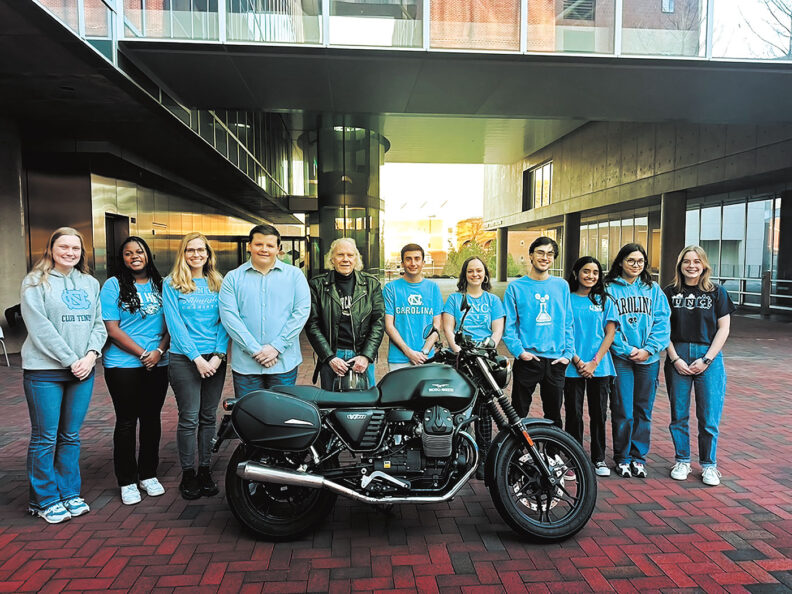
Around campus Pielak sports an Einstein-like mane of white hair. He stands out in his black leather motorcycle jacket that matches his black Moto Guzzi Italian motorcycle. At the bottom of his faculty web page, this quote appears in small type: “When the going gets weird, the tough turn pro.”
When asked why he selected a saying from the late gonzo journalist Hunter S. Thompson, Pielak replies, “Once you get interested in something unique, you want to go all into it and understand it. That’s what it means to me.”