

It’s no secret that the fashion industry is unfashionably wasteful.
“Fast fashion” often gets the blame for the industry’s environmental impact, but that’s not the whole picture.
“It’s the entire system, how the fashion industry operates,” says Armine Ghalachyan, an assistant professor in Washington State University’s Department of Apparel, Merchandising, Design and Textiles (AMDT).
That means people are buying more clothing than ever before but are only wearing items a few times. Many of the castoffs end up in landfills or incinerators because they can’t be recycled. Making fabric takes vast amounts of water and chemicals. And the fashion industry as a whole is responsible for a significant share, possibly as much as 10 percent, of global carbon emissions.
To address these issues, WSU builds an emphasis on sustainability into every part of the AMDT curriculum, says Ting Chi, professor and department chair.
The focus is on “circular fashion,” which means planning for both the beginning and end of a product’s life cycle. So, for example, is the garment designed in a way that it can be repaired or upcycled? Is the fabric recyclable or biodegradable? Circular fashion also might mean new ways of doing business, such as clothing rentals. It includes developing new fabrics out of sustainable materials, or devising new production methods that don’t consume as many resources or produce as much waste.
Chi points to Hang Liu, an associate professor in AMDT who successfully developed patented technology to upcycle cotton waste into new fibers.
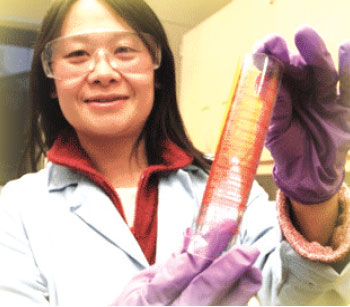
She has been honored for her work with the Mid-Career Excellence Award by the International Textile and Apparel Association.
“Our faculty are researching the development of new materials, textiles, and apparel to meet industry and consumer needs while addressing the sustainability challenges facing both the industry and society as a whole,” Chi says. “Our research has been very impressive.”
Students are all in too.
Rowena Gonzalez, for example, experimented with dried kombucha as a leather alternative and used the material to design and produce a handbag.

Mya Phan (’23 MS AMDT) designed modular, reusable wedding dresses.

Kiah Conway turned fabric scraps into wearable art, diverting textile waste from landfills.
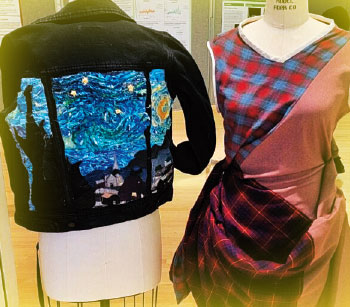
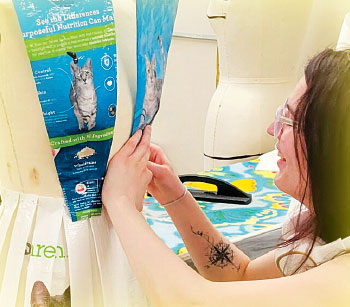
And AMDT students have designed products from discarded materials
like hotel linens …

… and even kitty litter bags.
Being in a design program that emphasizes sustainability is important to her, Gonzalez says. Based in part on her research into the kombucha material, she was awarded a competitive internship with a London design studio that specializes in regenerative materials. The experience exposed her to designers and manufacturers that are experimenting with things like dyes made from natural materials, and even biodegradable sequins.
She expects to graduate in May 2025 and eventually wants to have her own sustainable, affordable brand.
That aligns with WSU’s goals for the department, Ghalachyan notes: “We want to produce industry professionals who will become changemakers in fashion.”