Give the common fruit fly some respect.
After originating in sub-Saharan Africa, Drosophila melanogaster hitched rides on overripe fruit to follow migrating humans around the globe. The prolific flies with bulbous red eyes are annoying pests in kitchens and compost piles. But in the laboratory, fruit flies are powerhouses for studying evolution.
Each year, Seth Rudman raises about five million fruit flies in his lab at the School of Biological Sciences at Washington State University Vancouver. The clouds of buzzing insects are integral to the assistant professor’s study of rapid evolution and adaptation.
Because of their fast maturity rates and similarities to mammals and other organisms at the genetic, molecular, and cellular levels, researchers have used fruit flies in research for more than a century. About every two weeks, a new generation of fruit flies reaches adulthood.
“In my opinion, there is no other system in biology quite like Drosophila melanogaster,” Rudman says. “You can stand on the shoulders of so many other scientists and leverage previous research to answer difficult and important questions in your own field.”
Rudman’s work on the pace of evolution has implications for everything from pest control and new COVID strains to wildlife conservation. Evolution is often considered a process that occurs over hundreds or thousands of years, he notes. But species also can adapt and change quickly.
“Rapid evolution is important to so many aspects of our day-to-day lives,” says Rudman, whose research is supported by a National Institutes of Health grant. “Knowing more about the underlying process of adaptation, and how it occurs, gives us insights into how we can either speed it up or slow it down.”
Take pest control, for example. Insects’ and plants’ ability to adapt to chemical spraying is problematic for farmers, leading to the emergence of insecticide-resistant bugs and herbicide-resistant weeds. Similarly, antibiotic resistance makes certain strains of bacteria difficult to treat. And anyone who has rolled up their sleeve for a COVID booster shot has experienced the consequences of viruses mutating and spreading through natural selection.
“The rise and spread of new COVID variants is among the most visible evolutionary trajectories of my lifetime,” Rudman says. “Unfortunately for us as hosts, the variants with the highest fitness spread at the highest rates.”
Organisms’ ability to adapt quickly can also be beneficial, increasing plants’ and animals’ resilience to climate change, pollution, and habitat loss. Hotter ocean temperatures, for instance, are major contributors to the bleaching of coral reefs. But if some corals can adapt to the hostile conditions, they will boost survival rates for reef ecosystems that protect coastal communities from storms and support the fishing industry.
“We have questions about how much biodiversity will persist in response to the kinds of environmental changes occurring today,” Rudman says. “Rapid evolution could be one way in which we lose much less biodiversity than has been projected.”
The same traits that make Drosophila melanogaster kitchen pests are ideal for Rudman’s research. Over the course of its short lifespan, a female will lay 400 to 500 eggs. And as their globe-trotting past indicates, fruit flies are easy to rear and remarkably sturdy.
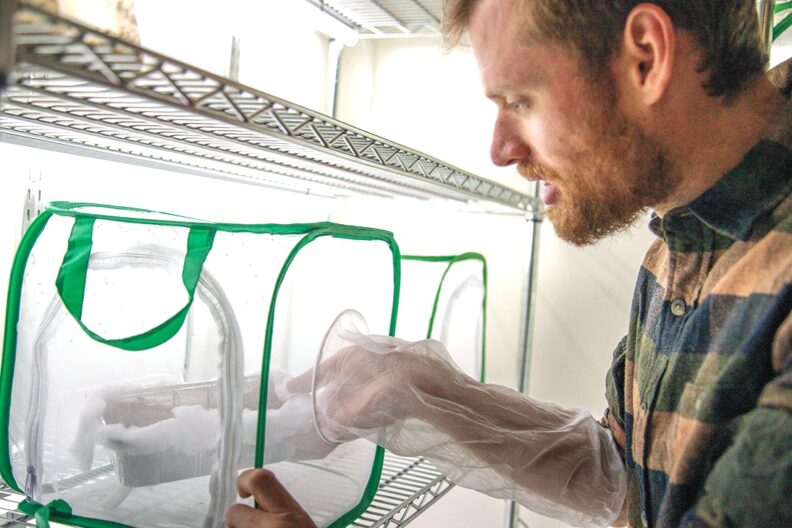
Rudman orders strains of fruit flies from a facility at Indiana University Bloomington, where the flies’ genetic lineages are carefully tracked. When the shipments arrive, the flies feed and lay their eggs in a medium that Rudman and his graduate students stir up. The recipe includes cornmeal, yeast, soy flour, and molasses—a mix that smells similar to the fermentation of fruit caused by natural yeasts and fungi.
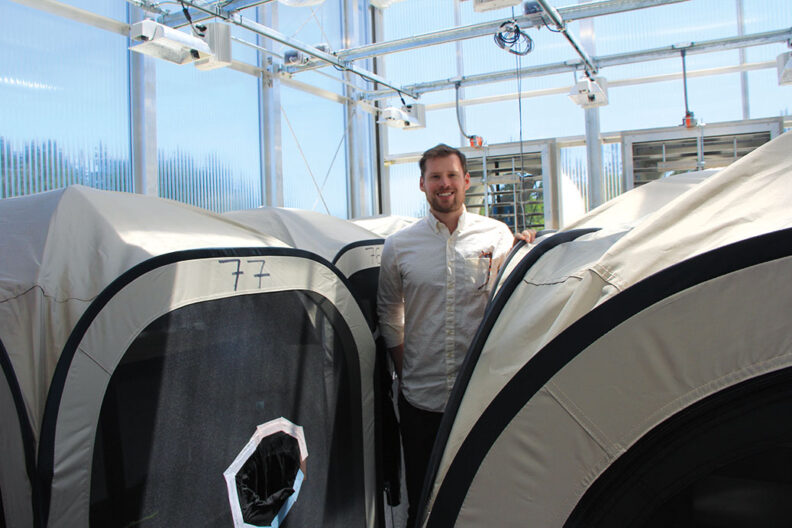
Between spring and early fall, 10 to 12 generations of fruit flies will hatch in tentlike structures called “population cages” at the WSU Vancouver campus. Some of the cages are indoors, where the environment is relatively controlled. The outdoor cages, however, are subject to fluctuating temperatures, wildfire smoke, changing hours of daylight, and other forces.
“In the natural world, many things are changing at the same time,” Rudman says. “Field experiments tell us about the way that natural selection works in populations subject to multiple changes, including changing seasons.”
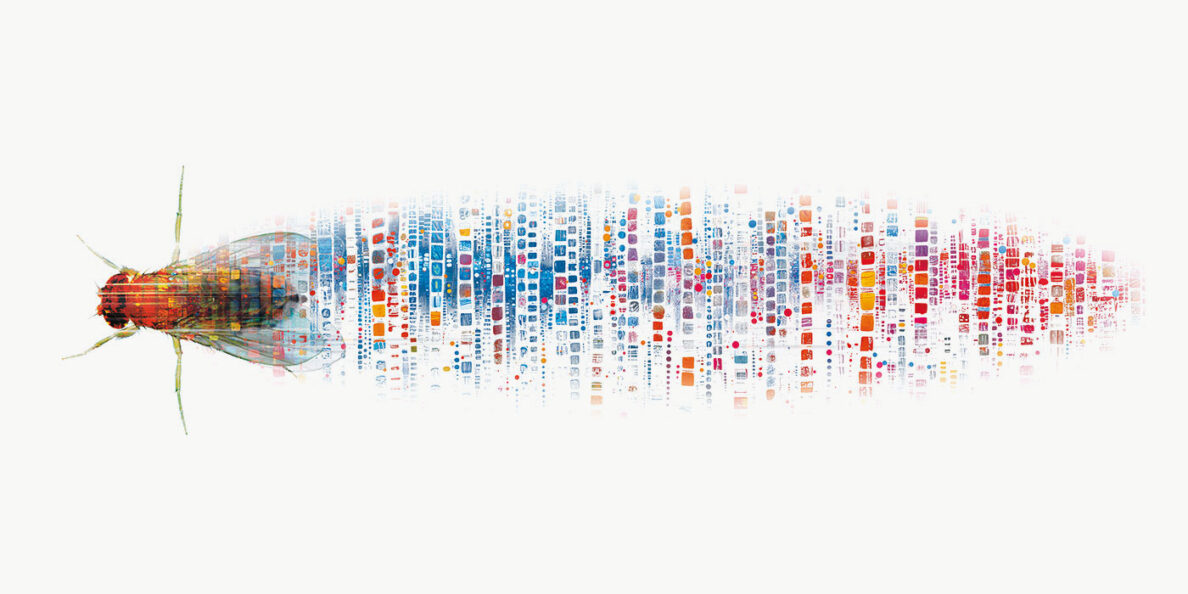
At the end of the field season, he and his students will sample the 50 fruit fly populations they’ve reared to look for population-wide changes. Their work involves repeated genome sequencing to detect evolution at the molecular level and additional lab work to track changes in inherited traits.
The data will help answer a central question in Rudman’s field: Can adaptation occur as rapidly as environments change? It’s a big query to ask of small insects, but the tenacious fruit flies are up to the task.