
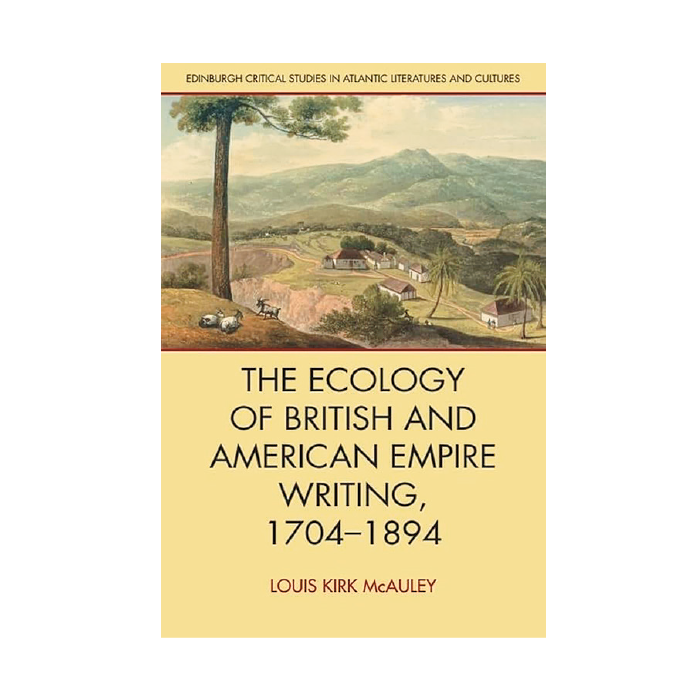
Louis Kirk McAuley
Edinburgh University Press: 2024
This scholarly but approachable text opens familiar books to environmental awareness and industrial expansion. By analyzing works such as Daniel Defoe’s Robinson Crusoe and Robert Louis Stevenson’s Samoan writings, Louis Kirk McAuley shows how “empire writing” served as both a chronicle and a catalyst of ecological change. Not only that, but he addresses the continuing relevance of historical literature to contemporary environmental problems.
To build his theoretical framework, McAuley, chair of the English department at Washington State University, draws partly on Jason Moore’s idea that capitalism is a political project as well as a process contingent on biology and geology. Using this and other sources, McAuley offers a lens through which to view the interconnected histories of human and non-human natures. Specifically, he draws attention to the British Empire as co-produced by humans, other animals, and plants.
His theoretical foundation also provides a tool to challenge traditional readings of British and American literature, revealing how these early texts acknowledge the environmental disruption of the expanding empire.
Take McAuley’s interpretation of Robinson Crusoe’s discovery of English barley on the “desert” island. What has traditionally been seen as divine providence becomes, in McAuley’s analysis, a window to a larger story of how European expansion reshaped global environments. This important moment signals Crusoe’s shift toward ecological awareness. Crusoe changes from seeing his surroundings in purely religious terms to understanding how humans can cause environmental change.
Equally compelling is McAuley’s treatment of Caribbean sugar cultivation. Here, he turns to 18th-century Scottish physician and poet James Grainger, who wrote the 1764 poem “The Sugar Cane.” McAuley argues it reveals how empire writing celebrated as well as exposed the environmental costs of monoculture agriculture.
His discussion of Stevenson’s encounters with invasive species in Samoa challenges readers to see the description of the sensitive plant Mimosa pudica as an example of the “horror of creeping things,” itself a commentary on rampant ecological change.
“Entropical” transformation—McAuley’s concept combines “entropy” and the “tropics”—helps readers understand how colonial agriculture wrote irreversible changes throughout the empire. This innovation partly explains how island dynamics, once disrupted by European commerce, suffered damages that affect them to this day.
McAuley’s interdisciplinary approach draws on environmental history, economic theory, and literary analysis. The result is a robust and highly readable book that speaks to the past while providing vital insight to contemporary issues. In fact, McAuley’s own experience in Kingston, Jamaica, while researching this book, narrated in the afterword, adds to his analysis. His observation of hurricane damage to historical archives and the contrast between tourist resort and urban poverty shows how “unruly natures” continue to shape both environmental and cultural memory.
Part of the Edinburgh Critical Studies in Atlantic Literatures and Cultures series of Edinburgh University Press, the book was shortlisted for the 2025 ASLE-UKI book prize in ecocriticism. It’s a reminder that the best literary criticism can make us see old books and the natural world with new eyes.