
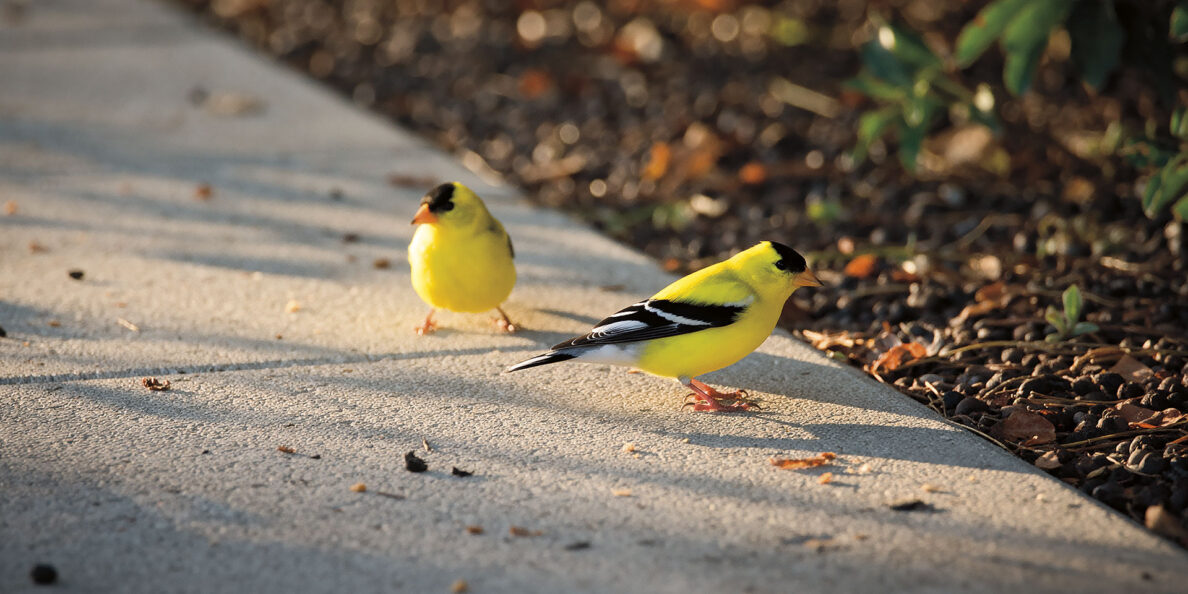
Johanna Brown’s daughter just turned two, but the toddler is already learning to look for birds on family walks and count them.
Brown (’13 MEd) encourages her daughter’s curiosity and observation skills—traits she hopes will lead to a lifelong interest in science and the natural world. Through her work at the state Office of the Superintendent of Public Instruction (OSPI), Brown has the same goals for Washington’s K-12 students.
“I want every student to have that deep feeling that their questions and wonderings about the world are valuable and should be pursued,” says Brown, OSPI’s associate director of secondary science education.
 Courtesy Johanna Brown
Many decisions in life require a basic grasp of science and related math concepts. Should you get a vaccine booster shot? What are the risks of building in a floodplain? How will a vehicle’s mileage-per-gallon affect its operational costs over time?
Yet studies show that fourth graders’ interest in science drops off by the time they reach eighth grade and continues to decline through high school. Only 40 percent of Americans achieved high scores on a short test of basic science concepts, according to a 2019 Pew survey.
And while Americans generally view science favorably, the National Science Foundation reports, relatively few take part in any kind of scientific activity, including helping their kids with science projects.
For Brown, who leads grades 6-12 science education at OSPI, those kinds of statistics represent missed opportunities for individuals and society. Deficits in scientific literacy have repercussions for the US economy, innovation, and government policy.
“Scientific literacy is at the heart of so many decisions we make—individually for our families, but also for our community, the nation, and the planet,” Brown says.
Ironically, the lackluster interest in science comes at a time of unprecedented access to information, says Robert Danielson, associate professor of educational psychology at Washington State University Spokane.
People can follow well-known scientists on social media and ask them questions. Many scientific journals now offer free access to their articles. And if you’re wondering what causes thunderstorms, how some birds navigate by the stars, or what nuclear fusion is, smartphones provide instant answers.
Danielson didn’t have those options as a kid. “If I wanted to learn something science-related on a weekend, I could ask my parents. I could look it up in an encyclopedia or go to the library. Or I could wait to ask my teacher on Monday.”
Before she joined OSPI, Brown was a nationally recognized Pullman High School science teacher and a recipient of the 2021 Presidential Award for Excellence for Math and Science Teaching.
“I shed some tears when I left teaching,” she says. But her work at OSPI aligns with her goals of helping other teachers convey science in relevant ways.
During her classroom days, Brown’s chemistry classes took field trips to the WSU creamery and dairy farm, where they got a first-hand look at chemistry’s role in ice cream’s structure and freezing point and how cow manure composts. During the COVID-19 pandemic, Brown’s students used their kitchen microwaves and chocolate bars to measure electromagnetic waves at home.
Scientific literacy involves more than memorizing facts for a test, she says. Developing that deeper understanding of scientific principles better serves students in the long run, Brown says.
“I love the idea of a scientific conspiracy, where a bunch of scientists get together and all agree to doctor the books,” Danielson says with a chuckle. “But that’s not how science works.”
The spread of conspiracies like “climate change is a hoax” require a target audience unfamiliar with the process of scientific discovery, says Danielson, who studies the public understanding of science and related policy implications.
Results from studies are reported in scientific journals. Before publication, the paper is peer reviewed by other scientists. After the findings are publicly released, other scientists seek to replicate the research results.
“A single finding does not make a breakthrough,” Danielson says. “We see this with climate change. More than 99.9 percent of scientific studies and 97 percent of scientists agree that burning fossil fuels causes the earth to warm. One or two studies might dispute that, but they are not based on science.”
Danielson says increased scientific literacy would help quell misinformation. “If people questioned some of these claims, they would fizzle out instead of going viral on social media channels.”
A robust economy needs workers with skills in science, technology, engineering, and math. That’s particularly true in Washington, a national leader in STEM jobs.
“We’re experiencing a large shortfall of qualified workers, and it’s only going to grow,” Brown says.
By 2030, Washington will have 151,400 more STEM jobs than local postsecondary graduates who can fill them, according to projections from Washington STEM, a Seattle nonprofit.
Some of those jobs require four years of college or a graduate degree. Others are attainable with a community college degree or a technical education certificate, Brown says.
Creating a pipeline of STEM workers starts with engaging elementary students in science and related fields. Parents’ interest in science can set a positive example for their kids, Danielson says.
In graduate school, he was part of project with fourth graders and the Mattel Children’s Foundation. It used Hot Wheels to teach kids about potential and kinetic energy—or stored energy and energy in motion.
Parents liked helping their kids with the experiments. The students measured how far Hot Wheels traveled after being released down ramps of various lengths and steepness. When Hot Wheels collided, they graphed the transfer of energy from moving to stationary objects.
“We realized that many parents didn’t have the vocabulary to describe the physics concepts demonstrated in the experiments,” Danielson says. To correct that oversight, the parents received definitions of terms like force, motion, mass, and velocity.
Raising the parents’ scientific literacy rubbed off on the kids. “Seeing your parents playing with Hot Wheels and using a science vocabulary makes you want to adopt that terminology, too,” he says. “Now everyone’s having fun and learning science.”
For adults, hobbies can also rekindle an interest in science.
“Some of my friends say they didn’t like science in high school,” Brown says. “But they love foraging for mushrooms. Or they’re nerdy about their garden. Or they’re interested in understanding how electricity works in their house.”
Brown encourages people to use their hobby to ponder how fungi reproduces, why some plants require acidic soils to thrive, or what happens when they plug in a vacuum cleaner.
Danielson adds, “nothing is stopping you from engaging in the scientific process yourself.”
In Berkeley, California, people frequently complained that parking meters weren’t giving them a full hours’ worth of paid parking. For a science fair project, a girl and her parents tested the meters. While the meters were inaccurate, they found that most awarded patrons extra time. In another example, a statistician making meatloaf questioned the amount of catsup in a jar, confirming that the product label erred by nearly 2 ounces.
After gathering the data, “you can write to your local officials or the company’s CEO and say, ‘here’s what I’ve documented and here’s my claim,’” Danielson says.
Parents often ask Brown how to get their children interested in science. She encourages them to spend time with their kids wondering “why” and coming up with hypotheses.
“When you have questions about the world around you, don’t immediately look up the answer,” she says. “First, try to figure it out yourself, then compare your ideas with the answer.”
Ask Dr. Universe fields questions from kids about the world around them, inspiring curiosity and a love of science. Find out more about the WSU program and podcast.