
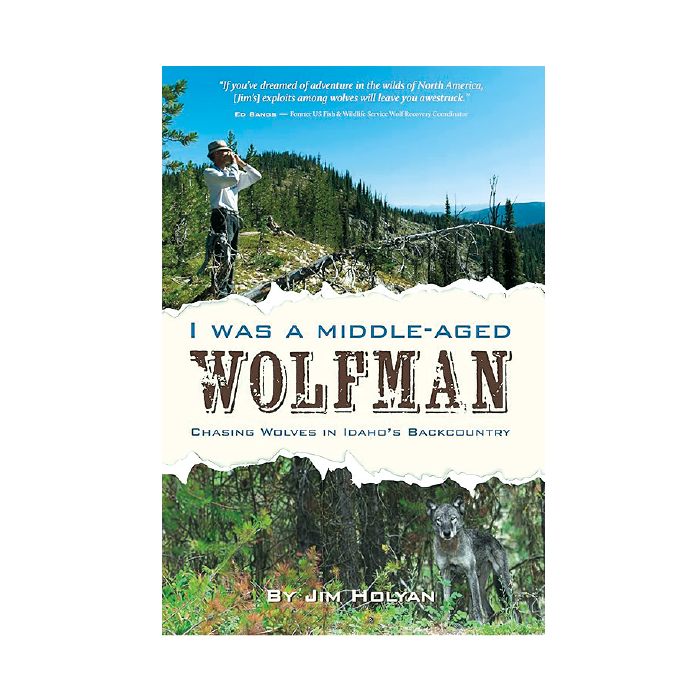
Jim Holyan ’86 Wildlife Biol.
Caxton Press: 2025
The hauntingly beautiful howl of a lone wolf leaves an air of mystery lingering in the nightscape at the start of the prologue of Jim Holyan’s new memoir. He hears the call after about a half hour in his tent and listens as two other animals answer while he drifts off to sleep.
“I find it one of nature’s most enchanting and thrilling sounds, right up there with the call of a loon, the hoot of a spotted owl, or the clicking of the hooves (tendons actually) of thousands of caribou moving over the tundra,” he writes in chapter six, contemplating the cry of the animals he tracks for 18 seasons.
The wildlife biologist details his adventure-filled career of looking for and monitoring lupine packs in central Idaho, the frontlines of the reintroduction of wolves in the West. His collection of stories covers surveying, radio tracking, assisting law enforcement, and providing information, education, and outreach. First-hand accounts include highlights of wolf recovery efforts, like identifying new pups, and lowlights, such as discovering the remains of wolves killed by poachers’ bullets or poison.
Holyan began working with the Nez Perce Tribe’s Wolf Recovery Project in 1997, two years after the Idaho legislature rejected the Wolf Recovery and Management Plan, developed by the Legislative Wolf Oversight Committee, and 70 years after the US government drove the wolf population to near extinction in the Rocky Mountains.
When the state of Idaho stepped back, the tribe stepped in, partnering with the US government to aid in one of its most controversial wildlife programs: capturing wild wolves in Canada to reintroduce them to the Idaho wilderness and Yellowstone National Park.
Management transferred to Idaho in 2006. Within a year, the state planned its first regulated wolf hunt since reintroduction in 1995.
In 2011, wolves in Idaho, Montana, and Wyoming were removed from the Endangered Species list. Today they remain protected in the other contiguous 48 states, listed as threatened in Minnesota and endangered in the others.
Holyan kept tabs on the elusive North American Gray Wolf from 1997 to 2014: how many there were, where they were, and how fast they were reproducing.
The post was “the highlight of my wildlife career,” he writes. “Nothing else came close. It had been a dream to work with wolves…Wolf biologist was the best job I will ever have…I am proud of my part in wolf recovery.”