
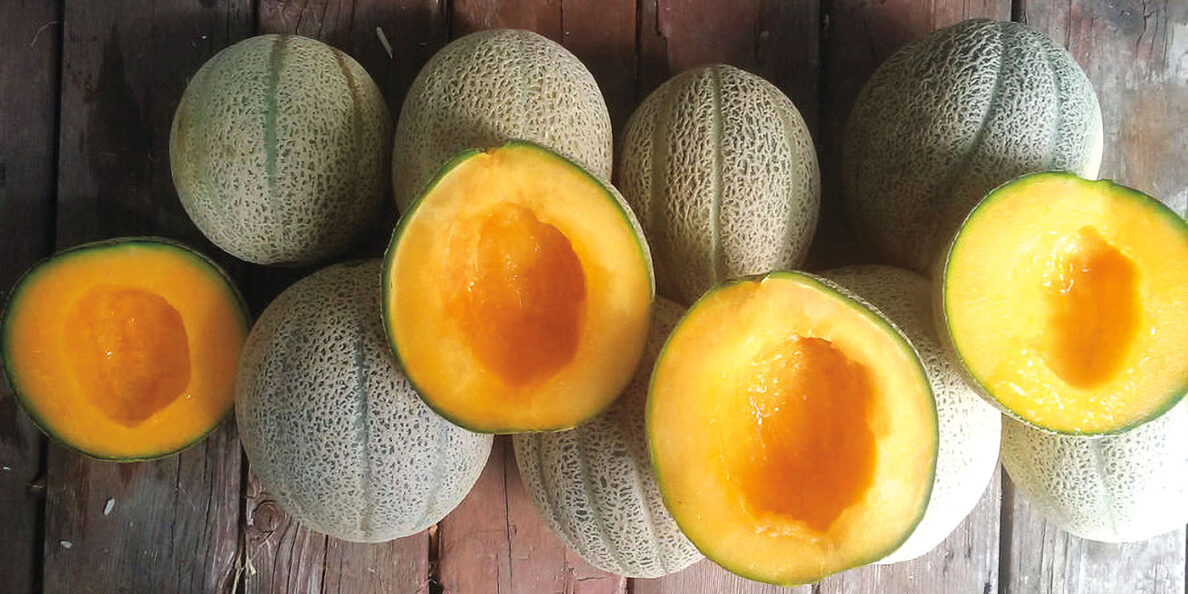
It’s a classic combination, one that evokes that long-dreamed-of Italian vacation and sun-drenched summery days that stretch lazily into early autumn. Ribbons of salty, paper-thin prosciutto wrapped around wedges of honey-sweet cantaloupe make for a simple and elegant starter or light, warm-weather lunch or dinner.
The best part? Savory dry-cured ham coupled with cantaloupe requires no actual cooking. And that’s the best way to enjoy melons, says Carol Miles, Washington State University Extension vegetable specialist at the WSU Mount Vernon Northwestern Washington Research and Extension Center. “They’re meant for fresh eating,” she says.
While prosciutto e melone hails from Italy, cantaloupe (Cucumis melo var. cantalupensis) and all sorts of other melons are easy to grow in Washington. On the west side of the state, opt for early varieties, bred to mature faster and therefore suitable for cooler climates like the Puget Sound region. In eastern Washington, where the climate is warmer and the growing season lasts longer, there are more options. Whether early- or longer-season varieties, Miles says, “melons are a great-tasting crop to grow.”
They’re nature’s dessert, aromatic and sweet, but not cloying, and—unlike other treats—low in calories. A cup of cantaloupe has just 53 calories. The same serving size of honeydew melon (Cucumis melo ssp. melo var. inodorus H. Jacq.) has 60. Watermelon (Citrullus lanatus), just 46. All three are great sources of vitamins A and C.
Until about 20 years ago, there were “basically two kinds of melons on the mainstream American market, besides watermelon: cantaloupe and honeydew,” Miles says. “Now we’re seeing a lot more diversity. The advantage is there are so many more varieties that are early maturing, which means we can grow them in western Washington and throughout the state.”
Cantaloupes and honeydews—warm-season, cold-sensitive crops—account for a third of the total US melon market and “provide great opportunity for Washington,” says Miles, who studies high-value fruit production for local and overseas markets.
“We work with a lot of Asian companies that put a lot of effort into breeding and developing varieties with excellent eating quality,” such as the Japanese white-fleshed, early-maturing Picasso melon with firm flesh and high sugar content. It hit the market in 2022. “It’s the best melon that I have ever grown and that I have ever eaten,” Miles says.
She found that grafting melons, specifically watermelon and cantaloupe, onto heartier squash rootstalks produced not only more but also slightly bigger fruit. That recent study was part of an effort to combat the soil-borne fungal disease verticillium wilt, which affects melons and other crops in the Pacific Northwest and California as well as northern states and temperate zones.
Watermelons are grown commercially in the Columbia Basin, with harvest typically taking place from July through late September. Throughout the country, the fruit has gotten smaller. “If you go back 20 years, you basically only found picnic-sized watermelons in grocery stores,” Miles says. “It was a seasonal crop, and it was this really large fruit. Today, we have icebox-sized watermelon, including basketball size and minis,” available all year.
In 2004, Miles led variety trials for the smaller-sized fruit and saw the market opportunity. Others saw the potential too. Within a couple of years, smaller watermelons were available in grocery stores nationwide. “I have never seen a crop move to market so fast,” says Miles, who tested 115 varieties and found 77 early-maturing that did well in western Washington.
Watermelons date to ancient times. Archeological evidence suggests Egyptians were growing them more than 5,000 years ago. Cultivation is believed to have originated in Africa, spreading to the Near and Middle East.
The Roman cookbook De Re Coquinaria (The Art of Cooking), attributed to Marcus Gavius Apicius in the first century AD, includes a recipe for unspecified melons dressed with pepper, pennyroyal, honey or condensed must, broth, vinegar, and, sometimes, silphium, an unidentified plant used in antiquity.
The first known reference in the English colonies to watermelons, brought to the Americas by Africans and Europeans, dates to 1629 Massachusetts. Thomas Jefferson later grew watermelons, Zatta di Massa cantaloupes, and other varieties.
The 1796 cookbook American Cookery by Amelia Simmons includes a recipe for “American citrons.” It reads: “Take the rine [sic] of a large watermelon not too ripe, cut it into small pieces, take two pound(s) of loaf sugar, one pint of water, put it all into a kettle, let it boil gently for four hours, then put it into pots for use.”
Today, Tonnemaker Hill Farm, run by brothers Kole and Kurt Tonnemaker (’84 Hotel & Rest. Admin.), organically grows about 35 varieties of watermelon, cantaloupe, honeydew, and canary melons near Royal City. The farm was established by their grandparents, WSU Extension agent Orland Tonnemaker (1922 Ag., ’56 Ed.) and his wife, Pearl, in 1962.
Melons grow best when temperatures hit 86 to 95 degrees. For western Washington gardeners, Miles recommends getting a jump on the season by starting seeds indoors four to six weeks before transplanting on or around June 1. “Start them in a nice warm place like your kitchen or a greenhouse, and make sure they get enough light,” she says. “In eastern Washington, you’re going to be able to start maybe a month earlier.”
Before transplanting, be sure to “harden off” vines for three days to a week. “Keep them in pots, and put them outside in a protected space, not exposed to wind,” advises Miles, who also recommends black plastic mulch, or sheeting, to help soil retain moisture and warmth in western Washington. “In eastern Washington, you don’t need it,” she notes.
When it’s time for plants to go into the ground, “make sure they have enough water.” At WSU Mount Vernon, fields are irrigated so vines are transplanted into wet soil.
Planting melons among or near flowers is also a good idea, Miles says. The practice invites pollinators.
Most varieties mature within 70 to 100 days. But, Miles warns, “in western Washington for a crop that takes 80 days, you’re realistically going to add 10 or 20 days. That’s why transplanting is critical; you gain four to six weeks.”
When it’s time to harvest, Miles says, “don’t let them stay on the vine too long. Some melons will do what’s called slipping. They’re going to slip away from the vine and self-detach. You have to do your homework and find out if the varieties you are growing are slipping or non-slipping.
“For watermelon, harvest the fruit when the tendril and leaflet where the fruit are connected to the vine are both brown and dry. If fruit is left on the vine too long, it starts fermenting and doesn’t taste any good.”
Miles recommends trying many kinds—from pinkish red and yellow watermelons to sherbet-orange cantaloupes, green honeydews, and ivory-fleshed snow leopard and canary melons, encased in a cheerful yellow rind.
“That’s why I think melons are exciting,” Miles says. “There are so many really good-tasting melons, and they’re very fun and easy to grow. If I can grow them in Mount Vernon, you can grow them anywhere.”
Web exclusive
Hearts of Gold: A Spokane Valley heirloom melon
Recipes and growing tips
Planting dates for watermelons in Washington state
Growing melons in Central Washington (Yakima Herald-Republic)
Canary melon recipe (Spokesman-Review)
Cantaloupe recipes (Spokesman-Review)
Watermelon carving (Spokesman-Review)