
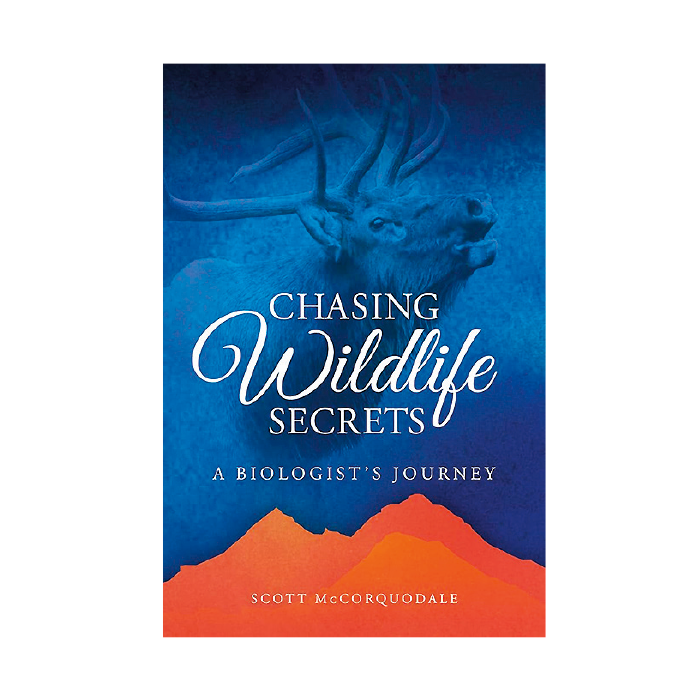
Scott McCorquodale
WSU Press: 2025
Tracking black bears, tagging elk, learning about Columbian black-tailed deer—the life of a wildlife biologist is an adventure.
Scott McCorquodale’s four decades of this pursuit inspired his detailed and fascinating memoir of the natural world and the wildlife that shares it with us.
“What drove me was an innate curiosity about wild animals,” writes McCorquodale. “They captivate me—always have, still do, and probably always will.”
His respect for wild animals and reverence for wild places started as a kid in California reading National Geographic and tracking iguanas in the Mojave Desert. His interest increased when his family moved to Montana. McCorquodale eventually graduated with undergraduate and graduate wildlife biology degrees.
Stories from his ensuing career in Washington state fill the book with colorful and gripping anecdotes of learning how and where bears, elk, moose, deer, and other animals live.
The animals themselves take on major roles in this memoir. Bears like Greasy and Midnight, elk named Granny and Brutus, and many others bring the research of the wildlife biologist to life. McCorquodale even worked diligently to find celebrity elk Buttons, far too habituated to people and unhealthy, a forever home at Seattle’s Woodland Park Zoo.
The research itself also sheds light on the behavior and range of state’s fauna. For example, McCorquodale studied how 27 elk could survive in the arid central Washington landscape around Hanford.
The work is demanding but has relevant and consequential conservation implications, he notes. “Wild animals don’t give up their secrets easily. Discovering the answer to any one question can take years.”
His tools to answer such questions in fieldwork were radio collars, tranquilizer darts, tags, and eventually GPS and DNA analysis.
McCorquodale traveled extensively around the state to learn about the secret lives of animals, by snowshoe, truck, four-wheeler, small plane, helicopter, and any method that worked. There was always an element of danger, particularly with small aircraft. The author shares the tragedy of losing colleagues in such an accident, and its effect on him.
Throughout his career, McCorquodale collaborated with scientists, farmers, Native American tribes, and others on the research and conservation of wild animals. He concludes the book with a call for everyone to take part: “Alliances can be a powerful way to do wildlife science.”