
The best place to experience history is often where it happened.
On a bright sunny morning in early March this year, Assistant Professor of History Ryan Booth (’21 PhD History) and I shuttled a group of history majors out of the classroom to Walla Walla, where they learned about public memory, contested histories, and what can be gained from looking at the past through a different lens.
Our first stop was the Whitman Mission National Historic Site. Known to the Cayuse peoples for thousands of years as Waiilatpu, it is also the place where Marcus and Narcissa Whitman established their Protestant mission in 1836, one of the first in the Pacific Northwest. Nearly 12 years after their arrival, the Whitmans and 11 other White people were killed after increasing White settlement and disease outbreak. The Whitmans’ reluctance to culturally adapt also led to Cayuse frustration.
At the mission site, students learned about interpretation of the events there in the decades that followed the killings, which largely cast the Whitmans as innocent victims of a savage massacre. The pair became martyrs within a heroic and patriotic narrative of westward expansion.
More recently historians have complicated this narrative and placed it within a larger framework of prideful settler colonialism and Indigenous dispossession. The National Park Service has installed new signage at the site inviting visitors to consider what happened there through Indigenous perspectives. For their part, the Cayuse have always understood Waiilatpu as part of the land from which they come, and the killings as an act meant to preserve their community.
Students are asked to analyze primary sources and discuss change over time in classrooms, but it is infinitely more powerful when done in the actual place where the history being examined occurred. Rachael Waagen (’25 Ed., Soc. Stu.) remarked that though she and her peers learn about the historically marginalized and ignored, it was not until visiting the Whitman Mission that she saw “those biased and silencing narratives being changed” in a practical way.
Kyleigh Davis (’25 History) agreed, saying she especially appreciated how public historians can drive those changes when they make bold decisions to reframe old narratives in ways that seek not to alienate but invite folks into unfamiliar and uncomfortable conversations.
Park Ranger Kate Kunkel-Patterson told students she hopes visitors feel connected, heard, and inspired. She believes that place-based experiences can help people form emotional connections to what they are seeing and hearing.
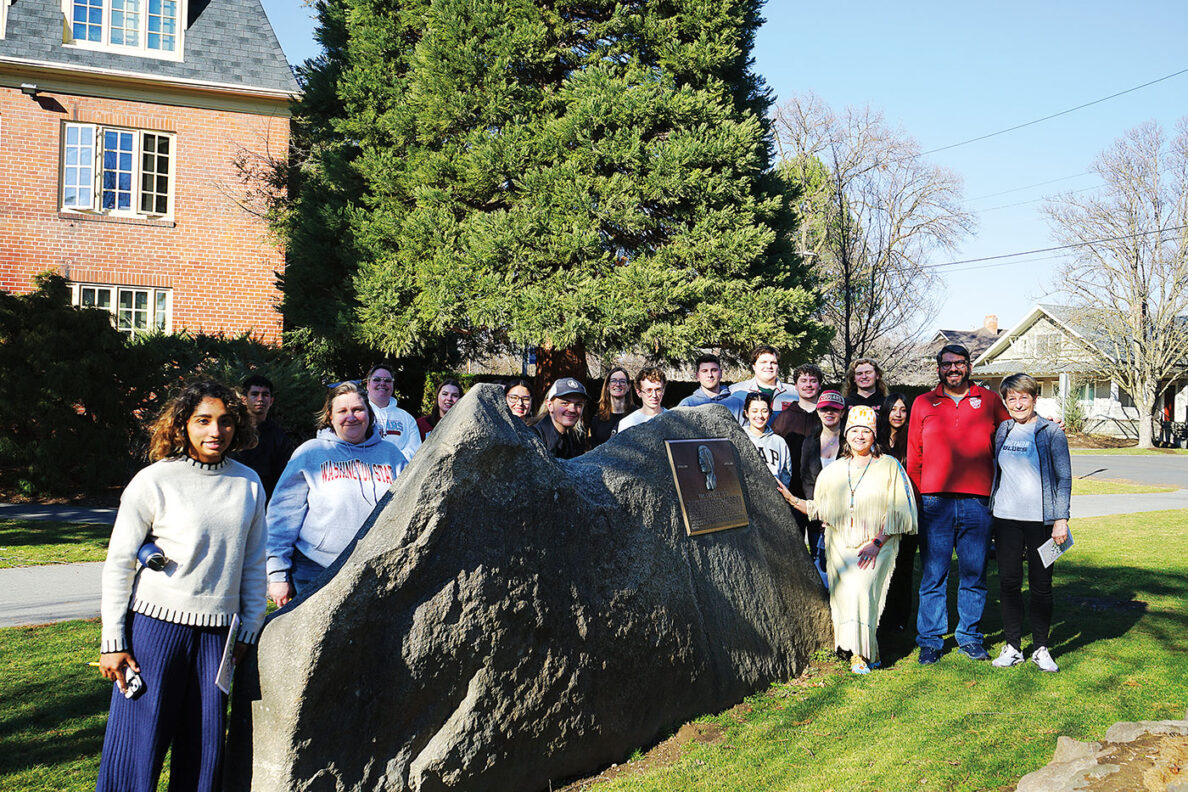
We then traveled to Whitman College where Jeanine Gordon, enrolled member of the Confederated Tribes of the Umatilla Indian Reservation and special assistant to the Whitman College president for Native American outreach, hosted a First Foods luncheon for us. Students learned about the cultural and spiritual significance of the foods we were eating as well as of the traditional deer-hide dress and basket hat Gordon wore.
After feasting on roasted root vegetables, bison meatballs, and frybread with huckleberry jam, Gordon told the history of the Walla Walla Treaty Council of 1855 which drew 5,000 tribal leaders and delegates from across the Columbia Plateau to the current site of Whitman College. Many of Gordon’s ancestors signed the treaty, including her fifth great-grandfather, Chief Peo Peo Mox Mox, heralded leader and head chief of the Walla Walla tribe. In those treaties, Indigenous peoples agreed to cede land to the US government but were promised continued access to their traditional hunting and fishing lands—promises that have not always been kept.
A walk across Whitman’s central lawn led us to Treaty Rock (“Pewaooyit”), a large boulder the Yakima, Nez Perce, Cayuse, Walla Walla, and Umatilla Tribes donated to the college in 1955 to commemorate the approximate place where the treaty was signed.
As we gathered around the memorial, Gordon explained the significance of the treaty for her peoples: “Our treaty that was made in agreement with the United States is part of the supreme law of the land, along with the Constitution and US laws. It has the force of federal law and is a binding agreement between our tribal nation and the nation of the United States. The treaty establishes and reinforces our guaranteed rights and sovereignty as a tribal nation.”
At the end of the trip, Ryan and I led students in a conversation about the different but intersecting histories they had encountered throughout the day, how public memorials help tell those histories, and how the landscape itself can shape our understandings of the past.
Katy Whalen (’11 PhD History) is an associate professor of history and assistant director of the Roots of Contemporary Issues program at WSU.