
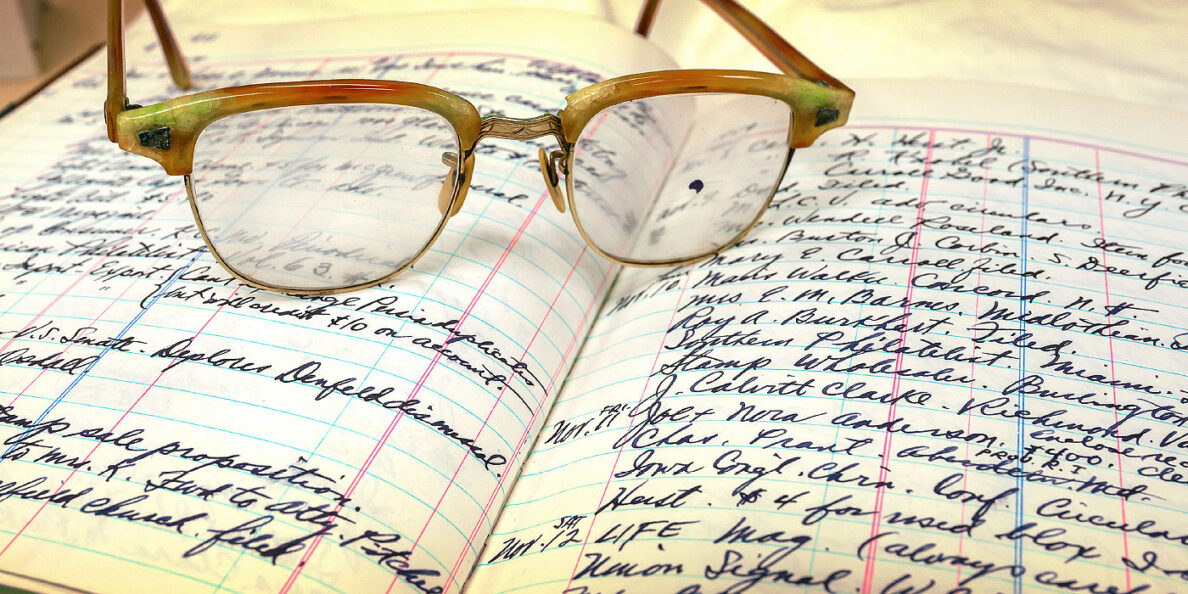
The diarist spared no details.
He documented his dreams and bodily functions, what he ate and when he ate it, when he slept and how well he slept, what he read and what he watched on TV. He discussed the weather and where he went: the post office, the park, the bank, the gas station, Safeway, church, McDonald’s on his fourteenth wedding anniversary.
He described how many students were in each of his classes, how many people were in church on Sunday to hear his sermon, what he wore, what he bought at McQuary’s Grocery store—famous in its day for its pork sausages—and how much he paid. He loved those pork sausages. The T-bone steaks, too.
Robert W. Shields logged his relatively ordinary life in southeast Washington in an extraordinary way, recording the minutia of his days, minute by minute, no matter how mundane. Washing the dishes. Filling the humidifiers. Shaving his face. Receiving foot rubs from his wife.
He even journaled about his journaling.
When he was no longer able to write or type—a debilitating stroke robbed him of his obsession in 1997—he donated his words, approximately 37.5 million of them, preserved in 97 boxes containing at least 112 linear feet, to the Washington State University Libraries’ Manuscripts, Archives, and Special Collections (MASC). There was one condition: The collection was to remain closed until both he and his wife died.
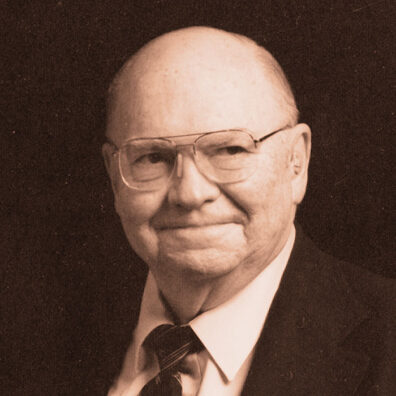
Shields, a high school English teacher, minister, manuscript editor, and author of what’s largely considered the world’s most voluminous diary, died at 89 on October 15, 2007, in Dayton. His wife, Grace, died April 17, 2024, at 97.
Her obituary didn’t mention her husband’s diary, or as he called it, “the daily record” or “GOD,” short for “Genesis of the Day.” But her death triggered the beginning of the unboxing of a lifetime of her husband’s memorabilia, donated to WSU in eight installments from 1999 to 2007.
In 1986, the couple agreed to donate $100,000 to WSU Libraries to arrange, describe, and rehouse the Robert Shields Papers, now packed in eight dozen cardboard boxes on the fourth floor of Holland Library. Their investment is now valued at approximately $240,000.
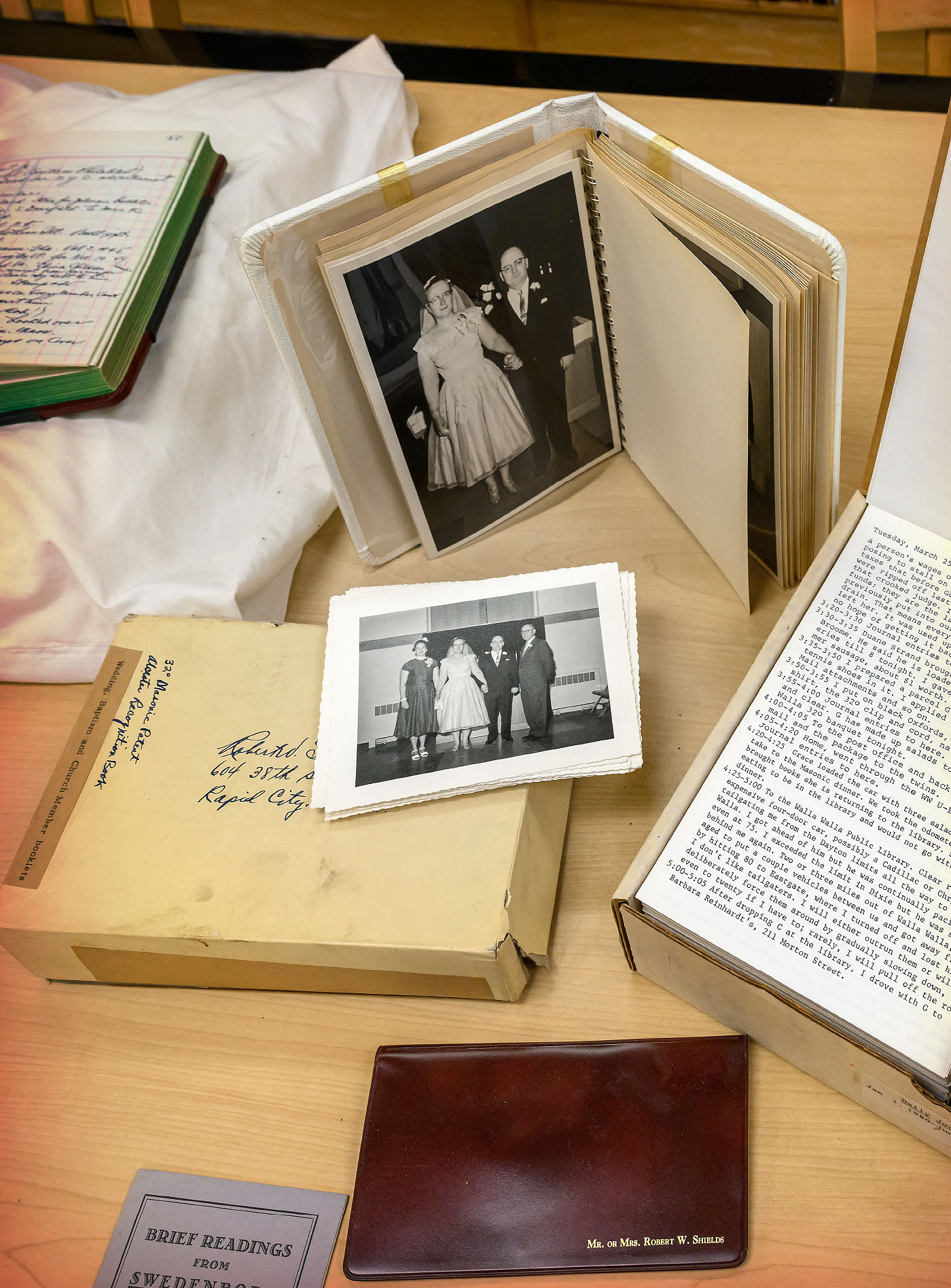
A preliminary inventory of Shields’s single-spaced life was completed in September 2024. “A lot of the boxes haven’t been opened yet,” says WSU manuscripts librarian Will Gregg, slicing through strapping tape with a box cutter a month later. “You’ll be the first person to look at this box.”
Inside, an interesting find: a typewritten letter addressed to a girl Shields loved in high school. “Fifty-six years have passed since we graduated from Shields High School but it seems like yesterday,” it begins.
The dispatch is dated April 7, 1991, two months after Shields suffered a mild stroke “that slowed his output from 90 words a minute to a plodding 15 or so,” according to a 1994 Seattle Times story.
Shields was most prolific in his 50s, 60s, and 70s—from the 1970s through the 1990s—typically sleeping in two- or four-hour sessions in order to record his dreams. The constant diarist often listed his daily doings in five-minute increments, sometimes transforming handwritten notes into typewritten, single-spaced pages using the half-dozen IBM Wheelwriter machines that were always at the ready in his small study. Some days, he wrote an estimated 3,000 to 6,000 words.
“Maybe it helped him process his thoughts,” Gregg muses, noting the Robert Shields Papers isn’t MASC’s biggest collection. “But it’s certainly one of them.”
Shields, Gregg observes, “was very thorough about saying how many words each box contains. I hope for his sake it was an estimate.”
Boxes are labeled with his name, address, phone number, and word count. Box 23: 254,000 words. Box 35: 432,400. Box 65: 385,100 words.
Box 59 is labeled: “Diaries 1935–1940,” with a word count of 245,500. Cutting through the strapping tape feels exciting, even a little taboo, something to be done with reverence not just curiosity. Shredded white packing paper pops through the top of the newly unsealed cardboard box. Underneath lies a 1986 paperback: Seven for Oregon, written by the eldest of his three daughters when she was in her early twenties.
Shields began journaling in his late teens. His first entry dates to spring 1935, the year he graduated from Shields High School in Seymour, Indiana, where he was born on May 17, 1918.
“He first kept a diary at age 17, pouring out his heart about a girl who did not even know he existed and could scarcely have imagined what chain reaction she would touch off,” Kit Boss, Seattle Times reporter turned TV writer and producer, wrote.
Perhaps she’s the one Shields wrote to in 1991?
Beneath his daughter’s book, there’s a brown metal box that appears to be locked—and no key. Maybe the librarian will locate it during the long task that lies ahead.
Processing the entire collection could take as much as six months for a full-time employee, Gregg says.
Shields not only enclosed copies of letters he wrote but letters he received, and sometimes—in the case of the wedding of one of his daughters—simply the envelopes in which the RSVPs arrived. He signed his letters “All the best!” and “Very best!”
He signed the one to the girl from high school, “With all my heart.”
He included photographs, receipts, newspaper articles, his teacher’s plan book for the 1964–1965 academic year, original poems and short stories, price stickers from packages of meat he cooked for dinner, a losing lottery ticket, a checkbook, a book of stamps sans the stamps, dead spiders, toenail clippings, nose hairs.
“For DNA purposes,” he told the Seattle Times.
“There was a pair of eyeglasses. That was a fun find,” Gregg says. “It’s really interesting to go through the things. A lot of these boxes are packed so tightly it’s hard to get the materials back in. Normally when we have this much material about someone, it’s a person who’s historically noteworthy. Shields is kind of just an everyday guy, which is why I think it’s so interesting. You often don’t get this quotidian perspective.”
Shields worried about finances. The price of things figures into much of his writing. So do daily headlines: “Edward VIII abdicates, brother prepares to take throne,” “Mattson kidnapping in Tacoma,” “Flood: Seymour under martial law!”
And so does food. He went to Wendy’s and Kentucky Fried Chicken, came home for lunch, fixed himself bowls of Campbell’s soup, drank milk and orange juice—described down to the ounce—and ate eggs, whole wheat toast, Cream of Wheat, and Cream of Rice for breakfast. He snacked on salted tomatoes and enjoyed hot cups of Carnation cocoa.
He read Newsweek, Reader’s Digest, the Atlantic, the National Enquirer, The Collected Works of Abraham Lincoln, Time magazine, the Tri-City Herald, and the Bible.
Blue was his favorite color.
“We’re just scratching the surface,” Gregg says. “It’ll be a while before we fully understand it. It’s a complete representation of a person’s life.”
Shields taught English in West Virginia, South Dakota, and Washington state, in Kennewick and Dayton. Before that, he worked for an art studio in Chicago as well as a yearbook company and World Book Encyclopedia.
He moved with his family in 1969 to Dayton, where he served as a minister at the First Congregational Church. He married at 42 and, he wrote, “had three beautiful daughters,” all of whom graduated from WSU: Cornelia (’84 English) and identical twins Klara (’85 Psych.) and Heidi (’85 Zool.).
Save for trips to Walla Walla, he stuck close to home. “The diary doesn’t run me; I run the diary,” he told the Seattle Times, also admitting, “If I’m away for three or four days I get so far behind in my diary it’s impossible to catch up. I want to stay close to my work.”
His “work” caught the attention of National Public Radio reporter David Isay, who featured Shields in his 1995 book Holding On: Dreamers, Visionaries, Eccentrics, and Other American Heroes, as well as reporters at the Spokesman-Review, New York Times, Associated Press, and more. Even Oprah was interested.
“I think the interest in this collection will grow over time,” Gregg says. “In the future, if someone is interested in life in a small town in eastern Washington at the end of the twentieth century, this is going to be a complete record of it. It’s fun to think about the anticipated uses.”
Turns out the brown metal box wasn’t, in fact, locked. “Just had a mechanism that wasn’t very intuitive,” Gregg reports.
In it, Shields placed his first diary, a blue, Rexall Store notebook. “Seventeen years old and a High School Senior!” it starts. “High time, I think, for a young man to begin his diary.”
He discusses his unrequited love in the first entry. Indeed, the recipient is the same woman to whom he writes 56 years later. Alas, teenage Shields observes, she “did not seem to care for me.”
Shields had wanted to write his last entry on the day he died, telling the Seattle Times, “It’s gotten to the point that if I don’t write it down, it’s as if it never happened.”
While he didn’t get that particular wish, he will—through his gift to WSU—likely have a different dream come true. Shields also had hoped his diary might, he told the Spokesman-Review in 1995, “be of psychological value, sociological value, historical value” and serve as “a cross-section of a person’s mind and life.”
A 1995 Washington Post story reminded readers of an oft-quoted philosophical axiom of Socrates: “The life which is unexamined is not worth living.” But it also rightly points out that Shields’s diary is less of an examination and more of a list or chronology.
What’s more: Shields never read his own work. He didn’t have time. He was too busy documenting to reflect.
“Nothing is nuanced. Nothing is rationalized,” wrote Marc Fisher, now a senior editor at the Washington Post. “There is no apology, posturing, explanation, defense.”
Fisher called Shields “both scientist and subject” and “neither an idiot nor deranged. He can be thoughtful, even funny. He is well read, alert, and exceedingly polite.”
He was also obsessed.
Shields admitted as much to NPR, plainly stating, “It’s an obsession. That’s all I can say. It’s an obsession.” If he quit, he said, “It would be like … turning off my life.”
The time-stamped entries in the hard copy of his life share some similarities with today’s posts on platforms such as Instagram, notes Chris Barry, a professor in the Department of Psychology at the WSU College of Arts and Sciences who researches psychopathy and social media behavior.
“Hobbies serve a valuable purpose for any of us,” Barry says. “We get into hobbies because we find something enjoyable about them.
“For Shields, something about writing and documenting was enjoyable to him, and it grew from there to the point that leaving something out might have been stressful to him.
“Time spent on a hobby means time not spent on other things. I think Shields’s diary probably served a very healthy purpose at the beginning. But he was losing sleep over it, and it sounds like the fear of not doing it became more important than the joy of doing it. To what degree did it interfere with other things, such as work, sleep, and relationships?”
Shields didn’t seem to understand his own need to build a monster of a paper monument to himself. “I don’t know why I do it,” he told the Seattle Times.
To the Spokesman-Review, he said, “Some people would say ‘Well, he’s a nut.’ Maybe I am.” The story, written by the now-retired Paul Turner, noted Shields preferred to “be called an eccentric.”
John Brownlee, in Wired magazine in 2006, called Shields a “hypergraphiac,” or someone with a behavioral condition characterized by the intense desire to write or draw. Similarly, graphomania, or scribomania, is an obsessive impulse to write.
Atlas Obscura, in 2016, called him “the unacknowledged father of microblogging.”
Then–senior editor Ella Morton wrote, “All the way back in the ’70s, Shields was logging Twitter-style status updates in five-minute increments. Think you’ve hit peak minutiae with your social media contacts? Wait ’til you read this guy’s accounts of opening soup cans and scraping dead skin from the soles of his feet.”
The story of Shields and his detailed diary—by today’s terms—experienced the analog version of going viral in the early to mid 1990s.
“He became ‘The Diary Guy,’” Barry observes. “He became known around the world for his diary. It was part of his persona. But at what point was he doing it just because needing to do it took over?”
Perhaps it stemmed from the very human desire to make a mark, leave a legacy, be remembered, show he once existed in this world.
“If anything is to survive, it will be words,” Shields told the Washington Post.
“Go back to Plato and Aristotle. Their words are all we have. I’d like to think of the diary as Homeric. I suppose self-confession is part of the reason. But to me, the main thing is the recording of history.”
Just a few of the 97 boxes holding the collection…
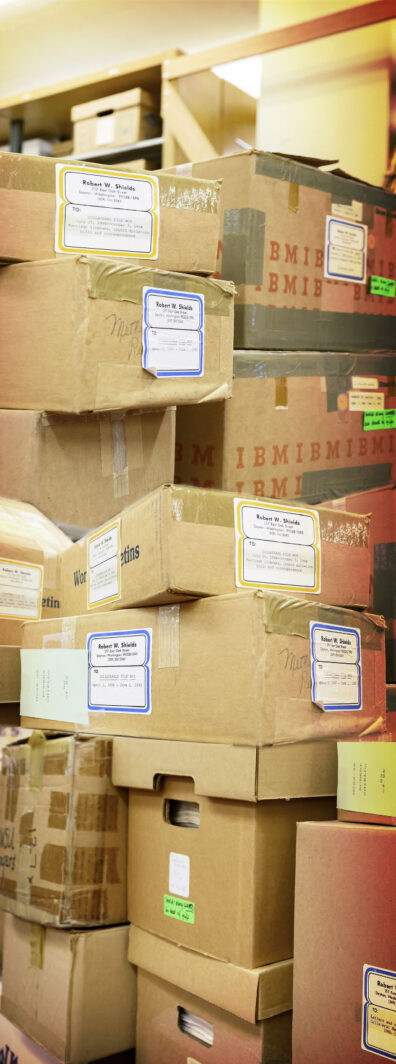 (Photo Robert Hubner)