

Luke Vannice’s Tacoma neighborhood heats up quickly on hot summer days. It lacks the leafy canopy found in many other residential areas.
Tacoma itself is short on trees. With a tree canopy of 20 percent, the city trails Seattle (28 percent) and Bellevue (37 percent), making it the least treed urban area in the Puget Sound region.
The city’s tree deficit is particularly noticeable in the historic Hilltop area, where Vannice lives in a century-old craftsman house. Unshaded pavement holds heat overnight and amplifies it by late afternoon. Across Tacoma, summer highs can vary as much as 14 degrees.
“Urban trees are very much a public health and equity issue,” says Vannice (’14 Land. Arch.), who recently planted three native Garry oaks on his parking strip. “Trees provide lots of ecosystem services, and shade is one of them.”
 Luke Vannice (Courtesy Tacoma Tree Foundation)
A landscape architect who moved to Hilltop in 2020, Vannice volunteers as the Tacoma Tree Foundation’s board president. Each year, the nonprofit works with local residents and community partners to distribute and plant more than 5,000 trees in Tacoma, with a focus on tree-deficient areas.
The foundation has an ally in the Ravenholt Urban Forest Health Lab at Washington State University’s Puyallup Research and Extension Center. The lab works on urban forestry research, education, and service projects to help communities increase their climate resilience.
The benefits of urban trees are well established, says Joey Hulbert, research assistant professor at the Ravenholt lab. They reduce air pollution, filter stormwater, and cool the air by providing shade and releasing water vapor.
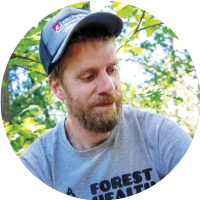 Joey Hulbert (Courtesy Washington Department of Natural Resources)
Hulbert studies issues that affect resilience in urban forests. That includes pests and diseases. Climate change’s impact on western redcedar and other keystone species. Urban heat and tree stress. “If you’re in an urban heat island by the Tacoma Mall, those street trees are feeling the heat as much as you are,” he says.
In his work, Hulbert comes up against a well-documented fact: Urban forests are largely concentrated in affluent, predominantly White areas. And when neighborhoods lack trees, the results can be deadly.
KNKX Public Radio mapped where heat-related deaths occurred during the June 2021 heat dome. Eight Tacoma residents died over a three-day period, primarily in areas with more concrete and fewer trees.
To increase urban tree cover across Washington, the Ravenholt lab is working with four community colleges in Tacoma, Spokane, Des Moines, and Bellingham. The community colleges were selected because they’re near low-income areas with tree deficits.
Besides partnering with the colleges on educational and community tree planting projects, the lab provides urban forestry internships to community college students. The five-year project is supported by a $1.8 million US Forest Service grant.
Neighborhoods that experienced discriminatory housing and lending practices in the past typically have fewer trees. The Hilltop area is a classic example.
“Tacoma is exceptionally diverse for a Northwest city,” Hulbert says. “It has a legacy of historical racism that is still evident in the infrastructure of the city and its neighborhoods, especially the urban forest.”
In 1870, Black businessman George Putnam Reilly purchased 67 acres in Tacoma on behalf of a real estate consortium. The Alliance Addition became part of the Hilltop neighborhood, attracting Black settlers and European immigrants.
During the 1960s, more Black families moved to Hilltop as result of growth at the Joint Base Lewis-McChord military installation near Tacoma. In later decades, Southeast Asian immigrants and Cuban refugees settled there. Hilltop—built on a bluff overlooking downtown and Commencement Bay—remains a multicultural neighborhood today.
Tacoma’s challenges come with opportunities to correct past mistakes, says Lowell Wyse, the Tacoma Tree Foundation’s executive director. Many residents are startled to learn that tree canopy varies from 3 to 64 percent by census tract.
“Tacoma is a city with pride and a strong sense of place,” Wyse says. “We have a lot of beautiful parks and green spaces. People are surprised to find out there aren’t many trees in areas where people are walking, breathing, and living their daily lives.”
Like other Northwest cities, Tacoma is grappling with how to grow its housing stock while retaining livability and mitigating for climate change. The Ravenholt lab is a valuable partner in that work, Wyse says. The lab provides information about planting trees for different microclimates and what species will thrive in hotter, more polluted areas, or in restricted spaces.
“The research has local and statewide impact,” Wyse says. “Without Joey’s group working on the ground, we’d have less information about how to grow urban forests that will support healthy communities across Washington.”
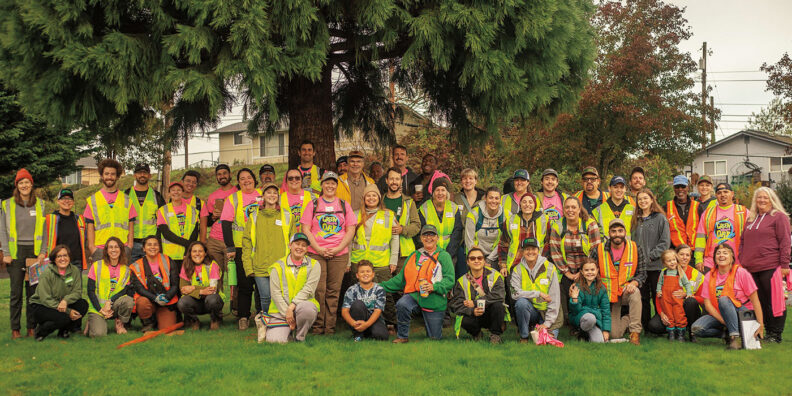 Tree planters in Tacoma (Courtesy Tacoma Tree Foundation)
Web exclusive
Mapping trees at Tacoma schools
Learn more
Ravenholt Urban Forest Health Lab at WSU Puyallup Research Center
Trees At Work (Information on community forestry and urban trees from Arbor Day Foundation, US Forest Service, and partners)