
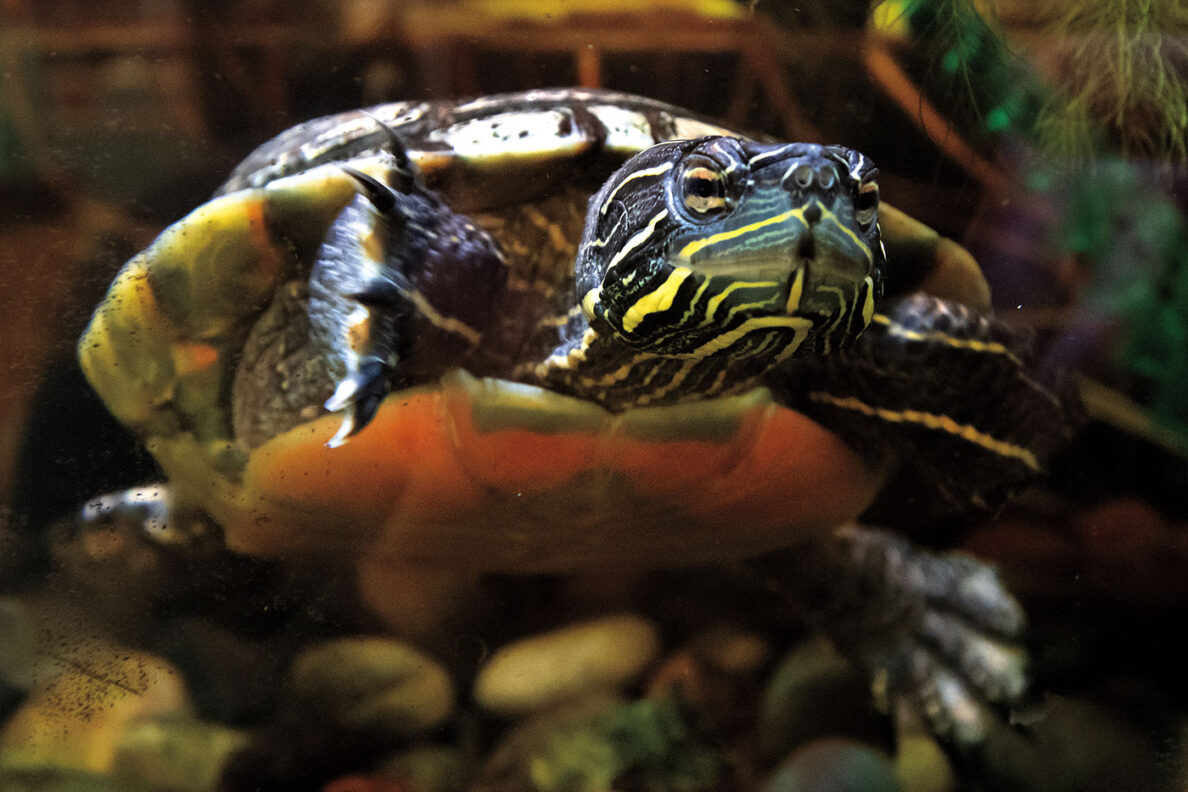
With her wrinkly legs, reptilian gaze, and colorful lower shell, Bruce the turtle is a popular attraction in the lobby of Washington State University’s Veterinary Teaching Hospital.
When visitors approach her tank, Bruce swims over to match them stare for stare. “She likes to see what people are doing and likes to interact. She’s probably hopeful that someone will feed her,” says Marcie Logsdon (’08 Vet. Sci., ’12 DVM), associate professor of exotics and wildlife at the College of Veterinary Medicine.
Bruce, a western painted turtle, is a comforting distraction for anxious pet and livestock owners waiting for their vet appointments. She also delivers an important message about leaving native turtles in the wild.
Shortly after she hatched on the Palouse in 2013, the young turtle was scooped up and kept as a pet by a well-intentioned woman. When she moved to a nursing home, Bruce landed at the Veterinary Teaching Hospital.
Keeping native wildlife as pets is illegal in Washington, but the woman wasn’t aware of that, Logsdon says. She might have thought the little turtle was in trouble. “After baby turtles hatch, not all of them go to the closest body of water. Some of them will wander out looking for a new home.”
Painted turtles are easily identified by the vivid orange-red coloring on their lower shells. They’re usually found near ponds, but can disperse as hatchlings, during breeding season, and while laying eggs. If you see a turtle plodding along on dry ground, it probably knows where it’s headed, Logsdon says.
Because Bruce had been exposed to other animals in captivity, she wasn’t a candidate for release into a natural habitat. State wildlife managers feared she could spread diseases to native turtle populations.
But Bruce did have the makings of a wildlife ambassador. She was comfortable around people and used to living in a tank. Logsdon worked with the Washington Department of Fish and Wildlife to keep Bruce at WSU in an educational role.
Logsdon’s mother—veterinarian Ginny Logsdon (’84 DVM)—raised $5,300 to purchase a 139-gallon tank in 2022 so she could be displayed in the hospital lobby. Offered the chance to rename Bruce, she liked the turtle’s original name so it stuck.
Unlike wild turtles, which hibernate during winter, Bruce is active year-round—basking on her perch under a heated light, paddling around the tank, and eating a diet of turtle pellets, mealworms, and water lettuce. Since she lives indoors, Bruce’s lower shell is a muted peach and olive green instead of the brighter colors that would develop with sunlight exposure.
Despite Bruce’s comfortable tank, “this is still second best,” Logsdon says. “We would rather that wildlife stays in the wild, but we are here when things go awry.”