
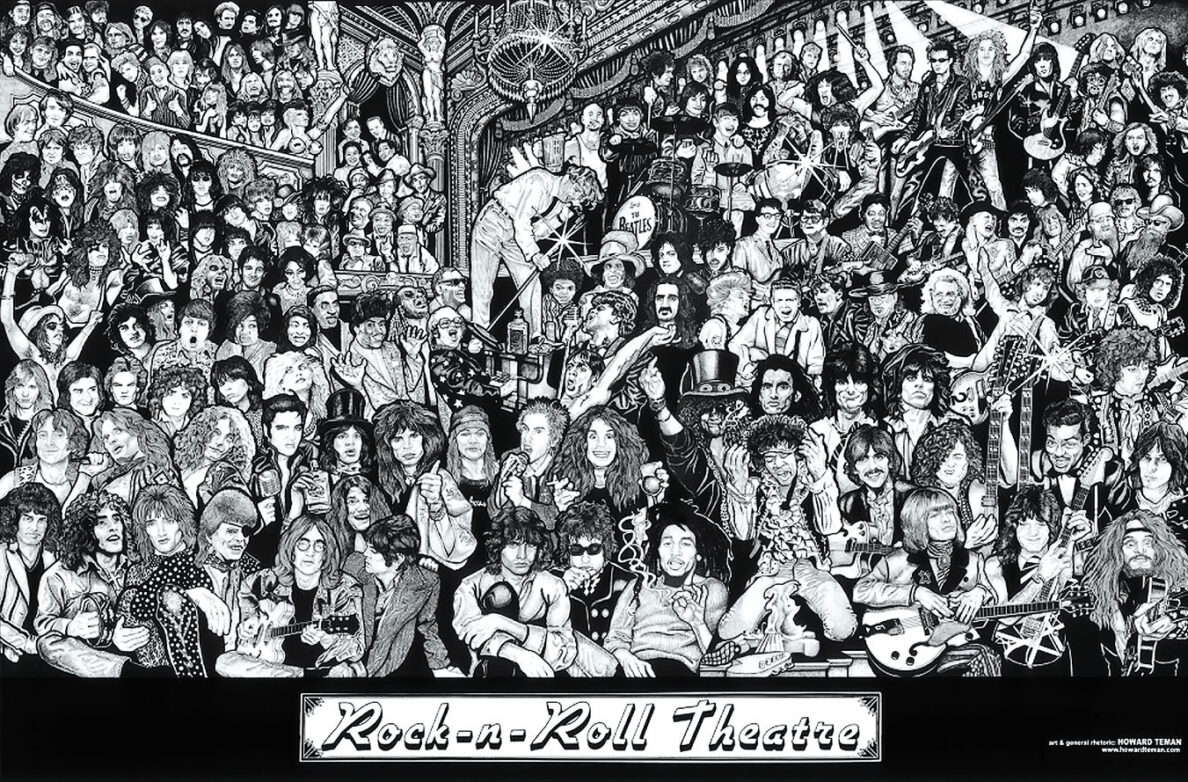
One day, it’s Bob Dylan. Before that, it’s the Beatles. Elvis is there too. And the Beach Boys and the beginnings of MTV.
In this class, one of the most popular at the School of Music at Washington State University, students watch music videos. They listen to carefully curated playlists. They analyze lyrics, discuss performances, and research the societal and cultural factors that led to the creation of rock ’n’ roll.
“It’s really common for someone to say, ‘Hey, check out this song. I really like it,’” says A. J. Miller, assistant director of Cougar Marching Band. He wears sneakers and band T-shirts to class in the Kimbrough Concert Hall, giving off a vibe that’s laid-back yet engaging, quirky, and cool. Think Jack Black’s character in 2003’s School of Rock. “You respond, ‘Cool. That’s great. Why do you like it?’ And that is where the conversation stops. So many people just say, ‘I don’t know. I just like it. It makes me feel good.’ But there’s a reason that it makes you feel that way.”
WSU’s history of rock ’n’ roll class helps students understand and explain why—as it has for more than 20 years.
“I spent my sabbatical creating the whole thing,” says David Jarvis (’81 MA Music). He taught at WSU from 1987 to 2020, coordinated percussion studies at WSU for more than 30 years, and is now an emeritus professor.
“I don’t remember when I first did it, maybe around 2000 or 2001. It was an elective, and it had about 17 students or something. Then it leapt up to like 110. Finally, I had to cap it at 250. Now, it’s a core class, and there are two face-to-face sections and two online sections—and like 750 students per semester involved.”
During Jarvis’s tenure, Peter Rivera, former lead singer of 1970s band Rare Earth, spoke to the class about Motown and growing up in Detroit. Steve Smith, former drummer for Journey, also talked to the class. “I loved teaching that rock history class,” Jarvis says.
Miller does too. “Now,” he says, “it’s my baby.”
Formally known as “Rock Music: History and Social Analysis,” or Music 262, the class is typically offered fall, spring, and summer. Its official course description reads: “History and analysis of rock music related to its African American origins, its societal role, and its diverse development and impact.”
It’s Miller’s primary teaching responsibility, and he generally has two sections of the three-credit class per semester—with around 225 students each. “That’s around 450 people,” says Miller, who updated the course when he took it over. Not only does the course enjoy a large enrollment, but most of the students who take the class are not music majors.
Rock ’n’ roll, his syllabus says, “is a natural extension of America’s purest musical art form, jazz.” The course explores the early roots of the genre right up through contemporary musicians and bands. Discussed are: Chuck Berry, Little Richard, Led Zeppelin, Pink Floyd, the Eagles, the Police, the Talking Heads, Michael Jackson, Tech N9ne, Lauryn Hill, OutKast, the Roots, Nirvana, Foo Fighters, Weezer, and much more. “We talk about sub-genres,” Miller says. “We look at emo. We look at punk. We look at New Wave and country.”
Students learn how rock ’n’ roll is a catalyst for social and political change, how power and privilege influence the music, and how the music affects cultural values and beliefs.
“In the broadest sense, my goal for them is to be able to listen to music and articulate what they do or don’t like about that music,” says Miller, who began teaching the class online in fall 2019 and in person in fall 2021.
“I know that’s really simplistic, but there’s a lot that goes into that. We look at how tunes are constructed. We spend a lot of time learning to analyze lyrics from kind of a literary perspective,” he says. “And through it all, there’s a broader cultural lens. Why did Bob Dylan write the way that he wrote? Why did Kendrick Lamar say the things that he said? We learn to contextualize things in order to hopefully give students a better understanding of the music and also a greater appreciation for it.”
The course features several pop quizzes, two exams, a song analysis, and a two-page essay in which students compare and contrast two songs about a topic of their choosing.
“The example I give them is by Toby Keith, “Courtesy of the Red, White and Blue,” and then “An Open Letter to NYC” by the Beastie Boys. Both of these songs are direct references to the September 11, 2001, terrorist attacks. But how they approach writing those songs, or writing about that event, is really different,” Miller says. “My goal for them is to look at how artists interpret events and how they experience the world around them. And how does that experience influence the songs that they create? Hopefully, by doing that, and actually being able to write about it and say something in a coherent way, they can actually have a conversation that is more meaningful other than ‘I like it’ or ‘I don’t like it.’”
Miller teaches students a six-step process for analyzing song lyrics, using Bob Dylan’s “Subterranean Homesick Blues” as an example. “And we do that because Bob Dylan is the GOAT”—Greatest Of All Time—“for lyrical analysis,” says Miller, who aims to be approachable and authentic in his teaching. “I want students to come to class and recognize that we are learning about something fun. In terms of creating an environment, I try to be welcoming and open with all of them. And I never shy away from giving my own opinion.”
He wants students to learn “that these artists have made a huge impact on how we view and how we approach the world” and that “music is a reflection of modern culture.”
Miller says, “I didn’t think it was going to be as profound for me personally as it has become. Whenever we listen to something that I’m confident they’ve never heard before and see some of them tilt their head and be like, ‘That’s really cool,’ that’s really enjoyable. That’s just a cool teacher moment.”