
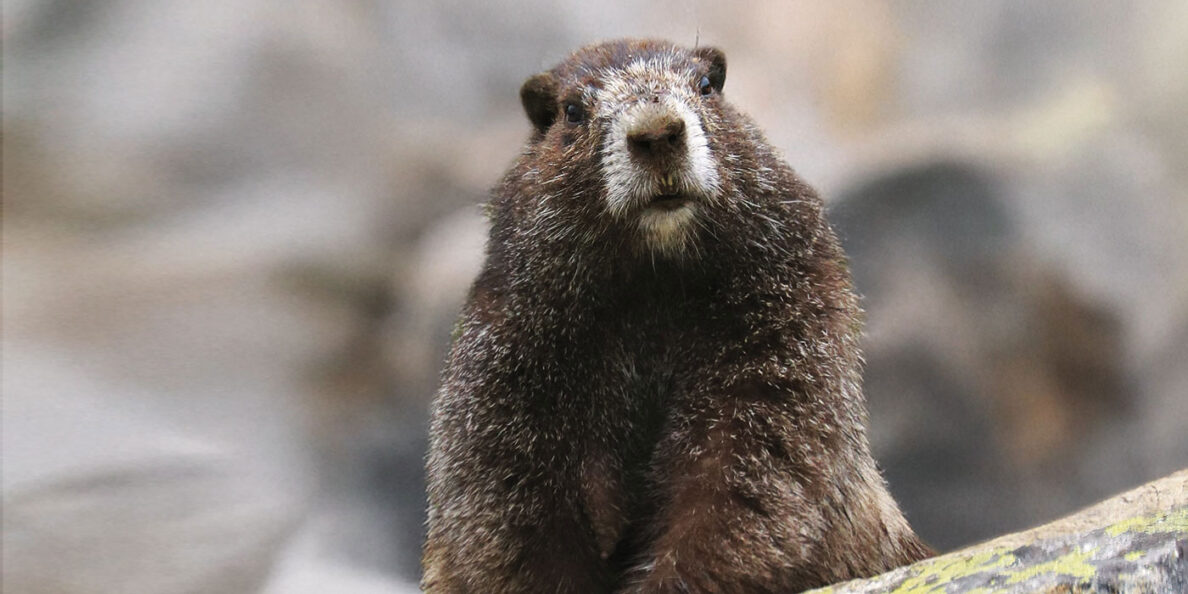
Logan Whiles spent two summers watching hoary marmots in the subalpine meadows of Washington’s North Cascades range.
As the endearing rodents sunbathed on rocks, foraged for vegetation, and groomed their pups, Whiles (’21 MS Nat. Res.) tracked their activity through binoculars, recording the time they devoted to different behaviors, including watching for predators. When danger approached, the marmots’ piercing cries alerted others in their colonies.
Marmot populations in the North Cascades National Park Service Complex are plummeting, and Whiles’s graduate research at Washington State University sought to understand why. Between 2007 and 2016, hoary marmot numbers dropped by about 74 percent, according to the National Park Service.
The declines were previously linked to weather, but shrinking snowpacks could also be allowing coyotes to expand into the marmots’ territory, according to recent research authored by Whiles, Professor Lisa Shipley, and Associate Professor Daniel Thornton in the WSU School of the Environment, in collaboration with the National Park Service, Cascades Carnivore Project, and Oregon State University.
“Despite the fact that coyotes are not really common visitors to the park’s subalpine meadows, we found a high proportion of marmot predation events from coyotes,” Whiles says. “I think we noticed something early in the process. As the park’s snowpack diminishes, little by little, year after year, the landscape will become more accessible to coyotes.”
Hoary marmots live at elevations above 4,000 feet, where deep snowpacks have historically insulated their dens and limited predator access to their habitat in late spring when they emerge from hibernation.
Since the 1930s, however, spring snowpack in the Cascades has declined by about 2 percent each decade. Mountain meadows are snow-free sooner, and coyotes are hunting in that terrain. Besides field surveillance, researchers placed remote cameras near marmot colonies and analyzed scat from potential predator species. Coyotes had the highest percentage of marmot DNA in their scat, which was present in 22 percent of the coyote samples.
Although marmots spend about half their time scanning the surroundings for predators, coyotes appear well suited to hunting them, Whiles says. Unlike bobcats and cougars, which are nocturnal or active near dusk and dawn, coyotes evolved to hunt in open areas during daylight. In addition, marmots are similar in size to other coyote prey.
Marmot DNA was also detected at lower percentages in the scat of Pacific martens, a member of the weasel family. Pacific martens are smaller than marmots, but they’re fierce and ambitious hunters, Whiles says.
The two summers of fieldwork gave Whiles a new appreciation for the North Cascades’ hoary marmots. In four months, they have to double their weight to survive eight months of hibernation. But they’re still playful, social animals.
“Marmots sit on boulders with their family members. The juveniles wrestle, and the mom and the pups spend lots of time grooming each other,” he says. “On hot days, they’ll stretch out spread-eagle on patches of snow to cool off. It’s fun to watch their behaviors.”
Did you know?
Washington is home to three marmot species: the yellow-bellied marmot, the hoary marmot, and the Olympic marmot. In 2009, the Olympic marmot was named the state’s endemic mammal. The species is found only in Washington’s Olympic Mountains.